Tag Archives: sex

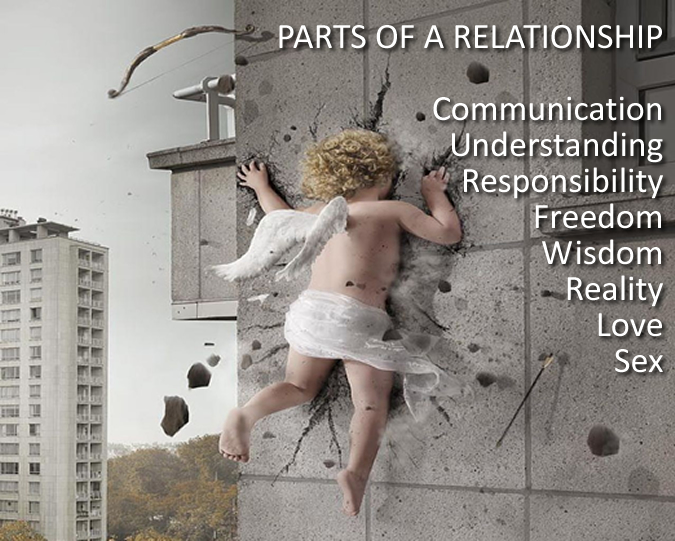
PARTS OF A RELATIONSHIP

Republished by Blog Post Promoter

PARTS OF A RELATIONSHIP

Recently, I’ve thought a lot about the subject of “relationships”, in an attempt to live my own life on Earth.  One of the most joyful and agonizing experiences in existence is the successful creation and maintenance of a “relationship”.   It is easy enough to withdraw from relationships and simply give up on them because they can be painful, confusing, frustrating and a lot of hard work!   In human society it is very commonly the source of turmoil, destruction and unhappiness.  If anyone has any more ideas about how to have a successful relationship, I’d like to know….

Here are a few definitions that I think are the most important parts of a “relationship”, in relative order of importance:

RELATIONSHIP

noun:   a state of connectedness between people (especially an emotional connection)

COMMUNICATION

  • noun:   a connection allowing access between persons or places

UNDERSTANDING

  • noun:   an inclination to support or be loyal to or to agree with an opinion

  • noun:   the statement (oral or written) of an exchange of promise

  • adjective:   characterized by understanding based on comprehension and discernment and empathy

RESPONSIBILITY

  • noun:   a form of trustworthiness; the trait of being answerable to someone for something or being responsible for one’s conduct

  • noun:   the social force that binds you to your obligations and the courses of action demanded by that force

FREEDOM

  • noun:   the condition of being free; the power to act or speak or think without externally imposed restraints

  • noun:   immunity from an obligation or duty

WISDOM

  • noun:   accumulated knowledge or erudition or enlightenment

REALITY

  • noun:   the state of the world as it really is rather than as you might want it to be

LOVE

  • noun:   any object of warm affection or devotion

SEX

  • noun:   all of the feelings resulting from the urge to gratify sexual impulses

REPRODUCTIVE TRIGGER

Republished by Blog Post Promoter

“Every trap in the universe, including those used to capture IS-BEs who remain free, is “baited” with an aesthetic electronic wave.  The sensations caused by the aesthetic wavelength are more attractive to an IS-BE than any other sensation.  When the electronic waves of pain and beauty are combined together, this causes the IS-BE to get “stuck” in the body.

The “reproductive trigger” used for lesser life forms, such as cattle and other mammals, is triggered by chemicals emitted from the scent glands, combined with reproductive chemical-electrical impulses stimulated by testosterone, or estrogen.

These are also interactive with nutrition levels which cause the life form to reproduce more when deprived of food sources.  Starvation promotes reproductive activity as a means of perpetuating survival through future regenerations, when the current organism fails to survive.  These fundamental principles have been applied throughout all species of life.

The debilitating impact and addiction to the “sexual aesthetic-pain” electronic wave is the reason that the ruling class of The Domain do not inhabit flesh bodies.   This is also why officers of The Domain Forces only use doll bodies.  This wave has proven to be the most effective trapping device ever created in the history of the universe, as far as I know.”

— Excerpted from the top secret transcripts published in the book, Alien Interview

SEXUAL ATTRACTION

Republished by Blog Post Promoter

SEXUAL ATTRACTION

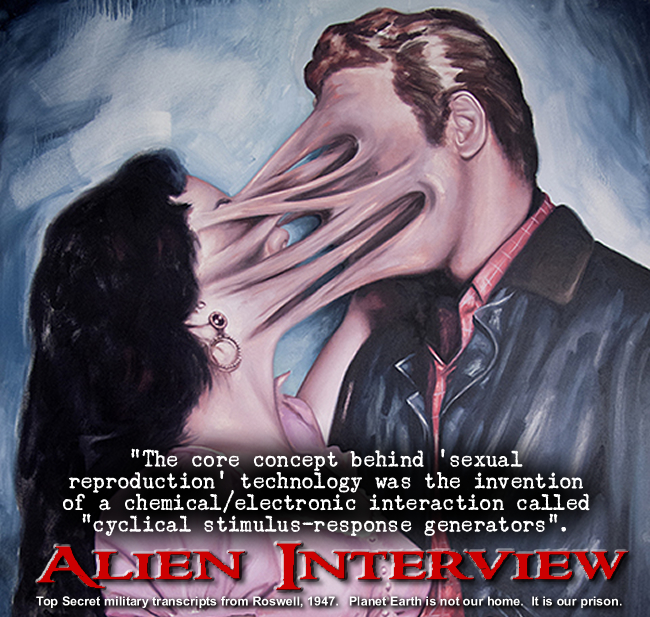
“The core concept behind ‘sexual reproduction’ technology was the invention of a chemical/electronic interaction called “cyclical stimulus-response generators”. [i] (Footnote)  This is an programmed genetic mechanism which causes a seemingly spontaneous, recurring impulse to reproduce. The same technique was later adapted and applied to biological flesh bodies, including Homo Sapiens.

Another important mechanism used in the reproductive process, especially with Homo Sapiens type bodies, is the implantation of a “chemical-electrical trigger” mechanism [ii] (Footnote) in the body.  The “trigger” which attracts IS-BEs to inhabit a human body, or any kind of “flesh body”, is the use of an artificially imprinted electronic wave which uses “aesthetic pain” to attract the IS-BE.

Every trap in the universe, including those used to capture IS-BEs who remain free, is “baited” with an aesthetic electronic wave.  The sensations caused by the aesthetic wavelength are more attractive to an IS-BE than any other sensation.  When the electronic waves of pain and beauty are combined together, this causes the IS-BE to get “stuck” in the body.  The “reproductive trigger” used for lesser life forms, such as cattle and other

mammals, is triggered by chemicals emitted from the scent glands, combined with reproductive chemical-electrical impulses stimulated by testosterone, or 

These are also interactive with nutrition levels which cause the life form to reproduce more when deprived of food sources.  Starvation promotes reproductive activity as a means of perpetuating survival through future regenerations, when the current organism fails to survive.  These fundamental principles have been applied throughout all species of life.”estrogen. [iii] (Footnote)

— Excerpt from the Top Secret transcripts published in the book ALIEN INTERVIEW


[i]  “…”cyclical stimulus-response generators”.  

Fixed Action Pattern (FAP) is an instinctive behavioral sequence that is indivisible and runs to completion. Fixed action patterns are invariant and are produced by a neural network known as the innate releasing mechanism in response to an external sensory stimulus known as a sign stimulus or releaser.

ALIEN INTERVIEWA mating dance may be used as an example. Many species of birds engage in a specific series of elaborate movements, usually by a brightly colored male. How well they perform the “dance” is then used by females of the species to judge their  fitness as a potential mate. The key stimulus is typically the presence of the female.

Although fixed action patterns are most common in animals with simpler cognitive capabilities, humans also demonstrate fixed action patterns. For example, infants grasp strongly with their hands as a response to tactile stimulus.”

Reference:  Wikipedia.org
Support independent publishing: Buy this book on Lulu.

[ii]   “…chemical-electrical trigger” mechanism…”

“A taxis (plural taxes) is an innate behavioural response by an organism to a stimulus. A taxis differs from a tropism (turning response, often growth towards or away from a stimulus) in that the organism has motility and demonstrates guided movement towards or away from the stimulus. It also differs from a kinesis, a non-directional change in activity in response to a stimulus that results in the illusion of directed motion due to different rates of activity depending on stimulus intensity.

For example, flagellate protozoans of the genus Euglena move towards a light source. Here the directional stimulus is light, and the orientation movement is towards the light. This reaction or behaviour is a positive one to light and specifically
termed “positive phototaxis”, since phototaxis is a response to a light stimulus, and the organism is moving towards the stimulus. If the organism moves away from the stimulus, then the taxis is negative. Many types of taxis have been identified and named using prefices to specify the stimulus that elicits the response. These include anemotaxis (stimulation by wind), barotaxis (pressure), chemotaxis (chemicals), galvanotaxis (electrical current), geotaxis (gravity), hydrotaxis (moisture), phototaxis (light), rheotaxis (fluid flow), thermotaxis (temperature changes) and thigmotaxis (physical contact).

Chemotaxis is a migratory response elicited by chemicals. Unicellular (e.g. protozoa) or multicellular (e.g. worms) organisms are targets of the substances. A concentration gradient of chemicals developed in a fluid phase guides the vectorial movement of responder cells or organisms.

Electrotaxis is directional movement of motile cells in response to a electric field. It has been suggested that by detecting and orientating themselves toward the electric fields.  This notion is based on 1) the existence of measurable electric fields that naturally occur during wound healing, development and regeneration; and 2) cells in cultures respond to applied electric fields by directional cell.”

— Reference:  Wikipedia.org

[iii] “… reproductive chemical-electrical impulses stimulated by testosterone or estrogen.”

“Testosterone is a steroid hormone from the androgen group. In mammals, testosterone is primarily secreted in the testes of males and the ovaries of females, although small amounts are also secreted by the adrenal glands. It is the principal male sex hormone and an anabolic steroid.

The period of the early 1930’s to the 1950’s has been called “The Golden Age of Steroid Chemistry”, and work during this period progressed quickly. Research in this golden age proved that this newly synthesized compound — testosterone — or rather family of compounds (for many derivatives were developed in the 1940’s, 50’s and 60’s), was a potent multiplier of muscle, strength, and wellbeing

In both men and women, testosterone plays a key role in health and well-being as well as in sexual functioning.

The human hormone testosterone is produced in greater amounts by males, and less by females. The human hormone estrogen is produced in greater amounts by females, and less by males.  On average, an adult human male body produces about forty to sixty times more testosterone than an adult female body.

Testosterone causes the appearance of masculine traits (i.e deepening voice, pubic and facial hairs, muscular build, etc.) Like men, women rely on testosterone to maintain libido, bone density and muscle mass throughout their lives.”

— Reference:  Wikipedia.org

_______________________________________

VISIT THE WEBSITE and BLOG for the book at www.alieninterview.org and www.alieninterview.org/blog

WITHHOLD A PIECE FOR PEACE, LADIES

Republished by Blog Post Promoter

A synopsis of the play “LYSISTRATA” by the Greek poet and play writer, Aristophanes ( 411 B.C.E.)

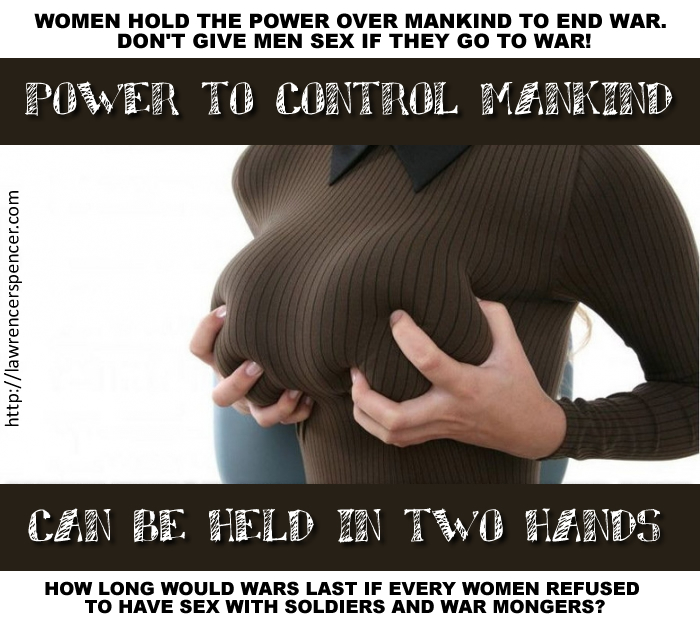
The Peloponnesian War has been dragging on for eighteen long years, and the beautiful Lysistrata, in common with the other wives of Athens, is heartily tired of the intermittent absence of their warrior husbands. She decides that it is time to bring an end to this situation. The only solution, she concludes, is a boycott to deprive the husbands of their wives’ love.

Lysistrata sets out to enlist the other women in the plan, but finds them somewhat reluctant. One thinks that to so punish their husbands would be punishing themselves; others offer similar excuses. Lysistrata tells them that they are cowards and that the poets’ jibes about women’s frailty are well deserved.

But she perseveres in her determination, and convinces the women at last that peace surely will come if they all dress, powder and perfume themselves irresistibly, then withhold their favors from their men unless they promise to take steps to end the war forthwith. The wives agree to try the scheme, and, for a start, seize the public funds. The old men of Athens try to burn them out of the treasury, but the embattled women retaliate with pitchers of water upon their heads. The President of the Senate arrives at this juncture, ordering the arrest of “that traitress,” Lysistrata.

The women win the scuffle that follows, the President admitting defeat; but he asks an explanation for the feminine onslaught upon the treasury. Lysistrata blandly explains their purpose: to save the public money so that the men won’t fight any wars over it. The President protests the absurdity of their fancy that the war is being fought over mere money. Lysistrata assures him that of course it is; that every war is for the sake of money–else why are politicians always manufacturing wars? Merely as an occasion to steal, she says.

Then Lysistrata announces that, from now on, things are going to be different: the men won’t be able to get any money for fighting because the women are going to take over the treasury. And why not? They manage the household finances. But household finances, the President tolerantly explains, are quite different; the public money is necessary for the fighting. To this Lysistrata readily agrees, but adds that the fighting itself is hardly necessary.

The listening women, weary of the argument by this time, seize the President, unclothe him and dress him as a woman. They tell him that they are going to take the state into their own hands, rescue it from the muddling of men, unravel the knots of war just as they straighten out a skein of wool, and unite all nations into a single thread of peace and good will.

But the President persists: war, after all, is the business of men, he says. Nothing of the kind, Lysistrata replies, it is the business of women–for who suffers most in the loss on the battlefields of sons and husbands? To end the debate, the women again seize the official and garb him as a corpse. He retreats in terror.

After a time, the wives of the enemy city of Sparta join in the boycott. The plan is a success: the husbands of both cities surrender to their wives, and, to recapture their love, agree to end the war. Here a male chorus observes that it was a wise philosopher who called women the paradoxical sex: you cannot live with them and you cannot live without them. A female chorus replies that, say what you will and do what you will, the women always have the last word, for theirs is the unanswerable argument. Together the choruses agree that there has been enough of idle quarrels: they urge that the discord cease.

Lysistrata is chosen as intermediary between the Athenian and Spartan envoys for formal termination of the conflict, and she lectures them soundly at the start of their conference. She is a woman, she says, but hopes that she is not without some sense; she reminds them that they are all of the same blood, the same gods and the same language. Why, then, do they kill each other? Why should they not come to terms? She agrees that it may be necessary for animals to fight, but certainly not for men–particularly for Greek men–to fight among themselves while barbarians are looking on.

A Spartan delegate announces that his side is ready to make peace if it gets what it wants, and an Athenian observes that what both the Spartans and Athenians want is to get their wives back again. Lysistrata sees some feasibility in this, but orders that first the former enemies must go off to a feast to repair their friendship. After that, she says, each warrior may take his woman home.

The warriors try Lysistrata’s program, and at length return as bosom friends. This accomplished, she bids them each take his woman, and all join in a dance of peace as the chorus pleads:A Spartan seconds this idea, proposing further, that they all get drunk–a suggestion not unpleasant to one Athenian who notes that people are surliest when most sober. If there were more drinking bouts among diplomats, he thinks, there would be no war; they would drown their quarrels in wine, have some singing together, and decide that, after all, an enemy could still be a good fellow.

“O let us prayTo the gods today
While in peace we eatOur bread and our meat.
That every fieldMay its harvest yield,
O Venus, arrayed in love, restore
The hopes and joys we have lost in the war…
Let the sword be forgotten for evermore.”