Tag Archives: government

I BELIEVE

Republished by Blog Post Promoter
BELIEVE

I BELIEVE IN THE “ONLY” GOD

I BELIEVE “IT CAN’T HAPPEN HERE”

I BELIEVE THAT TV “NEWS” IS REAL

I BELIEVE THAT MY VOTE “COUNTS”

I BELIEVE THAT “MY” GOVERNMENT IS GOOD

I BELIEVE THAT I MUST “BELIEVE” IN “HOPE” AND “LOVE”

I BELIEVE THAT FEDERAL RESERVE NOTES ARE “REAL” MONEY

I BELIEVE THAT “GOOD” ALWAYS CONQUERS THE “FORCES OF EVIL”

I BELIEVE THAT WHEN I DIE I WILL GO THE HEAVEN IF I AM “GOOD”

I BELIEVE THAT “GOD” WILL DECIDE I AM “GOOD” BECAUSE I BELIEVE IN LIES

HOODWINKED MINDS

Republished by Blog Post Promoter

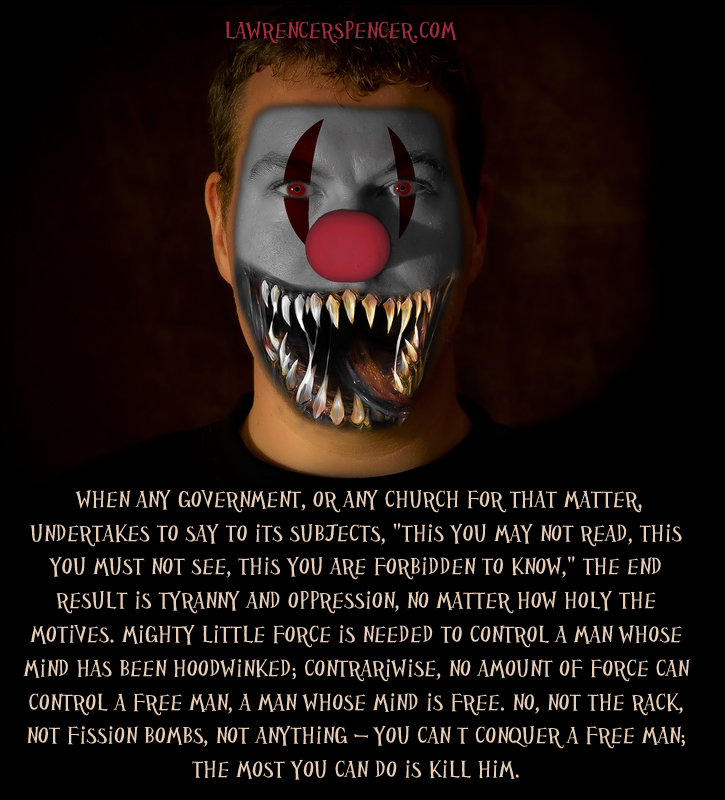
“When any government, or any church for that matter, undertakes to say to its subjects, “This you may not read, this you must not see, this you are forbidden to know,” the end result is tyranny and oppression, no matter how holy the motives. Mighty little force is needed to control a man whose mind has been hoodwinked; contrariwise, no amount of force can control a free man, a man whose mind is free. No, not the rack, not fission bombs, not anything — you can’t conquer a free man; the most you can do is kill him.”

If This Goes On (1940) by Robert Anson Heinlein (7 July 1907 – 8 May 1988) was one of the most popular, influential, and controversial authors of science fiction of the 20th Century.

DOUBT EVERTHING

Republished by Blog Post Promoter

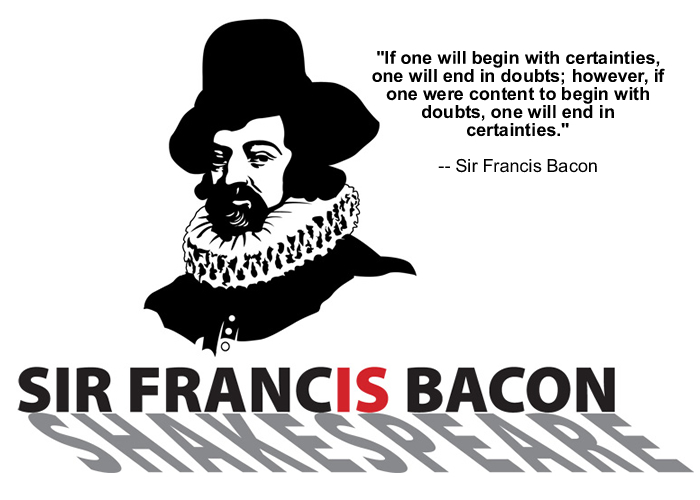
BACONSPEAREOn planet Earth, it’s really not a good idea to “believe” or to accept ANYTHING on the surface.  As safe bet is to DOUBT EVERYTHING.

This is especially true when it to do with “royalty” or “leaders” of governments.  I very excellent example of this illustrated by the discovery that Sir Francis Bacon was the “bastard” son of Queen Elizabeth I of England. (7 September 1533 – 24 March 1603)  This is compounded by the discovery that Sir Francis Bacon actually wrote the plays attributed to Bill Shakespeare!

Sir Francis Bacon was a scientist, philosopher, courtier, diplomat, essayist, historian and successful politician, who served as Solicitor General (1607), Attorney General (1613) and Lord Chancellor (1618). Those who subscribe to the theory that Sir Francis Bacon wrote the Shakespeare work generally refer to themselves as “Baconians”, while dubbing those who maintain the orthodox view that William Shakespeare of Stratford wrote them “Stratfordians”.

The idea was first proposed by Delia Bacon in lectures and conversations with intellectuals in America and Britain. William Henry Smith was the first to publish the theory in a letter to Lord Ellesmere published in the form of a sixteen-page pamphlet entitled Was Lord Bacon the Author of Shakespeare’s Plays?  Smith suggested that several letters to and from Francis Bacon hinted at his authorship. A year later, both Smith and Delia Bacon published books expounding the Baconian theory. In Delia Bacon’s work, “Shakespeare” was represented as a group of writers, including Francis Bacon, Sir Walter Raleigh and Edmund Spenser, whose agenda was to propagate an anti-monarchial system of philosophy by secreting it in the text.

Baconian theory developed a new twist in the writings of Orville Ward Owen and Elizabeth Wells Gallup. Owen’s book Sir Francis Bacon’s Cipher Story (1893–5) claimed to have discovered a secret history of the Elizabethan era hidden in cipher-form in Bacon/Shakespeare’s works. The most remarkable revelation was that Bacon was the son of Queen Elizabeth. According to Owen, Bacon revealed that Elizabeth was secretly married to Robert Dudley, Earl of Leicester, who fathered both Bacon himself and Robert Devereux, 2nd Earl of Essex, the latter ruthlessly executed by his own mother in 1601. Bacon was the true heir to the throne of England, but had been excluded from his rightful place. This tragic life-story was the secret hidden in the plays.

Baconian theory had received support from a number of high profile individuals. Mark Twain showed an inclination for it in his essay Is Shakespeare Dead?   Friedrich Nietzsche expressed interest in and gave credence to the Baconian theory in his writings. The German mathematician Georg Cantor believed that Shakespeare was Bacon. He eventually published two pamphlets supporting the theory in 1896 and 1897.  By 1900 leading Baconians were asserting that their cause would soon be won.

In 1916 a judge in Chicago ruled in a civil trial that Bacon was the true author of the Shakespeare canon!

_____________________________________

READ MORE ABOUT BACON vs. SHAKESPEARE HERE:   http://en.wikipedia.org/wiki/Baconian_theory

STRANGE LOVE

Republished by Blog Post Promoter

strangelove posterDr. Strangelove or: How I Learned to Stop Worrying and Love the Bomb is a political commentary, disguised as a satire black comedy film, that reveals the “Cold War” fears of a nuclear conflict between the USSR and the US.  The story concerns a psychopathic United States Air Force general who orders a first strike nuclear bomber attack on the Soviet Union.

It follows the President of the United States, his advisers, the Joint Chiefs of Staff, and a Royal Air Force (RAF) officer as they try to recall the bombers to prevent a nuclear apocalypse. It separately follows the crew of one B-52 bomber as they try to deliver their payload of nuclear bombs to destroy a Russian nuclear missile and begin the Global Nuclear Holocaust when Russian retaliates by exploding their a “doomsday device“, which consists of many buried bombs jacketed with “Cobalt-Thorium G” connected to a computer network set to detonate them automatically should any nuclear attack strike the country. Within two months after detonation, the Cobalt-Thorium G would encircle the earth in a radioactive cloud, wiping out all human and animal life.

SUFFER-RAGE

Republished by Blog Post Promoter

The Theory of Suffrage is often conceived in terms of an egalitarian election of representatives by ALL citizens.  Theoretically, Suffrage applies to initiative and referendum.

Suffrage describes not only the legal right to vote, but also the practical question of whether a question will be put to a vote. The utility of suffrage is reduced when important questions are decided unilaterally by elected or unelected representatives.

Until the nineteenth century, many Western democracies had property qualifications in their electoral laws; e.g. only landowners could vote or the voting rights were weighed according to the amount of taxes paid.

In the modern United States, as it has been throughout almost all of human history, voting to pass or prevent Legislation is bought and paid for through bribes from professional “Lobbyists” who represent private (corporate) interests.  This form of government can also be known as Tyranny or Dictatorship or Oligarchy, or Privateering or Profiteering or Legalized Theft.