Republished by Blog Post Promoter
In human experience, written symbols (letters, numbers, musical signs, etc. ) are physical representations of an idea or thought. Symbols organized into sentences, songs, compositions, formula, articles or books convey many complex ideas. These symbols enable communication between people in the physical universe. Although there a many forms of non-physical communication which we refer to as “emotion” or “telepathy” or “empathy” or “intuition” or “knowing”, the common denominators of human experience or culture is often expressed in books. When these have been read, understood and compared to other thoughts, we can assume points of view of the various universes we inhabit. When we agree on a our perception of these universes, we call this “reality”.
Which books have helped to shape your reality? How many books have your read in your life, so far? How many more books are on your “must read” list? According to Google, that is busily scanning every book they can get their digitizing hands on, there are about 130 million book titles in the world. There are more than 2 million NEW book titles published every year (in all languages) . There are approximately 8 billion people in the world. That is more than 65 book titles per every person in the world. So, theoretically every person needs to read a minimum of 65 books to reach an “average” level of literacy. Of course this does not include the avalanche of words available to read that have not been organized into an actual book title, like Twitter and Facebook posting, newspaper and magazine articles and other “non-literature” such as scientific papers, and school textbooks and other propaganda published by governments and corporations.
The largest bookseller on-line is Amazon.com, which has an inventory of only about 1,750,000 titles in English. That’s only 13 percent of all the book titles in the world! This a critically small number of books available to read. How can one possibly consider themselves to be a literate person? This does not even include the fact that the majority of books written in the ancient world (prior to 400 AD) were burned by the Christian church! If you read one book every week 50 for years you would have read only 2,600 books! According to Google, the average book is 300 pages. That’s about 75,000 words per book.
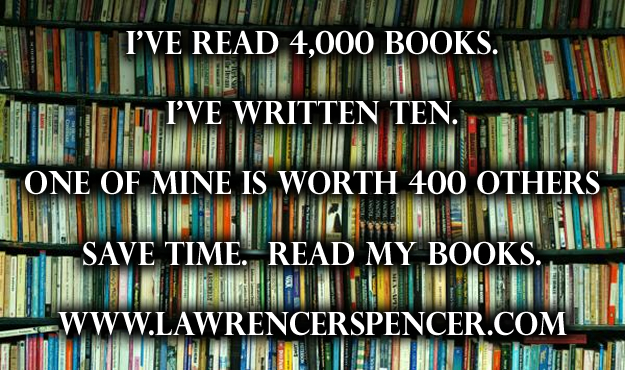
As a writer, I am also a reader. I have often read several books each week during the 50+ years of my reading life, as well as a lot of printed material, etc.. All together I estimate I’ve read about 4,000 books, so far. That’s a lot of words — not including the millions of words on the internet — that are not in the form of a book. Fortunately, there are more than 100,000 book titles available as spoken books — narrated for you by professional actors — on Audible.com, Librivox.com and sites on the internet. Now, I can “read” a book with my ears, instead of my eyes, a fact that I appreciate more and more as I grow older. I can “read” while I’m walking, driving, jogging, cooking, cleaning, waiting and doing a lot of things that would prevent me from reading with my eyes. It’s a wonderful age we live in!
So, how do we select the most cherished, life-giving, knowledge-quenching word droplets from the ocean of words? Having read more than my share of books I can say without any doubt that reading a lot of books does not make a person “smart”, or “wise”, or “literate”. However, for me, reading books is usually a more gratifying experience, mentally and spiritually, than watching television or movies or videos. Books are usually more thoroughly researched, planned, crafted, edited and perfected than other forms of communication.
In this electronic age, when more books are available to us — thanks to digital technology — than during all of the history of humankind combined, can we expect that humanity would be more well informed and intelligent that ever before? Books themselves are not wisdom. If books are not read by people, the knowledge contained in them remains hidden. They might has well not have been written.
My personal recommendation for your reading or listening book list are the books I’ve written, of course. My view of “reality” is different than most. My universe is unique, as is yours. I invite you to share my universe, through my books.
— This blatant self-endorsement is brought to you by Lawrence R. Spencer —