
ACE OF CUPS

Republished by Blog Post Promoter
ace-of-cups

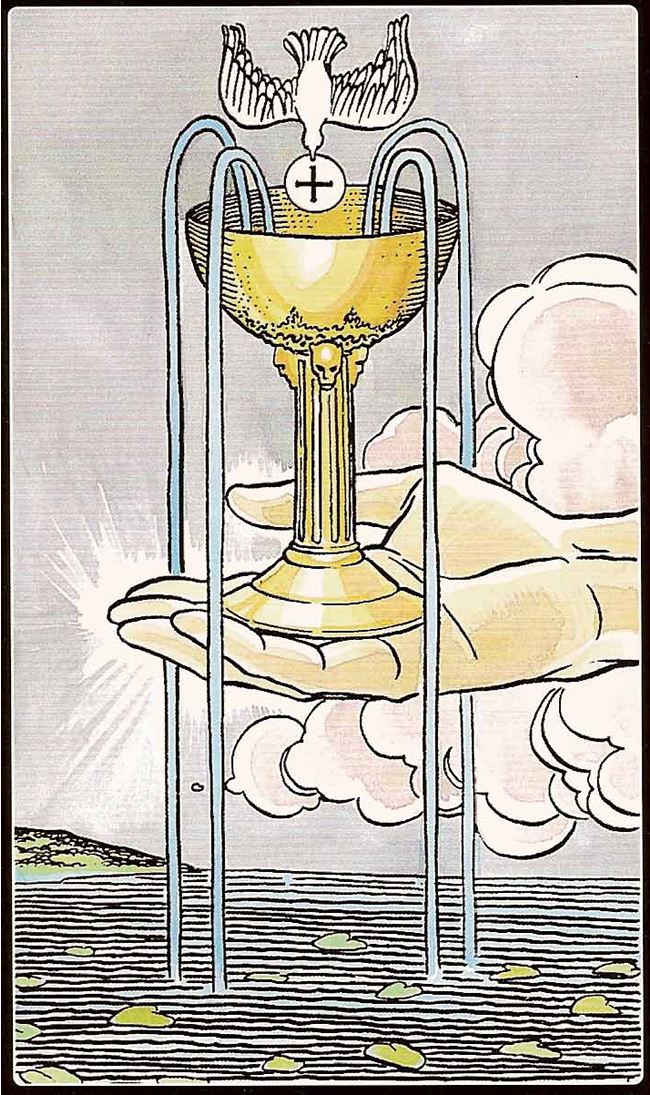
Ace of Cups is a card used in Latin suited playing cards (Italian, Spanish and tarot decks). It is the Ace from the suit of Cups. In Tarot, it is part of what card readers call the “Minor Arcana”, and as the first in the suit of Cups, signifies beginnings in the area of the social and emotional in life.  Tarot cards are used throughout much of Europe to play tarot card games.

Playing cards first entered Europe in the late 14th century, probably from Mamluk Egypt, with suits very similar to the tarot suits of Swords, Staves, Cups and Coins (also known as disks, and pentacles) and those still used in traditional Italian, Spanish and Portuguese decks.

The first known documented tarot cards were created between 1430 and 1450 in Milan, Ferrara and Bologna in northern Italy when additional trump cards with allegorical illustrations were added to the common four-suit pack. These new decks were originally called carte da trionfi, triumph cards, and the additional cards known simply as trionfi, which became “trumps” in English. The first literary evidence of the existence of carte da trionfi is a written statement in the court records in Ferrara, in 1442.  The oldest surviving tarot cards are from fifteen fragmented decks painted in the mid 15th century for the Visconti-Sforza family, the rulers of Milan.

The Ace of Cups shows a hand holding a cup or chalice that is overflowing with five streams of water. The hand that appears from the clouds represents our consciousness of spiritual energy and influence. Radiating from the hand are rays which symbolizes that you must always trust your inner feelings and your heart to lead the way. This is your intuition and inner power talking to you. The five streams represent the abundance and power of the spirit and the effect of spiritual energy upon our five senses. A dove holding a wafer or small disc in its mouth descends from above, signifying the incarnation and appearance of the spirit in the material world. Below the hand is a great sea covered with lotus blossoms, symbolizing the awakening of the human spirit.

The Ace of Cups Tarot card’s meaning is of joy and inner peace from friends and family. The five streams pouring out of the cup represent the five senses: sight, smell, hearing, taste and touch.  As a symbol of possibility in the area of deep feelings, intimacy, attunement, compassion and love, in divination, it shows that a seed of emotional awareness has been planted in your life although you may not yet recognize it. When the seed sprouts, it could take almost any form. It might be an attraction, strong feeling, intuitive knowing, or sympathetic reaction. On the outside, it could be an offer, gift, opportunity, encounter or synchronistic event.

This card also suggests inner spirituality. Cups are the suit of the heart, and the Ace stands for the direct knowing that comes from the heart. Trust what your feelings are telling you. Seek out ways to explore your consciousness and your connections with Spirit.  Allow the power of your emotions to guide you in a new direction. Embrace the love that is the Ace of Cups.
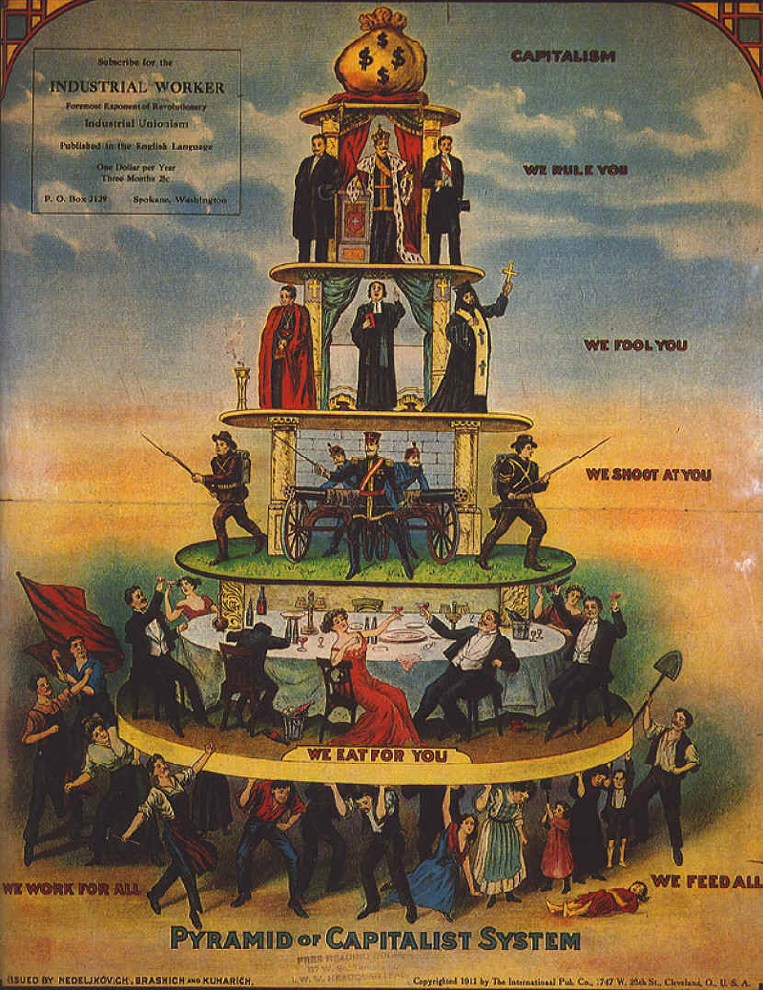

PYRAMID OF CAPITALISM (1911)

Republished by Blog Post Promoter

“The whole dream of democracy is to raise the proletarian to the level of stupidity attained by the bourgeois.”

— Gustave Flaubert (December 12, 1821 – May 8, 1880) was a French writer who is counted among the greatest Western novelists. He is known especially for his first published novel, Madame Bovary (1857)

bourgeoisie, the social order that is dominated by the so-called middle class. In social and political theory, the notion of the bourgeoisie was largely a construct of Karl Marx (1818–83) and of those who were influenced by him. In popular speech, the term connotes philistinism, materialism, and a striving concern for “respectability.”  The term bourgeois arose in medieval France, where it denoted an inhabitant of a walled town. Its overtones became important in the 18th century, when the middle class of professionals, manufacturers, and their literary and political allies began to demand an influence in politics consistent with their economic status.

The proletariat (from Latin proletarius, a citizen of the lowest class) is a term used to identify a lower social class, usually the working class; a member of such a class is proletarian. Originally it was identified as those people who had no wealth other than their children.

MAKE FRIENDS

Republished by Blog Post Promoter

FRIENDS WITH YOUR SELF

Maxwell Maltz (March 10, 1889 – April 7, 1975) was an American cosmetic surgeon and author of Psycho-Cybernetics (1960), which was a system of ideas that he claimed could improve one’s self-image. In turn, the person would lead a more successful and fulfilling life.  He wrote several books, among which Psycho-Cybernetics was a long-time bestseller — influencing many subsequent self-help teachers. His orientation towards a system of ideas that would provide self-help is considered the forerunner of the now popular self-help books.

The book introduced Maltz’s views where a person must have an accurate and positive view of him- or herself before setting goals; otherwise he or she will get stuck in a continuing pattern of limiting beliefs. His ideas focus on visualizing one’s goals and he believes that self-image is the cornerstone of all the changes that take place in a person. According to Maltz, if one’s self-image is unhealthy or faulty — all of his or her efforts will end in failure. —  (reference: Wikipedia.org)

QUESTION SCIENTIFIC DOGMA

Republished by Blog Post Promoter

TED Talks Chris Anderson censored Rupert Sheldrake, and removed this video from the TEDx YouTube channel.  Dr. Sheldrake dared question the “Scientistic Orthodoxy”, and for that they have been publicly castigated and defamed.  What is the materialistic dogma of “science” trying to hide?

BIOGRAPHY:
Rupert Sheldrake, Ph.D. (born 28 June 1942) is a biologist and author of more than 80 scientific papers and ten books. A former Research Fellow of the Royal Society, he studied natural sciences at Cambridge University, where he was a Scholar of Clare College, took a double first class honours degree and was awarded the University Botany Prize. He then studied philosophy and history of science at Harvard University, where he was a Frank Knox Fellow, before returning to Cambridge, where he took a Ph.D. in biochemistry. He was a Fellow of Clare College, Cambridge, where he was Director of Studies in biochemistry and cell biology. As the Rosenheim Research Fellow of the Royal Society, he carried out research on the development of plants and the ageing of cells in the Department of Biochemistry at Cambridge University.

While at Cambridge, together with Philip Rubery, he discovered the mechanism of polar auxin transport, the process by which the plant hormone auxin is carried from the shoots towards the roots.

From 1968 to 1969, based in the Botany Department of the University of Malaya, Kuala Lumpur, he studied rain forest plants. From 1974 to 1985 he was Principal Plant Physiologist and Consultant Physiologist at the International Crops Research Institute for the Semi-Arid Tropics (ICRISAT) in Hyderabad, India, where he helped develop new cropping systems now widely used by farmers. While in India, he also lived for a year and a half at the ashram of Fr Bede Griffiths in Tamil Nadu, where he wrote his first book, A New Science of Life.

From 2005-2010 he was the Director of the Perrott-Warrick Project funded from Trinity College,Cambridge. He is a Fellow of Schumacher College , in Dartington, Devon, a Fellow of the Institute of Noetic Sciences near San Francisco, and a Visiting Professor at the Graduate Institute in Connecticut.

Books by Rupert Sheldrake:

A New Science of Life: The Hypothesis of Formative Causation (1981). New edition 2009 (in the US published as Morphic Resonance)
The Presence of the Past: Morphic Resonance and the Habits of Nature (1988)
The Rebirth of Nature: The Greening of Science and God (1992)
Seven Experiments that Could Change the World: A Do-It-Yourself Guide to Revolutionary Science (1994) (Winner of the Book of the Year Award from the British Institute for Social Inventions)
Dogs that Know When Their Owners are Coming Home, and Other Unexplained Powers of Animals (1999) (Winner of the Book of the Year Award from the British Scientific and Medical Network)
The Sense of Being Stared At, And Other Aspects of the Extended Mind (2003)
The Science Delusion (2012, published in the US as Science Set Free)