
Republished by Blog Post Promoter
“I suppose you are right Mr. Holmes. It is difficult, if not impossible, to stay apace of your ability to remain logical in the face of a situation which is so absurdly enigmatic. You are proposing that the philosophical paradigm of reality should be considered of equal importance with fiction. How can you ever solve a criminal case, your occupation, if every piece of hard evidence could be a contrivance of imagination on the part of the investigator or of the criminal?”, said Mr. Dodgson.
“Quite the contrary”, I said. “But rather than keeping to my methods alone, let me ask you what meaning you attribute to the following passage in your book”, I said, turning to the page which described in the encounter between Alice and the Cheshire Cat.
“Let me read your own words to you.”
“…she was a little startled by seeing the Cheshire Cat sitting on a bough of a tree a few yards off.
The Cat only grinned when it saw Alice. It looked good-natured, she
thought: still it had VERY long claws and a great many teeth, so she
felt that it ought to be treated with respect.
‘Cheshire Puss,’ she began, rather timidly, as she did not at all know
whether it would like the name: however, it only grinned a little wider.
‘Come, it’s pleased so far,’ thought Alice, and she went on. ‘Would you
tell me, please, which way I ought to go from here?’
‘That depends a good deal on where you want to get to,’ said the Cat.
‘I don’t much care where–‘ said Alice.
‘Then it doesn’t matter which way you go,’ said the Cat.
‘–so long as I get SOMEWHERE,’ Alice added as an explanation.
‘Oh, you’re sure to do that,’ said the Cat, ‘if you only walk long
enough.’
Alice felt that this could not be denied, so she tried another question.
‘What sort of people live about here?’
 ‘In THAT direction,’ the Cat said, waving its right paw round, ‘lives
a Hatter: and in THAT direction,’ waving the other paw, ‘lives a March
Hare. Visit either you like: they’re both mad.’
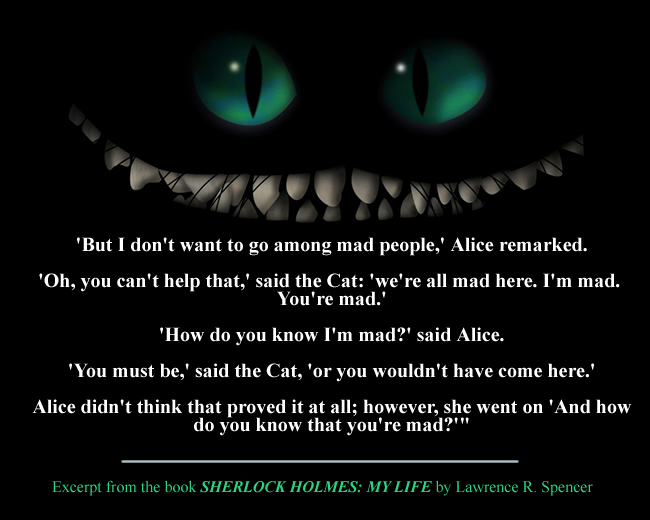
‘But I don’t want to go among mad people,’ Alice remarked.
‘Oh, you can’t help that,’ said the Cat: ‘we’re all mad here. I’m mad.
You’re mad.’
‘How do you know I’m mad?’ said Alice.
‘You must be,’ said the Cat, ‘or you wouldn’t have come here.’
Alice didn’t think that proved it at all; however, she went on ‘And how
do you know that you’re mad?'”
“So, Mr. Dodgson, let me pose the same question to you that young Alice asked of the chimerical cat in your own story: how do you know whether you are mad or not mad? How would you satisfy yourself that I am not mad? How do we know that everyone is mad or not mad?”, I said, rising from my chair to place the manuscript upon the sideboard.
I refilled my pipe once again, in anticipation of the protracted debate that was sure to follow on the heels of these profoundly, absurd, yet existential queries and arguments.
Mr. Dodgson did not seem the least bit nonplussed by my insinuation regarding his sanity, or the sanity of all. Rather, he thanked us very cordially for our hospitality, rose from his chair and reached the door to exit the apartment. As he reached the door he turned back to me.
“Mr. Holmes, I will leave the resolution of this mystery entirely in your very capable hands. If anyone were able to solve the questions you pose to me, I assure you that I am not that man. Neither are any of the mentors whom I have studied, including Sir Isaac himself. I trust that you will be kind enough to inform me of your eventual success, if such is possible. Good day to you, gentlemen”.”
Excerpted from the book SHERLOCK HOLMES: MY LIFE, by Lawrence R. Spencer
