Republished by Blog Post Promoter
(According to Earth “scientists”), genes are the fundamental units of inheritance in living organisms. Together, they hold all the information necessary to reproduce a given organism and to pass on genetic traits to its offspring.
Biologists have long debated what constitutes a gene in molecular terms but one useful definition is a region of DNA that carries that code necessary to make a molecular chain called a polypeptide. These chains link together to form proteins and so are the bricks and mortar out of which all organism are constructed.
Given this crucial role, it is no surprise that an ongoing goal in biology is to work out the total number of protein-coding genes necessary to construct a given organism. Biologists think the yeast genome contains about 5300 coding genes and a nematode worm genome contains about 20,470.
But the number for humans has been the subject of constant revision since biologists first began the task of estimating them in the 1960s. Then, they believed humans could have as many as 2 million protein-coding genes. But by the time the human genome project began in the late 1990s, the highest estimates put the number at 100,000 and the number has continued to shrink.
That’s an interesting result that is partly a reflection of the state of genomics. The human genome is by no means fully defined and biologists are still in the process of refining their gene models and withdrawing genes in the process.
Indeed, in the most recent update of the genome release, geneticists have withdrawn 328 of the 2000 genes that Ezkurdia, Tress and co identify as potentially non-coding.
And on this evidence, the human genome is set to get smaller still. “Our evidence suggests that the final number of true protein coding genes in the reference genome may lie closer to 19,000 than to 20,000.”
Which means that humans have fewer protein-coding genes even than nematode worms.
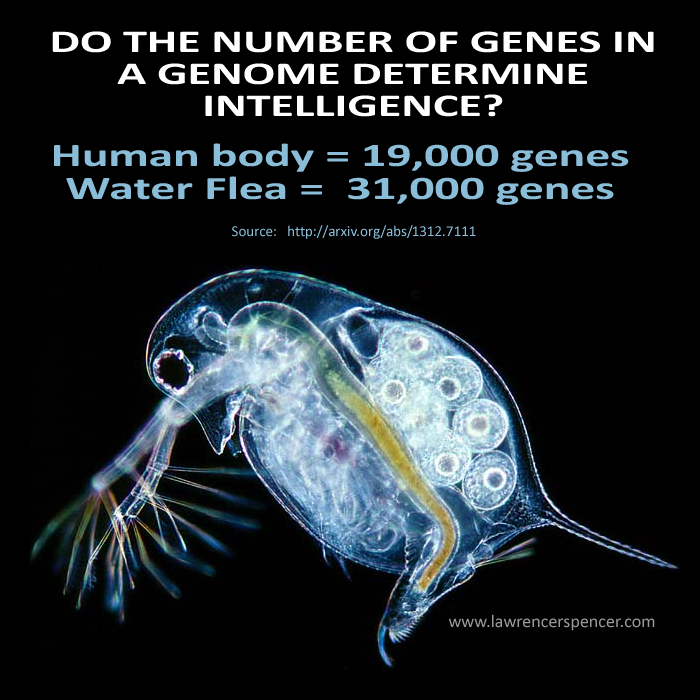
Geneticists long ago debunked the idea that more complex organisms require more genes. The water flea, for example, has 31,000 genes, the most in any animal, while the organism with the largest genome is thought to be the Paris jabonica, a rare flowering plant native to Japan.
The fact that the human genome is so parsimonious raises an interesting question. What exactly is it about the human genome that gives rise to our staggering complexity, in the brain for example, compared to other animals such as monkeys, worms or even water fleas?
A good answer to that question will win prizes!
Ref: arxiv.org/abs/1312.7111 : The Shrinking Human Protein Coding Complement: Are There Fewer Than 20,000