Republished by Blog Post Promoter
 “Count Dracula, and his kindred spirits, may be considered to be “evil” from the point of view of mankind. However, apart from the prejudice of the human victims who do not desire to serve as food for others who drink their blood, the vampire can not be considered to be anything other than an immortal spiritual being, attempting to persist and survive in a quasi-corporeal form.
I esteem that there is only one principle difference between a human being who eats a roasted chicken or pork or beef, and a vampire who drinks the living blood of a human being. That is, that the vampire, by consuming the living blood, derives a more sustainable form of energy than the man who eats the dead flesh of an animal.
 The man who eats dead meat lives 65 years, his own spirit is confined inside a fragile piece of flesh, with little or no self-awareness regarding his potential capabilities as a spiritual entity. Whereas, the vampire, consuming only the living blood of its victim, maintains an extreme spiritual power and ability, as well as physical strength and longevity which borders upon immortality!
Who is to say which condition is more or less desirable? There seems to me to be absolutely no limit to the inanity and credulity of the human race. Homo Sapiens! Homo idioticus!
Yet, it is entirely understandable that men do not trouble themselves with grotesque speculations as to the nature of life beyond the grave. They have enough to do in this world. Life is a beautiful thing. The man who appreciates its beauties enjoys a sufficient understanding of life without dabbling in religions or spiritualism.
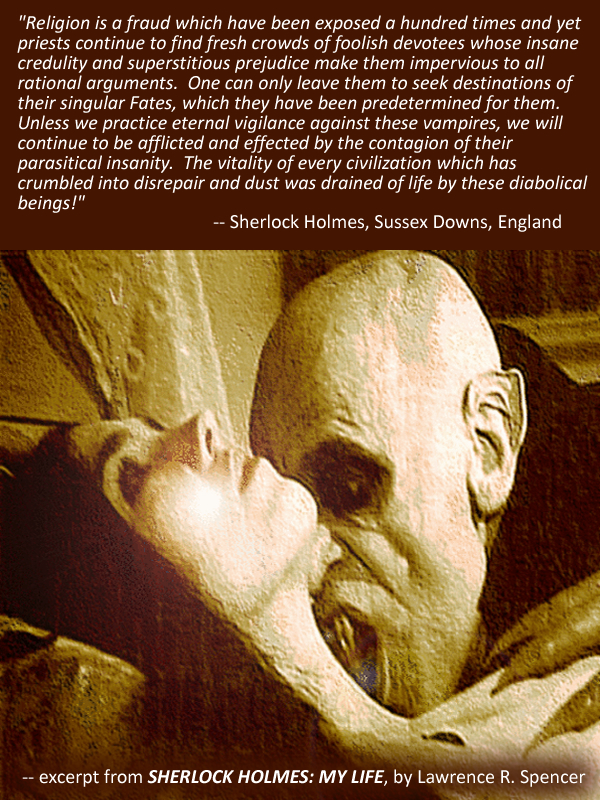
Religion is a fraud which have been exposed a hundred times and yet priests continue to find fresh crowds of foolish devotees whose insane credulity and superstitious prejudice make them impervious to all rational arguments. One can only leave them to seek destinations of their singular Fates, which they have been predetermined for them.
Unless we practice eternal vigilance against these vampires, we will continue to be afflicted and effected by the contagion of their parasitical insanity. The vitality of every civilization which has crumbled into disrepair and dust was drained of life by these diabolical beings!”
_________________________________________
— Excerpt from SHERLOCK HOLMES: MY LIFE, by Lawrence R. Spencer