Category Archives: POETIC NONSENSE

Poetry by Lawrence R. Spencer. Poetic nonsense by Lawrence R. Spencer and others. Haiku poems by Lawrence R. Spencer.

THE FUTURE

Republished by Blog Post Promoter

ELEANOR ROOSEVELT QUOTES

Anna Eleanor Roosevelt  — October 11, 1884 – November 7, 1962) was an American politician, diplomat, and activist. She was the longest-serving First Lady of the United States, holding the post from March 1933 to April 1945 during her husband President Franklin D. Roosevelt’s four terms in office.

Though widely respected in her later years, Roosevelt was a controversial First Lady for her outspokenness, particularly her stance on racial issues. She was the first presidential spouse to hold press conferences, write a syndicated newspaper column, and speak at a national convention. On a few occasions, she publicly disagreed with her husband’s policies. She launched an experimental community at Arthurdale, West Virginia, for the families of unemployed miners, later widely regarded as a failure. She advocated for expanded roles for women in the workplace, the civil rights of African Americans and Asian Americans, and the rights of World War II refugees.

Following her husband’s death, Eleanor remained active in politics for the rest of her life. She served as the first chair of the UN Commission on Human Rights, and oversaw the drafting of the Universal Declaration of Human Rights. Later she chaired the John F. Kennedy administration’s Presidential Commission on the Status of Women. By the time of her death, she was regarded as “one of the most esteemed women in the world” and “the object of almost universal respect” — Wikipedia.org
MAE WEST: SEXUAL REVOLUTIONARY

Republished by Blog Post Promoter

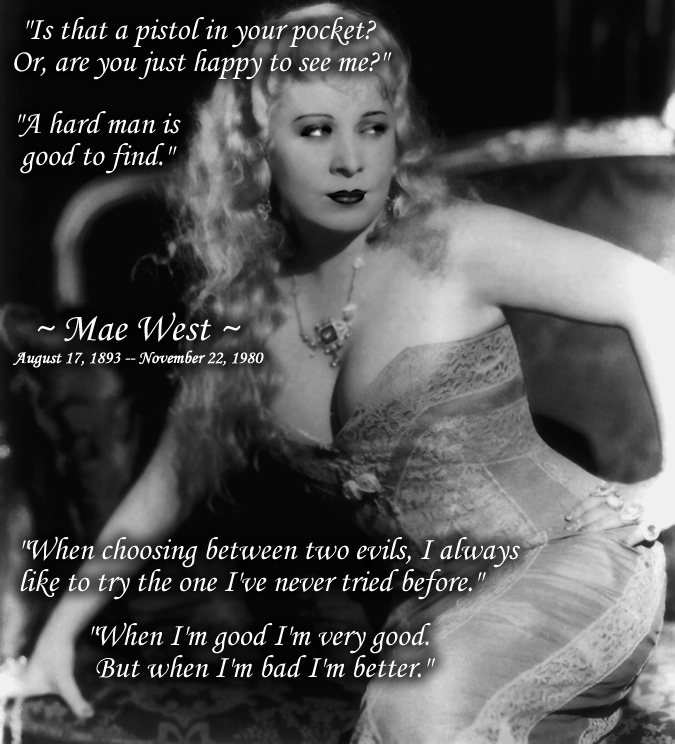
During a period of history when women were thought of a the “property” of men, Mae West refused to be bullied into silence and submission by the patriarchal society of American and the Hollywood film industry.  She used her wit, her talent and her sensuality to man-handle the oppression of the age and mold it to her will.  Women (and men) in the Western world owe Mae West a huge thanks for her fearless assault on the stupidity and suppression of society.

Here is a video composite of some of her famous one-liners from a few of her films:

Mary Jane West (August 17, 1893 – November 22, 1980),known as Mae West, was an American actress, playwright, screenwriter and sex symbol whose entertainment career spanned seven decades. Known for her bawdy double entendres, West made a name for herself in vaudeville and on the stage in New York before moving to Hollywood to become a comedienne, actress and writer in the motion picture industry. In consideration of her contributions to American cinema, the American Film Institute named West 15th among the greatest female stars of all time. One of the more controversial movie stars of her day, West encountered many problems, including censorship. When her cinematic career ended, she continued to perform on stage, in Las Vegas, in the United Kingdom, on radio and television, and recorded rock and roll albums.

Mae West was the first of force Hollywood film makers to allow African Americans to be featured in film.  She used her influence to introduce Duke Ellington and His Orchestra in her films.

THE MAGICIAN

Republished by Blog Post Promoter

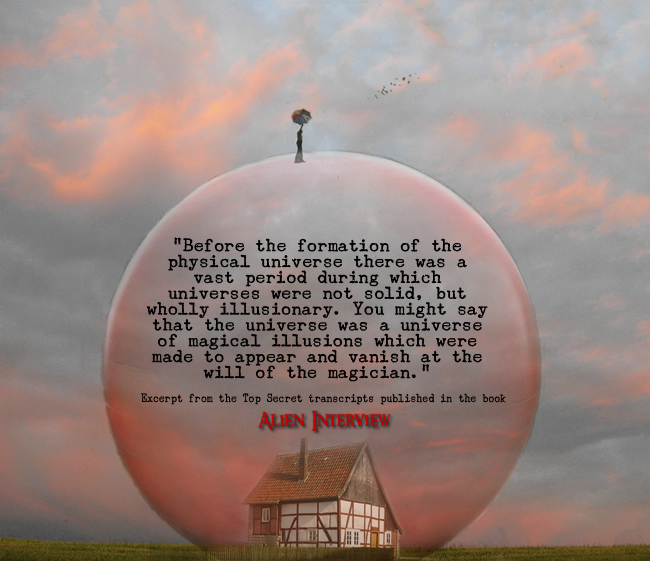
“Before the formation of the physical universe there was a vast period during which universes were not solid, but wholly illusionary.  You might say that the universe was a universe of magical illusions which were made to appear and vanish at the will of the magician.  In every case, the “magician” was one or more Immortal Spiritual Beings.”

— from the book ALIEN INTERVIEW, Edited by Lawrence R. Spencer

ROOT OF ALL EVIL

Republished by Blog Post Promoter

ROOT OF EVIL

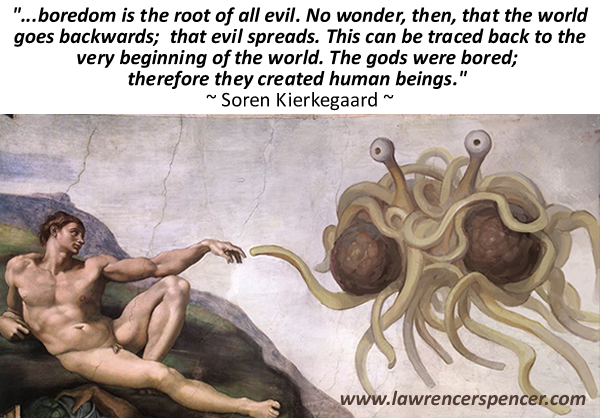
“Since boredom advances and boredom is the root of all evil, no wonder, then, that the world goes backwards;  that evil spreads.
This can be traced back to the very beginning of the world. The gods were bored; therefore they created human beings.”

~ Soren Kierkegaard ~

________________________

Søren Aabye Kierkegaard (5 May 1813 – 11 November 1855) was a Danish philosopher, theologian, poet, social critic and religious author who is widely considered to be the first existentialist philosopher. He wrote critical texts on organized religion, Christendom, morality, ethics, psychology and the philosophy of religion, displaying a fondness for metaphor, irony and parables. Much of his philosophical work deals with the issues of how one lives as a “single individual”, giving priority to concrete human reality over abstract thinking and highlighting the importance of personal choice and commitment.

NIHILISTIC NIETZSCHE

Republished by Blog Post Promoter

NIETZSCHE

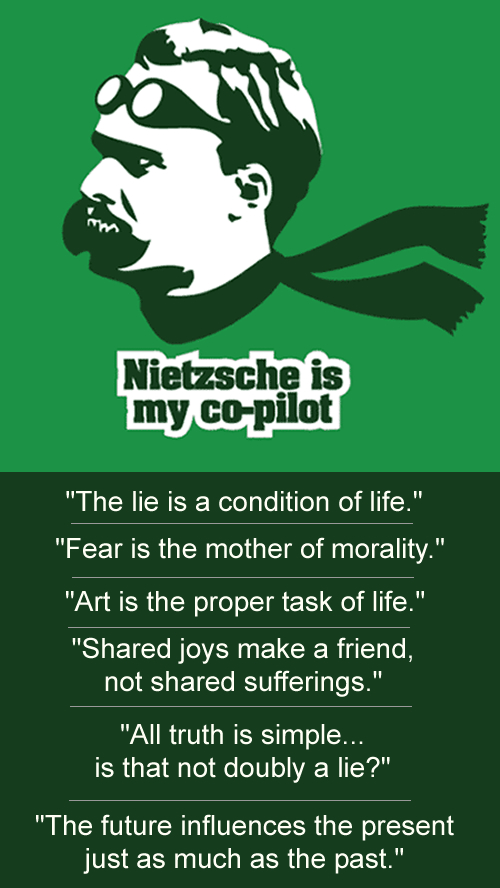
Friedrich Wilhelm Nietzsche (October 15, 1844 – August 25, 1900) was a German philosopher, poet, composer, cultural critic, and classical philologist. He wrote critical texts on religion, morality, contemporary culture, philosophy, and science, displaying a fondness for metaphor, irony, and aphorism.

Nihilism ( from the Latin nihil, nothing) is the philosophical doctrine suggesting the negation of one or more putatively meaningful aspects of life. Most commonly, nihilism is presented in the form of existential nihilism, which argues that life is without objective meaning, purpose, or intrinsic value.Moral nihilists assert that morality does not inherently exist, and that any established moral values are abstractly contrived. Nihilism can also take epistemological or metaphysical/ontological forms, meaning respectively that, in some aspect, knowledge is not possible, or that reality does not actually exist.

Nietzsche noted in his autobiographical Ecce Homo that his philosophy developed over time, so interpreters have found it difficult to relate concepts central to one work to those central to another, for example, the thought of the eternal recurrence features heavily in Also sprach Zarathustra (Thus Spoke Zarathustra), but is almost entirely absent from his next book, Beyond Good and Evil. Added to this challenge is the fact that Nietzsche did not seem concerned to develop his thought into a system, even going so far as to disparage the attempt in Beyond Good and Evil.  (Wikipedia.org)

READ MORE ABOUT THE PHILOSOPHY OF NIETZSCHE HERE