Sir Henry Rider Haggard (22 June 1856 – 14 May 1925) was an English writer of adventure fiction set in exotic locations, predominantly Africa, and a pioneer of the lost world literary genre
“Relax. As a disembodied spirit you don’t have to hang around with people any more so you don’t have to try to impress anyone. In human society you are usually expected to look good, smell good, be good, do good and exhibit other behavior that may not come naturally to you.
For example, if you don’t take a bath for a few weeks your body will stink like a bag of rotten meat – which is essentially what it is. As a spirit you don’t have to shower, shave, brush your teeth, eat, go to work, pee or perform any of those nasty habits.
The 19th century German philosopher Arthur Schopenhauer (1788 – 1860) said, “We forfeit three-fourths of ourselves in order to be like other people.”
So, forget all that stuff you were taught about “now I’m supposed to…”. Do what pleases you.”
_____________________
Excerpt from 1,001 Things To Do While You’re Dead: A Dead Persons’ Guide To Living, by Lawrence R. Spencer
Pan, the Greek god of forests, shepherds and fertility, has long represented the pagan gods in general. With the advent of the Christian church communication with the pagan gods was very heavily suppressed by priests who have a vested interest in eliminating religious competition, by any means required, including, but not limited to lying, stealing, cheating, murder, mayhem, extortion, torture and blackmail. As a result, general public attention to the pagan gods disappeared about 2,000 years ago.
PAN-GOD OF THE WOODSassumes that the pagan gods may still be active, living beings. If any of the ancient gods are still around in the 21st century, what are they doing now? If they are here now — still watching, still powerful, still immortal — where or how might we contact them? If Pan is still around which of us mortals could not use the helping hand of a friendly god once in awhile?
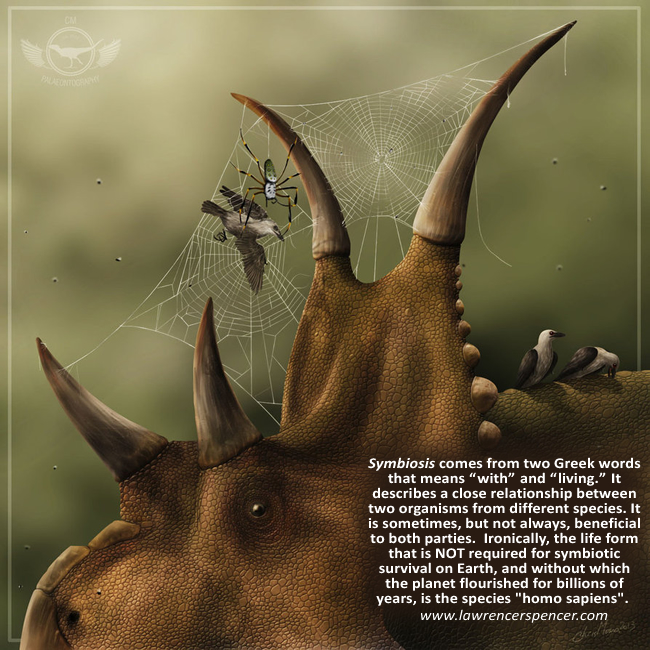
On a tiny, remote planet a Mythology has been conceived and taught that one relatively minor species of life form are “superior” to billions of others with whom they share the planet, and upon whom they depend for sustenance. Factually, all life forms exist in a perpetual state of interactive interdependency called “symbiosis”.
Symbiosiscomes from two Greek words that means “with” and “living.” It describes a close relationship between two organisms from different species. It is sometimes, but not always, beneficial to both parties. Ironically, the life form that is NOT required for symbiotic survival on Earth, and without which the planet flourished for billions of years, is the species “homo sapiens”.
If insects or bacteria (two small examples) disappeared from Earth, most other species, including homo sapiens, would perish quickly. However, if homo sapiens became extinct, nearly all other life forms would flourish, and return to a natural state of symbiotic abundance upon which the fragile, parasitic species of homo sapiens depends utterly. With the exception of a few domesticated animals humans would not be missed on Earth.
It has been observed that the Microcosm (relatively small) is a reflection of the Macrocosm (relatively large) in the physical universe. Human beings conceive themselves to be the “highest” form of life and most intelligent. Yet, when viewed in the context of stars, galaxies and universes, homo sapiens are infinitesimally insignificant, except in their own minds. This begs the question: “Are their beings in the universe for whom humans might provide symbiotic value?“ The final scene from the popular film Men In Black offers one example. Do humans exist symbiotically in an existential game played by beings who we make imperceptible by our Narcissistic Mythology?

 Sir Henry Rider Haggard (22 June 1856 – 14 May 1925) was an English writer of adventure fiction set in exotic locations, predominantly Africa, and a pioneer of the lost world literary genre