Republished by Blog Post Promoter
For all you aspiring “terrorists” or “heretics’ (same thing), take some advice from people who learned from their predecessors during the gruesome history of “humanity”:
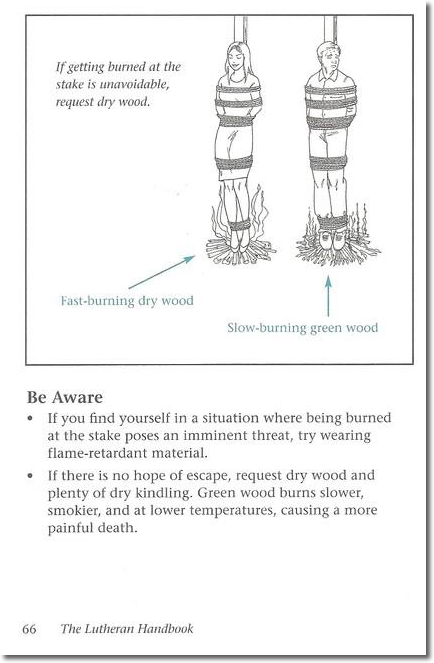
Deliberately causing death through the effects of combustion has a long history as a form of capital punishment. Many societies have employed it as an execution method for crimes such as treason, heresy, and witchcraft. The particular form of execution by burning in which the condemned is bound to a large stake is more commonly called burning at the stake. Death by burning fell into disfavour amongst governments in the late 18th century. (because more cost-effective methods were devised as the cost of wood increased).
Burning at the stake was popular in Catholic and Protestant lands. There were three methods of burning at the stake. In the first method, burning wood was piled around a stake driven into the earth. The prisoner hung from the stake from chains or iron hoops. In the second method (popular in punishing witches), the prisoner again hung from a stake, but this time the wood was piled high around the victim so the observers could not see her pain and suffering as she burned. In the third method (popular in Germany in the Nordic countries), the victim was tied to a ladder which was tied to a frame above the fire. The ladder was then swung down into the flames.
Law required that victims be strangled before burning at the stake, but many victims were deliberately burned alive. This violence was used as both punishment and warning, similar to the sacrificing of criminals in front of an audience at the Roman Colosseum. Originally, burning at the stake was primarily used for women convicted of treason (men convicted of treason were hanged, drawn and quartered). Later, burning at the stake became a popular punishment for men and women accused of heresy or witchcraft.
The 16th and 17th centuries saw a which-hunt such as the world had never seen. Rumors spread like wildfire of people participating in wild witches’ Sabbats, the adoption of animal forms, and ritual cannibalism. Superstitious fear flung accusations everywhere, and the population lived in terror. As many as 200,000 people were burned at the stake for witchcraft during this time. Burning was believed to cleanse the soul, tantamount for those accused of witchcraft or heresy.
Henry the VIII’s daughter, Mary Tudor (“Bloody Mary”) gave birth to England’s most famous burnings at the stake. One of her victims was the sometime Archbishop of Canterbury, Thomas Cranmer, in 1556. During the course of Bloody Mary’s five year reign, she was responsible for 274 burnings. Her victims were condemned of heresy–being Protestant.
In the 17th century, during the Spanish Inquisition, burning at the stake was a popular choice for punishment since it did not spill the victim’s blood (the Roman Catholic Church forbade this). The burning meant the victim would have no body to take into the afterlife. Burning at the stake began to fall out of favor in the 18th century when more “humane” methods of capital punishment rose.
Read a History of “Cripsy Critter Barbeque Techniques” (burning at the stake) in this Wikipedia article: http://en.wikipedia.org/wiki/Death_by_burning