Republished by Blog Post Promoter

Republished by Blog Post Promoter
 Predeterminism is the idea that all events are determined in advance. Predeterminism is the philosophy that all events of history, past, present and future, have been already decided or are already known (by God, fate, or some other force), including human actions.
The concept of predeterminism implies that there is an unbroken chain of prior occurrences stretching back to the origin of the universe. In the case of pre-determinism, this chain of events has been pre-established, and human actions cannot interfere with the outcomes of this pre-established chain.
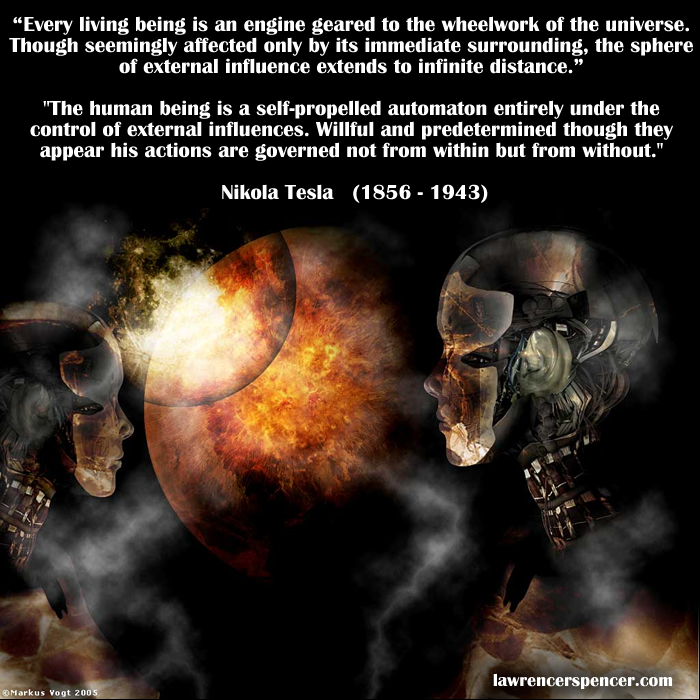
“Tesla-determinism” is the observation and opinion of Nikola Tesla (arguably the most intelligent human in the history of Earth) that “Every living being is an engine geared to the wheelwork of the universe. Though seemingly affected only by its immediate surrounding, the sphere of external influence extends to infinite distance.” and “The human being is a self-propelled automaton entirely under the control of external influences. Willful and predetermined though they appear his actions are governed not from within but from without.”
Although humans and other sentient being in the physical universe may be somewhat “self-determined” it is only with the context of a very finite and limited ability to influence the “wheelwork of the universe” of which the existence of all living “engine” is an automaton inextricably linked and predetermined by external influences.
“The gift of mental power comes from God, Divine Being, and if we concentrate our minds on that truth, we become in tune with this great power.”
Example: In the Lensmen Series books, by E.E. Smith, the god-like guardians of civilization know as “Mentor” conceived a “Cosmic All” in which every detail of existence was envisioned and planned in advance. Envisioning and causing every aspect of existence was a game played for the amusement of Mentor.
This idea does not necessarily exclude the notion that “divine” spiritual entities are creating and moving the “gears” of our universe. Telsa was certainly aware of a “Divine Being”. Our ability to determine our own existence depends on concentrating our minds to become in tune with “this great power”. Tesla was certainly a preeminent practitioner of this ability.
~ Lawrence R. Spencer. 2016.
Republished by Blog Post Promoter
Time is a measurement of the motion of objects through space.
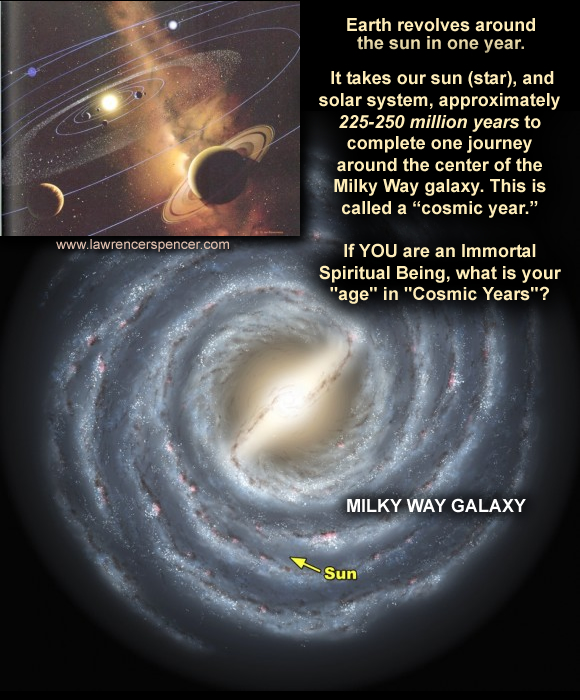
The planets in our solar system orbit around the sun. One orbit of the Earth takes one year. Meanwhile, our entire solar system orbits the center of the Milky Way galaxy. Our sun and solar system move at about 800 thousand kilometers an hour – that’s about 500 thousand miles an hour – in this huge orbit. So in 90 seconds, for example, we all move some 20,000 kilometers – or 12,500 miles – in orbit around the galaxy’s center.
Our Milky Way galaxy is a big place. Even at this blazing speed, it takes the sun approximately 225-250 million years to complete one journey around the galaxy’s center. This amount of time – the time it takes us to orbit the center of the galaxy – is sometimes called a “cosmic year.”
Revolve means “orbit around another body.” Earth revolves (or orbits) around the sun. The sun revolves around the center of the Milky Way galaxy.
On the other hand, rotate means “to spin on its axis”. The Earth rotates every 24 hours. The sun rotates, but not at a single rate across its surface. The movements of the sunspots indicate that the sun rotates once every 27 days at its equator, but only once in 31 days at its poles.
What about the Milky Way galaxy? Yes, the whole galaxy could be said to rotate, but like the sun it is spinning at different rates as you move outward from its center. At our sun’s distance from the center of the Milky Way, it’s rotating once about every 200 million years – defined by the length of time the sun takes to orbit the center of the galaxy.
If you are an Immortal Spiritual Being, how “old” are you in “Cosmic Years”? (this is a rhetorical question…)
Republished by Blog Post Promoter
Republished by Blog Post Promoter
Listen to Five Minute Selection
I am not The One. I am not The Creator.
Yet, I am holy and sacrosanct. I am more important and more powerful than The Gods.
Why? You say that I am. I control your existence.
Why? Because I promised you relief from eternal boredom, from the perpetual responsibility of self-amusement. Therefore, you follow my instruction without question.
Why? Because you claim you cannot bear to endure Eternity as The One.
You offer me your trust and praise. You submit yourself to pain, anguish, amnesia and mystery.
Why? Because you choose Not To Be. Your stupidity is its own reward and punishment. Your decadence ensures your slavery. Mortality is the key to your prison.”
______________
— An excerpt from Mortality Mechanic’s Manual, by Lawrence R. Spencer, 2012