Category Archives: LOUD ZOO

DOKKODO (THE PATH OF ALONENESS)

Republished by Blog Post Promoter
The “Dokkōdō” (Japanese: 独行道?) (“The Path of Aloneness”,  “The Way of Walking Alone“), is a short work written by Miyamoto Musashi (宮本 武蔵) a week before he died in 1645.


Precepts:

  1. Accept everything just the way it is.
  2. Do not seek pleasure for its own sake.
  3. Do not give preference to anything among all things.
  4. Think lightly of yourself and deeply of the world.
  5. Be detached from desire your whole life.
  6. Do not regret what you have done.
  7. Never be jealous.
  8. Never let yourself be saddened by a separation.
  9. Resentment and complaint are appropriate neither for oneself nor others.
  10. Do not let yourself be guided by the feeling of lust or love.
  11. Do not seek elegance and beauty in all things.
  12. Be indifferent to where you live.
  13. Do not pursue the taste of good food.
  14. Do not hold on to possessions you no longer need.
  15. Do not act following customary beliefs.
  16. Do not collect weapons or practice with weapons beyond what is useful.
  17. Do not fear death.
  18. Do not seek to possess either goods or fiefs for your old age.
  19. Respect Buddha and the gods without counting on their help.
  20. You may abandon your own body but you must preserve your honor.
  21. Never stray from the Way.

WEAK IS WRONG

Republished by Blog Post Promoter

RIGHT IS MIGHTTOTALITARIAN CREDO: “History is written by the victors”

Plato’s The Republic (380 BCE) claims that “justice is nothing else than the interest of the stronger”.   This is the maxim of The Physical Universe.  The entire history of humans on Earth is a demonstration of this fundamental principle.  Altruism, egalitarianism, love, beneficence, and kindness have forever been overwhelmed and trampled in the dust of the brutal force of armies.  “Right” and “Wrong” are the same is “Strong” and “Weak” in the physical universe.  If you are seeking a “loving” moral code, you must find it within yourself.  It does not exist in the physical universe.

— Lawrence R. Spencer

GARDEN OF EARTHLY DELIGHTS (AND SUFFERING)

Republished by Blog Post Promoter

https://tuinderlusten-jheronimusbosch.ntr.nl/en#

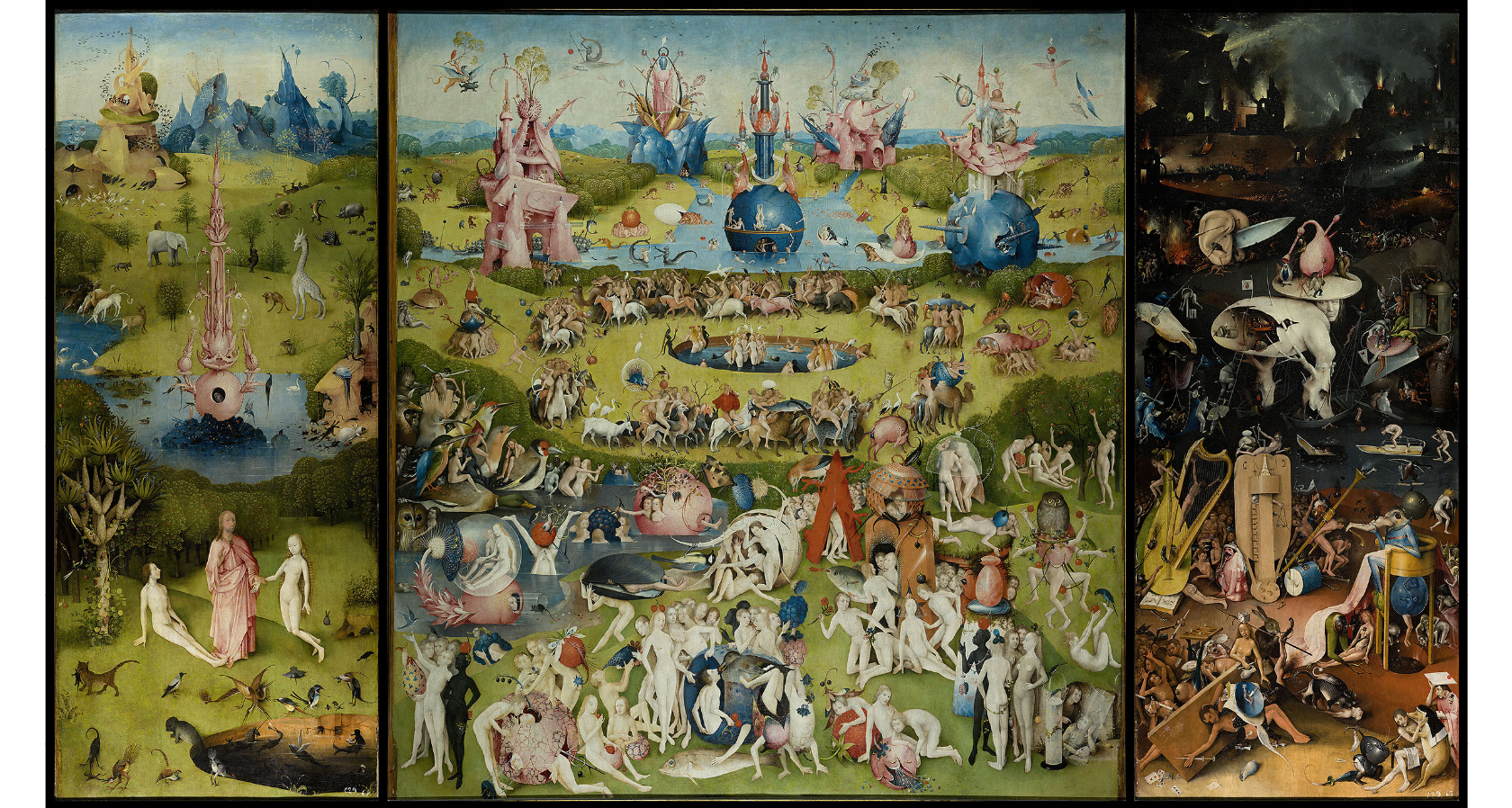
CLICK THE LINK ABOVE TO TAKE A GUIDED VISUAL AND VERBAL TOUR OF ONE OF THE MOST ENIGMATIC PAINTINGS IN HISTORY

canvasHieronymus Bosch (/ˌh.əˈrɒnməs ˈbɒʃ/;born Jheronimus van Aken [jeːˈroːnimɵs fɑn ˈaːkə(n)];  c. 1450 – 9 August 1516) was an Early Netherlandish painter. His work is known for its fantastic imagery, detailed landscapes, and illustrations of religious concepts and narratives. Within his lifetime his work was collected in the Netherlands, Austria, and Spain, and widely copied, especially his macabre and nightmarish depictions of hell.

Little is known of Bosch’s life, though there are some records. He spent most of it in the town of ‘s-Hertogenbosch, where he was born in his grandfather’s house. The roots of his forefathers are in Nijmegen and Aachen (which is visible in his surname: Van Aken). His pessimistic and fantastical style cast a wide influence on northern art of the 16th century, with Pieter Bruegel the Elder being his best known follower. His paintings have been difficult to translate from a modern point of view; attempts to associate instances of modern sexual imagery with fringe sects or the occult have largely failed. Today he is seen as a hugely individualistic painter with deep insight into humanity’s desires and deepest fears. Attribution has been especially difficult; today only about 25 paintings are confidently given to his hand along with 8 drawings. Approximately another half dozen paintings are confidently attributed to his workshop. His most acclaimed works consist of a few triptych altarpieces, the most outstanding of which is The Garden of Earthly Delights.

— Wikipedia.org

DIOGENES THE CYNIC

Republished by Blog Post Promoter

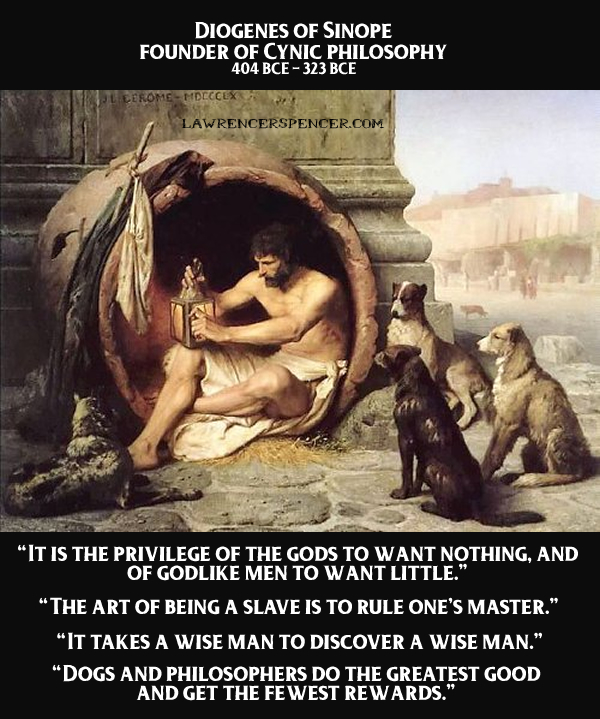
DiogenesDiogenes of Sinope  was a Greek philosopher and one of the founders of Cynic philosophy.  The term “Cynic” itself derives from the Greek word κυνικός, “dog-like”. Later Cynics also sought to turn the word to their advantage, as a later commentator explained:

There are four reasons why the Cynics are so named. First because of the indifference of their way of life, for they make a cult of indifference and, like dogs, eat and make love in public, go barefoot, and sleep in tubs and at crossroads. The second reason is that the dog is a shameless animal, and they make a cult of shamelessness, not as being beneath modesty, but as superior to it. The third reason is that the dog is a good guard, and they guard the tenets of their philosophy. The fourth reason is that the dog is a discriminating animal which can distinguish between its friends and enemies. So do they recognize as friends those who are suited to philosophy, and receive them kindly, while those unfitted they drive away, like dogs, by barking at them.

Diogenes of Sinope he was born in Sinope (modern-day Sinop, Turkey), an Ionian colony on the Black Sea, in 412 or 404 BCE and died at Corinth in 323 BCE.  He was a controversial figure. His father minted coins for a living, and when Diogenes took to debasement of currency, he was banished from Sinope. 

After being exiled, he moved to Athens and criticized many cultural conventions of the city.  He believed that virtue was better revealed in action than in theory. He used his simple lifestyle and behavior (which arguably resembled poverty) to criticize the social values and institutions of what he saw as a corrupt or at least confused society. In a highly non-traditional fashion, he had a reputation of sleeping and eating wherever he chose and took to toughening himself against nature.

He declared himself a cosmopolitan and a citizen of the world rather than claiming allegiance to just one place.  Diogenes made a virtue of poverty. He begged for a living and often slept in a large ceramic jar in the marketplace. He became notorious for his philosophical stunts such as carrying a lamp in the daytime, claiming to be looking for an honest man. He criticized and embarrassed Plato, disputed his interpretation of Socrates and sabotaged his lectures, sometimes distracting attendees by bringing food and eating during the discussions.

Diogenes was also noted for having publicly mocked Alexander the Great: 

“Alexander the Great found the philosopher looking attentively at a pile of human bones. Diogenes explained, “I am searching for the bones of your father but cannot distinguish them from those of a slave.”