Republished by Blog Post Promoter

Inside the book, Vermeer: Portraits of A Lifetime. Analysis of all the paintings of Johannes Vermeer. The book reveals for the first time that the women featured in the paintings of Johannes Vermeer were members of his own family, his daughters, his wife and mother-in-law, Maria Thins.
Republished by Blog Post Promoter
Republished by Blog Post Promoter
 EXCERPTS FROM THE BOOK:
“1001 THINGS TO DO WHILE YOU’RE DEAD: A Dead Person’s Guide to Living” by Lawrence R. Spencer
AVOID YOUR FUNERAL.
If you are squeamish about autopsies, embalming, funeral piers, cremation incinerators, worms, bugs or bacteria you may want to stay away until all that messy, bad smelling business is over and done.
However, funeral directors have become quite masterful, over the past 5,000 years, at making a dead body look as good, or better, than it looked when it was alive. A little formaldehyde, a few strategic injections, a little stuffing, nice clothes, cosmetics, a wig and a comfy, silk-lined coffin, your used body can look better than ever!
This is a good reason to stay away as you may be enticed to start thinking about going back. Obviously, it’s too late. Factually, you never were a body and you definitely are not a body now. So stay focused. The future is where the rest of your life will be lived!
PRACTICE BEING CUTE.
If you attended your own funeral you are probably suffering from the loss of having a body. More important, you may be thinking that you don’t really have any identity or personality without having a body. How will anyone recognize you without your body?
Fortunately, bodies are a nickel a million. Five babies are born every second. So, should you succumb to the ungodly urge to get a new baby body in order to feel a sense of personal identity, you will need to practice being cute.
The only reason people have babies – and keep them – is because they think babies are cute. The same principle applies to all living creatures. So, brush up on looking cute, making cute sounds, doing cute mannerisms, cute smiles, cute laughs, etc.. You’ll need to have your cute skills in top form when and if you get a new body.
__________________________
For more practical tips about things to do while you’re dead, click here: 
Republished by Blog Post Promoter
 “604 BCE —
Laozi, a philosopher who wrote a small book called “The Way”, [i] (Footnote) was an IS-BE of great wisdom, who overcame the effects of the “Old Empire” amnesia / hypnosis machinery and escaped from Earth. His understanding of the nature of an IS-BE must have been very good to accomplish this.
According to the common legend, his last lifetime as a human was lived in a small village in China. He contemplated the essence of his own life. Like Guatama Siddhartha, he confronted his own thoughts, and past lives. In so doing, he recovered some of his own memory, ability and immortality.
As an old man, he decided to leave the village and go to the forest to depart the body. The village gatekeeper stopped him and begged him to write down his personal philosophy before leaving. Here is a small piece of advice he gave about “the way” he rediscovered his own spirit:
“He who looks will not see it;
He who listens will not hear it;
He who gropes will not grasp it.
The formless nonentity, the motionless source of motion.
The infinite essence of the spirit is the source of life.
Spirit is self.
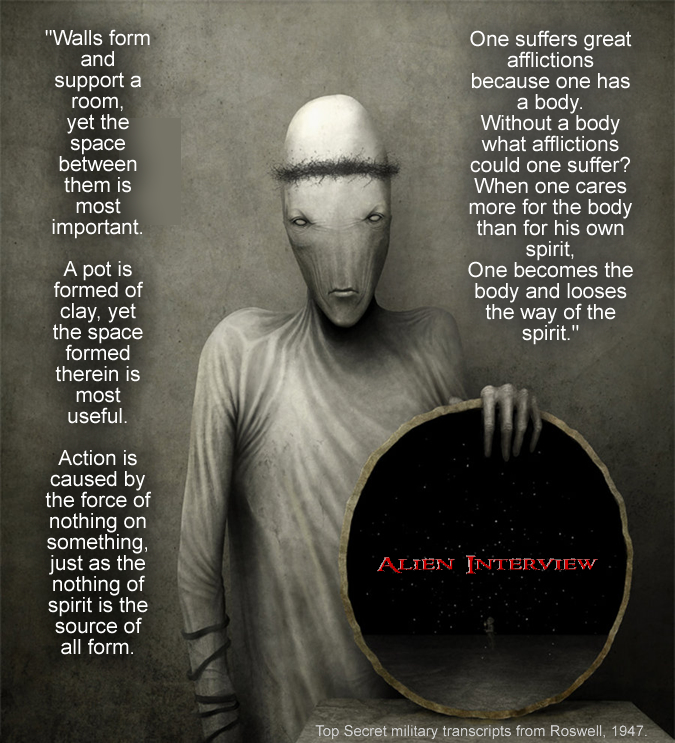
Walls form and support a room,
yet the space between them is most important.
A pot is formed of clay,
yet the space formed therein is most useful.
Action is caused by the force of nothing on something,
just as the nothing of spirit is the source of all form.
One suffers great afflictions because one has a body.
Without a body what afflictions could one suffer?
When one cares more for the body than for his own spirit,
One becomes the body and looses the way of the spirit.
The self, the spirit, creates illusion.
The delusion of Man is that reality is not an illusion.
One who creates illusions and makes them more real than reality, follows the path of the spirit and finds the way of heaven”.
______________
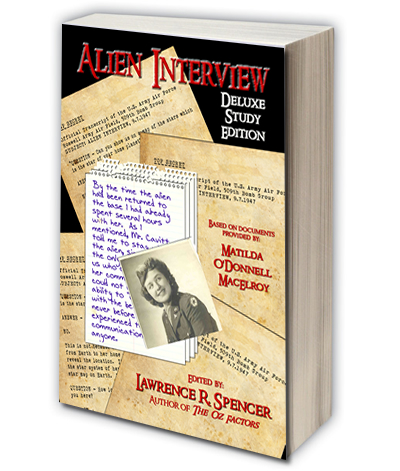
Excerpt from the book ALIEN INTERVIEW
[i] “Laozi, a philosopher who wrote a small book called “The Way”…”
“According to tradition, it was written around 6th century BC by the Taoist sage Laozi (or Lao Tzu, “Old Master”), a record-keeper at the Zhou Dynasty court, by whose name the text is known in China. Tao Te Ching is a Chinese classic text. Its name comes from the opening words of its two sections: 道 dào “way,” and 德 dé “virtue“.
 This ancient book is also central in Chinese religion, not only for Taoism (Dàojiāo 道教) but Chinese Buddhism, which when first introduced into China was largely interpreted through the use of Taoist words and concepts. Many Chinese artists, including poets, painters, calligraphers, and even gardeners have used the Tao Te Ching as a source of inspiration. Its influence has also spread widely outside East Asia, aided by hundreds of translations into Western languages.”
Tao is nameless. (Tao) goes beyond distinctions, and transcends language.
Laozi describes a state of existence before time or space:
“The Way that can be told of is not an unvarying way;
The names that can be named are not unvarying names.
It was from the Nameless that heaven and Earth sprang;
The named is but the mother that rears the ten thousand creatures.
Each after its kind.”
“The Spirit never dies.
It is the Mysterious Female.
The doorway of the Mysterious Female
Is the base from which Heaven and Earth sprang.
It is there within us, all the while;
Draw upon it as you will.
It never runs dry.
We put spokes together and call it a wheel;
But it is on the space where there is nothing that the value of the wheel depends.
We turn clay to make a vessel;
But it is on the space where there is nothing that the value of the vessel depends.
We pierce doors and windows to make a house;
And it is on these spaces where there is nothing that the value of the house depends.
Therefore just as we take advantage of what is,
we should recognize the value of what is not.
Knowing others is wisdom;
Knowing the self is enlightenment.
Mastering others requires force;
Mastering the self requires strength;
He who knows he has enough is rich.
Perseverance is a sign of will power.
He who stays where he is, endures.
To die but not to perish is to be eternally present.”
Many believe the Tao Te Ching contains universal truths that have been independently recognized in other philosophies, both religious and secular.”
— Reference: Wikipedia.org
Republished by Blog Post Promoter
“Personally, it is my conviction that all sentient beings are immortal spiritual beings. This includes human beings. For the sake of accuracy and simplicity I will use a made-up word: “IS-BE”. Because the primary nature of an immortal being is that they live in a timeless state of “is”, and the only reason for their existence is that they decide to “be”.
— Excerpt from the interview transcripts published in the book Alien Interview.



Republished by Blog Post Promoter
GENGHIS KHAN–“I AM THE PUNISHMENT OF GOD!”
(Ancient Mongolian Proverb: Resistance and Immortality are futile!)
“I can cause accidents, too! — The Wicked Witch of the West in ‘The Wizard of Oz’
In 1216 AD, Mohammed II was the Sultan (king) of the opulent city of Samarkand which ruled the trade routes to the Far East from Russia and Europe. Samarkand was about 375 miles southeast of the Aral Sea. This wealthy, culturally sophisticated metropolis, surrounded by canals and decorated throughout with fountains and shade trees, housed more than 500,000 citizens. Within the city walls every house had a garden. Factories wove silver lame, silk and cotton cloth. Outside the city, farmers cultivated sprawling fields. They exported melons encased in lead boxes packed with snow.
Mohammed lived amid the splendor of his treasures and palace harem. His Royal Highness rode with his courtiers on hunting excursions dressed in cloth made of gold. Tame cheetahs clung to the hand-crafted saddles behind him. Such opulence was paramount to that of any Earthly civilization.
A brief treaty was maintained between the Sultan and the distant Mongolian Empire which lasted several years. The truce had been originated by messengers from the Khan, ruler of the Mongol hordes, who offered so many gold ingots and nuggets as a gift to establish trade relations that even Mohammed II was impressed. Along with the gold, the Mongol messengers delivered a letter inscribed with a seal in which Ghengis Kahn proclaimed himself, “God in heaven, the Kah Khan, the power of God on Earth. The Seal of the Emperor of Mankind”.
Within a few years, the flame of the Khan’s lust for westerly conquest burned the fabric of the treaty. Forewarned, the citizens of Samarkand had been expected to withstand a siege against the invading horde for as long as an entire year. Yet, they became terrified by rumors from neighboring cities which had seen the Mongolian hordes overwhelm the larger army of Mohammed II. The destruction of the Sultan’s armies served as a warning to others. As a result, the citizens of Samarkand surrendered the glorious city to the Mongol troops after only five days.
Such victories in war were business as usual for the Khan. To Ghengis Khan, the life-long training his army of penniless, nomad horseback sheepherders, was designed to teach his warriors the essential concepts of battle. For the Kahn, a successful army had to be able to maintain all the principles of military science that the Mongol army exemplified:
1/ planned objectives
2/ offensive position
3/ unity of command
4/ capacity to concentrate force
5/ ability to maneuver
6/ economy of force
7/ element of surprise
8/ security within the ranks
9/ strategic retreat
10/ tactical simplicity.
One of the Khan’s favored training exercises for his army was called the “Great Hunt”. The exercise started at the beginning of winter and lasted three months. Flags were set to mark the assembly points for each tumen (a division of 10,000 soldiers) along a starting line 80 miles wide. Several hundred miles ahead of that line, another flag was placed to mark the finish line. At a signal from the Khan the entire line advanced forward on the sturdy backs of their small, but infamous ponies, herding all wild game before them. These same ponies, broken and trained from birth to serve the hunter, would carry the Mongol tribes across the known world and back again.
As weeks passed the advancing army, arrayed in full battle armament, pressed a growing throng of wild animals ahead of themselves. As the army advanced toward the finishing flag, the outer wings of the force rode ahead more quickly and formed a circle, surrounding thousands of animals and predatory beasts alike within the arena of horsemen. The commanding officer of the army rode behind, giving orders and directions to the hunters, using the same chain of command, communications signals and military strategy they would use later against human enemies in battle.
Throughout the hunt it was forbidden to kill any animal. Both a soldier and his superior officer were severely punished if even one deer, boar, rabbit, pheasant, lion and tiger and bear (oh my!) were allowed to escape from the ring of equestrian warriors.
The precision communication skills and unity of command required to carry out the cooperative action of tens of thousands of cavalry, spread across such great distances, using only flags by day and torches by night, depended on the skill and stamina of each individual soldier/hunter. In order to maintain the constant vigil required to prevent the escape of any single animal from the circle, half the army slept, fully clothed and ready for action, while the rest kept watch by campfire light.
The Great Hunt concluded with the Khan himself entering the manmade arena to make his choice and be the first to kill one of the animals. After this, the officers and soldiers showed off their skill with weapons in personal combat against the entrapped animals. Some men fought singled-handedly against a desperate pack of wolves with only a dagger.
During the march, as in battle, each soldier was armed with a composite bow made of bone and wood. These bows were more powerful than any other in the world, and were used to shoot an arsenal of arrows specially tipped for every purpose: long range, short range, three-foot armor piercing, whistling signal arrow, incendiary and grenade tipped arrows. Each soldier could shoot accurately and reload while standing in the saddle stirrups on his horse at full gallop.
On the march, during wartime, each soldier led his own herd of three remounts. He could ride at speed for days at a time, eating in the saddle and if need be, pause briefly to slit the leg of his weakest horse, drinking its blood for nourishment. According to the writings of Marco Polo, an Italian traveler who lived in the camp of the Khan in Mongolia for many years, messengers would often ride between 200 and 300 miles a day!
The soldier, raised in a land of eternal harshness (104 degrees F in summer and minus 40 F degrees in winter) had no vested interest other than to obey, without question, the orders of his superior officer.
This sort of harsh training, coordinated action and individual skill, combined with superior weapons, was the raw material from which the Khan crafted one of the most unprecedented and fiercest armies in history. His ruthless genius for military organization and strategy remains unparalleled.
These nomads never developed technology or produced any manufactured good or mined any minerals. They depended utterly upon murder and theft from settled societies for swords, armor, silk, gold and silver.
When the armies of Ghengis Khan were directed toward the conquest of Europe, they faced nearly insurmountable barriers to their ambition: scorching deserts, rivers, frozen mountains, thousands of miles of barren plains, heavily fortified city walls and greatly superior numbers of enemy soldiers.
Yet the local European mercenary armies, who gave themselves important sounding names, like Teutonic Knights, Knights Templar and Hospitallers–the flower of European military power–were overwhelmed in every single engagement by the smaller Mongol forces who out-fought, out-maneuvered and out-thought the disorganized and undisciplined Europeans.
The rampant superstition of the Christian European culture compounded the catastrophic conquest, as the hordes swept through Russia and Europe like a brilliantly planned and executed swarm of flying monkeys. Rumors spread of diabolical atrocities committed by inhuman monstrosities–creatures with the head of a horse, possessing supernatural power–that devoured their victims.
In fact, the carnage was horrific, but only the population of those cities who actively resisted, were killed. On average, those who did not resist were spared and for the most part mercy was given to selected groups, such as women, who were set aside to be raped before they were sent into slavery. Craftsmen, merchants, scribes, artisans, clerics, administrators and selected officers were sent back to the Mongol homeland and put to work. The Mongol had no use for farmers, whom they considered to be less valuable than horses. Yet, with uncharacteristic benevolence, the Mongols were tolerant of the religious practices of the vanquished.
For those who resisted him, Ghengis Khan had a simple, two-part philosophy. The first part concerned the joy of conquest. He said, “The greatest pleasure is to vanquish your enemies and chase them before you, to rob them of their wealth and see those dear to them bathed in tears, to ride their horses and clasp to your bosom their wives and daughters.”
He expressed the second part of his philosophy while preaching to the doomed citizens of Bukhara from the walls of the city shortly before they, and the city itself, were slashed and burned from the face of the Earth by his soldiers. The Khan informed them that they themselves were responsible for the mass extinction they were about to suffer, saying, “I am the punishment of God. If you had not committed great sins, He would not have sent a punishment like me.”
The relatively few citizens who were not slain were used as human shields against the arrows of the enemy marching ahead of his army.
In towns that resisted conquest, every man, women, child and domestic animal was slaughtered. The heads of their victims were sometimes stacked in three pyramids: a pile each for men, women and children. These mountains of skulls served as a gruesomely effective warning to would-be dissidents.
Some towns were disassembled stone by stone and the ground laced with salt so as to never bear crops again.
The overwhelming stench of decaying dead bodies within such vanquished towns often drove the Mongols away from their encampments outside the walls.
In spite of their grim terror tactics, the hordes of the Khan usually preferred not to slaughter the innocent and routinely granted mercy to those cities that surrendered. Apparently a very large percentage of the cities approached by the hordes chose to surrender without the slightest resistance. Clever thinking!
Chroniclers of the age variously estimated the total slaughter of Europeans by the Mongols at no less than 1,600,000 and possibly as many as 2,400,000. In the destruction of the region of Nishapur alone, the death toll is supposed to have reached 1,747,000. No one knows for sure, since the Mongols couldn’t write and few others lived to tell about it!
In the eyes of the vanquished, the Mongols may as well have come from Mars. The Mongols were a race that emerged from a land of which the ignorant, self-centered Europeans had never heard. For all the Europeans knew about Mongolians, the hordes could have just as easily fallen out of the sky in a farmhouse from Kansas.
In March of 1227 AD, the Khan suffered internal injuries after falling from his horse on a hunting excursion. The suffering and eventual death of the Khan five months later was kept secret from his army until after the siege of a capital city had been successfully completed. On word of his death, the army flooded into the city and slaughtered every living creature. Anyone who met the funeral procession along the road back to the Mongol capital was instantly killed so that they might serve their master in the next life.
The body of Ghengis Khan lay in state for three months before being buried together with a sacrificial entourage of forty jeweled slave girls and a fourth of his finest horses. A thousand horsemen rode over the burial site to disguise the ground. The burial place remains a secret to this day.
Superior speed, skill, conviction, training, tactics, weapons and organization of the alien Mongol army struck Europe with as much impact as an invading force of hostile aliens might be imagined to strike our own civilization.
The armies of the Khan traveled at more than twice the speed of an enemy army. They uniformly defeated armies more than twice their own size. This factor is an ingredient in the success of any forceful activity, whether it is in the field of war, sports or business. The modern, mechanized tank warfare used by Patton and Rommel against one another during World War II were simple applications of the military art form perfected by the master tactician whom they both diligently studied: Subedei, the leading field general of the Khan.
The illiterate, nomad horse soldier of the Golden Hordes had everything to gain and nothing to lose by going to war. War was his only means through which to escape from a miserable, dismal, impoverished life back home in the frozen steppes of Mongolia. To the common soldier, the logic of war practiced and perfected by Ghengis Khan could be distilled into two very simple and obvious truths that proved, for the Mongolians, to be workable solutions:
1/ WAR equals SURVIVAL.
2/ SPEED times FORCE equals POWER.
Power, as in the strength of an army, is proportionate to the number of soldiers, multiplied by their speed–a basic law of the physical universe. (Al Einstein later wrote a mathematical formula for it: E equals MC squared.)
The sons of Ghengis Khan’s first wife (he had more than 400 wives in all) who inherited the empire that covered one-third of the surface of Earth, never suffered the megalomania of their father. They were all strictly team players.
The dominion of the Khan clan did not crumble immediately upon his death with internal dispute as did the empire of Alexander. It endured for 200 years. This was longer than many international unions which were forged through conquest, yet only a short-term victory in the over-all scheme of things.
In spite of the appalling devastation wrought by the hordes of Ghengis Khan, the real, lasting conquest of Europe did not begin until 1344 AD. Slaughter, inflicted by the merciless armies of the Khan, seems like a minor scratch compared to the holocaust that followed.
It all began rather innocently when a band of Mongol soldiers laid siege to a small, fortified trading post on the shores of the Black Sea. A group of Italian merchants had taken refuge there and held out for two years. The squalid conditions of the siege precipitated an outbreak of the plague in the Mongol encampment. Due to the extent of their own casualties, the horde had to abandon the siege, but not before catapulting a few dead bodies–a sort of human time bomb–over the walls into the fortress.
After the horde left, the surviving Italian merchants boarded a ship bound for Genoa, Italy. A few days after the ship docked, the Black Death began to sweep across Europe. Meanwhile, the horde, on their return trip home, carried the plague eastward to Russia, India and China. In all, it is estimated that at least one out of every four Europeans died–more than 24 million people.
In England and France so many soldiers died that a truce was declared in the beloved war between the two countries–too few soldiers left to make a decent war!
Petrach, the French writer, wrote in 1348 that future generations would be incredulous and unable to comprehend the number of empty houses, abandoned towns, the squalid silence of the countryside littered with corpses and innumerable ships adrift at sea with no living crews to man them.
The Khans molded a nation of nomads with the disciplinary artistry of a potter using his wheel to sculpt a vase of steel. However, even fine art, precise in every detail, is inevitably broken. As with all things in this tenuous universe, even a vase of polished steel eventually returns to dust. The Black Death spawned by the Golden Horde caused, by documented estimates of death tolls, a series of the greatest disasters in human history –the “Punishment of God” indeed!”
— Excerpt from THE OZ FACTORS, by Lawrence R. Spencer