
Republished by Blog Post Promoter
Category Archives: FREE ADVICE
Free Advice about Life, Universe and Other Stuff from Lawrence R. Spencer
 There are only two games to play when you’re in prison: 1) doing time 2) getting out. Where did you come from? Where are you now? Remember who you really are: Fly.
VOLTAIRE OPINIONS
Republished by Blog Post Promoter
 “Opinions have caused more ills than the plague or earthquakes on this little globe of ours.” ~ Voltaire ~
Voltaire (François-Marie Arouet) lived from 21 November 1694 – 30 May 1778. He was a French Enlightenment writer, historian, and philosopher famous for his wit, his attacks on the established Catholic Church, and his advocacy of freedom of religion, freedom of expression, and separation of church and state.
His book Candide was listed as one of The 100 Most Influential Books Ever Written, by Martin Seymour-Smith.
Voltaire was a versatile writer, producing works in almost every literary form,  including plays, poems, novels, essays, and historical and scientific works. He wrote more than 20,000 letters and more than 2,000 books and pamphlets. He was an outspoken advocate of several liberties, despite the risk this placed him in under the strict censorship laws of the time. As a satirical polemicist, he frequently made use of his works to criticize intolerance, religious dogma, and the French institutions of his day.
Voltaire was also known to have been an advocate for coffee, as he was reported to have drunk it 50–72 times per day. It has been suggested that high amounts of caffeine acted as a mental stimulant to his creativity.
He is remembered and honoured in France as a courageous polemicist who indefatigably fought for civil rights (as the right to a fair trial and freedom of religion) and who denounced the hypocrisies and injustices of the Ancien Régime. The Ancien Régime involved an unfair balance of power and taxes between the three Estates: clergy and nobles on one side, the commoners and middle class, who were burdened with most of the taxes, on the other. He particularly had admiration for the ethics and government as exemplified by Confucius.
ALIEN INTERVIEW ON VERITAS RADIO — ENCORE PRESENTATION
Republished by Blog Post Promoter
I am very pleased to announce that Mel Hostalrich, host of the prestigious radio show “Veritas”, is re-airing his broadcast about the book Alien Interview from 2013. Listen to the show now, and subscribe to Veritasradio.com to hear the entire THREE HOUR interview.
LISTEN TO THE VERITAS SHOW ABOUT ALIEN INTERVIEW:
https://www.veritasradio.com/guests/2019/03mar/VS-190321-lspencer-s1.php
Learn more about Mel and the Veritas Radio Show: https://www.veritasradio.com/about.html
SUPER-RELATIONSHIPS
Republished by Blog Post Promoter

HAPPINESS
Republished by Blog Post Promoter
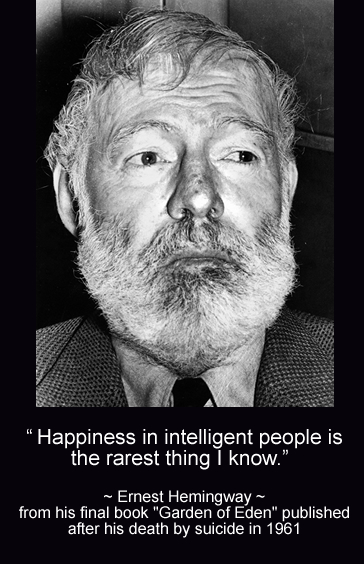 The Pulitzer Prize winning American writer Ernest Hemingway (1899 – 1961) said “Happiness in intelligent people is the rarest thing I know”.
 At the end of his life Hemingway was being chased by the FBI and IRS because he lived in Cuba and was a friend of Fidel Castro, a communist, who opposed the Rothschild international bankers ambition control of the world. Understandably, Hemingway, also a long time alcoholic, became depressed and suicidal. His wife sent him to a mental hospital where they gave him dozens of electric shock treatments and heavy drugs to “cure” his depression. Two days after being released from the hospital his shot himself in the head with his double-barreled shotgun! Hemingway was super-intelligent, but unhappy.
Hemingway is an example that Intelligence, alone, is not the “key to happiness”. I remembered what Krishnamurti said:
 “…you have the idea that only certain people hold the key to the Kingdom of Happiness. No one holds it. No one has the authority to hold that key. That key is your own self, and in the development and the purification and in the incorruptibility of that self alone is the Kingdom of Eternity….
You have been accustomed to being told how far you have advanced, what is your spiritual status. How childish! Who but yourself can tell you if you are incorruptible? I am not concerned, nor with creating new cages, nor new decorations for those cages. My only concern is to set men absolutely, unconditionally free.”
It is interesting that Krishnamurti uses the words “development, purification and incorruptibility” to describe the “key” to happiness. Perhaps this describes the path we have can follow to discover the truth and happiness.
Perhaps it is not as important to be “happy” as it is to see the truth and not become corrupted or depressed by it. Maybe our “development” and “incorruptibility” demand and require that we become “depressed” sometimes as part of our “development”. And, as part of our progress toward Freedom, which is an essential part of Happiness.