Republished by Blog Post Promoter

“SELF-DELUSION IS THE FIRST STEP OF AMBITION”. — lawrence r. spencer

Free Advice about Life, Universe and Other Stuff from Lawrence R. Spencer
Republished by Blog Post Promoter
“SELF-DELUSION IS THE FIRST STEP OF AMBITION”. — lawrence r. spencer
Republished by Blog Post Promoter
We are each a part of something much bigger. Being responsible for that “something” is an act of courage and responsibility. If we refuse or ignore this reality of our existence on Earth, we are doomed to endure the pain of imprisonment in the flesh for the rest of Eternity. We Perceive and Experience what we Cause: nothing more, nothing less…. However, we can UNDO what we have caused. But, we must first acknowledge that WE are the cause of it. As Gautama Siddhartha, The Buddha, said, “No one can cleanse another. Only you can cleanse your self.”

Republished by Blog Post Promoter
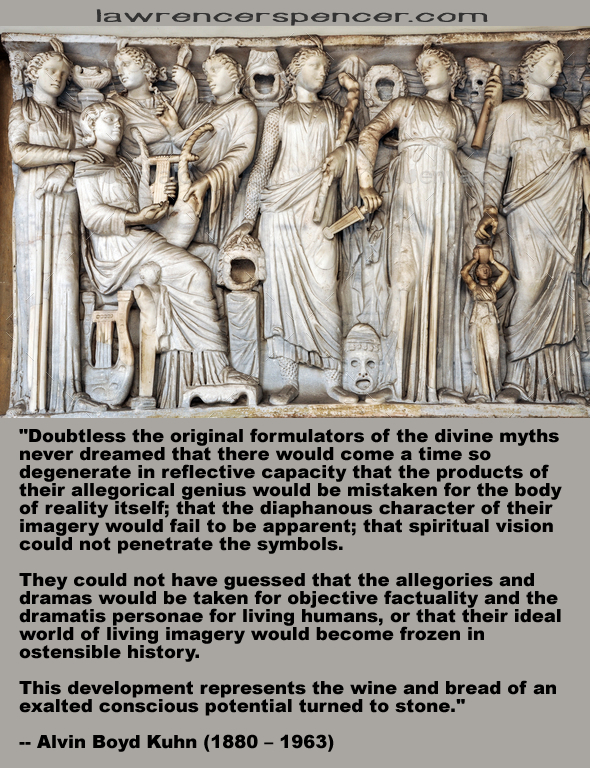 “Doubtless the original formulators of the divine myths never dreamed that there would come a time so degenerate in reflective capacity that the products of their allegorical genius would be mistaken for the body of reality itself; that the diaphanous character of their imagery would fail to be apparent; that spiritual vision could not penetrate the symbols. They could not have guessed that the allegories and dramas would be taken for objective factuality and the dramatis personae for living humans, or that their ideal world of living imagery would become frozen in ostensible history. This development represents the wine and bread of an exalted conscious potential turned to stone.” — Alvin Boyd Kuhn
—- —-
“Alvin Boyd Kuhn (September 22, 1880 – September 14, 1963) was an American Theosophist. A publisher who wrote books that he published himself and a lecturer, he was a proponent of the Christ myth theory.
Born in Franklin County, Pennsylvania, Kuhn studied the Ancient Greek language at university. He obtained his B.A. in 1903 and started his career working as a language teacher in high schools. He enrolled in summer sessions at Columbia University in 1926 and 1927, and then quit teaching to devote to full-time studies in 1927. His thesis, Theosophy: A Modern Revival of the Ancient Wisdom was, according to Kuhn, the first instance in which an individual has been “permitted” by any modern American or European university to obtain his doctorate with a thesis on Theosophy. Kuhn later expanded his thesis into his first book of the same name in 1930. After obtaining his Ph.D. in 1931, he returned to teaching for one year, but then spent the next 30 years writing, lecturing, and running his own publishing house, Academy Press in Elizabeth, New Jersey.
Highly influenced by the work of Gerald Massey and Godfrey Higgins, Kuhn contended that the Bible derived its origins from other Pagan religions and much of Christian history was pre-extant as Egyptian mythology. He also proposed that the Bible was symbolic and did not depict real events.” — Wikipedia.org
Republished by Blog Post Promoter

Republished by Blog Post Promoter
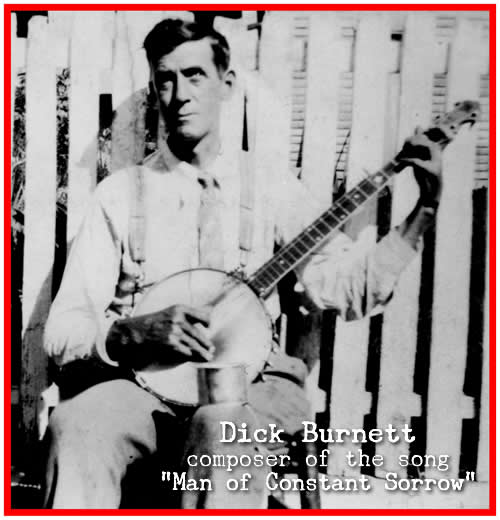
MAN OF CONSTANT SORROW is one of my favorite songs. It communicates the very real pain that all of the citizens of our Earthly prison experience, to a greater or lesser degree. The song was originally recorded by Burnett as “Farewell Song” printed in a Richard Burnett songbook, c. 1913.
Written by Richard (Dick) Burnett (October 8, 1883 – January 23, 1977) was an American folk songwriter from Kentucky. Burnett was born near Monticello, Kentucky. He was known to play the banjo and guitar and was blind in one eye. Burnett allegedly wrote the traditional American folk song, Man of Constant Sorrow, which was later to be covered by Bob Dylan. He recorded with fiddler Leon Rutherford for Columbia Records. An early version was recorded by Emry Arthur in 1928.
The following are subsequent “covers” of the song:
Ralph Stanley (Solo version (cover)) http://youtu.be/fLKltv26-00
Stanley Brothers (cover) http://youtu.be/ldnZnjGBGXw
Original Lyrics to “Farewell Song” (Man of Constant Sorrow)
I am a man of constant sorrow,
I’ve seen trouble all of my days;
I’ll bid farewell to old Kentucky,
The place where I was born and raised.
Oh, six long year [sic] I’ve been blind, friends.
My pleasures here on earth are done,
In this world I have to ramble,
For I have no parents to help me now.
So fare you well my own true lover,
I fear I never see you again,
For I’m bound to ride the Northern railroad,
Perhaps I’ll die upon the train.
Oh, you may bury me in some deep valley,
For many year [sic] there I may lay.
Oh, when you’re dreaming while you’re slumbering
While I am sleeping in the clay.
Oh, fare you well to my native country,
The place where I have loved so well,
For I have all kinds of trouble,
In this vain world no tongue can tell.
Dear friends, although I may be a stranger,
My face you may never see no more;
But there’s a promise that is given,
Where we can meet on that beautiful shore.
________________________________________________
Dick Burnett Biography on Wikipedia.org
Burnett was born near Monticello, Kentucky. He was known to play the banjo and guitar and was blind in one eye. Burnett was born near the end of the nineteenth century on October 8, 1883, in the area around the head of Elk Springs, about seven miles north of Monticello. He remembered little of his farming parents. His father died when he was only four and his mother died when he was twelve. Burnett did say that his mother told him how his father would carry him in his arms when he was only four years old and he would help his dad sing. It is notable that Burnett’s grandparents were of German and English descent and that particular ancestral influence would be instrumental in forming Burnett’s musical career. At seven-years-old, Burnett was playing the dulcimer; at nine he was playing the banjo, and at thirteen he had learned to play the fiddle.
Richard Burnett’s life took a drastic turn in early adulthood when he was attacked by a robber, shot in the face, and lost his eyesight. He was working in the oil field of central Kentucky, married with a young child, and now faced an uncertain future. Almost prophetically, his boss made the following statement to Burnett: “Well, you can still make it; you can make it with your music.”
In time, Burnett joined forces with a young fourteen-year-old orphaned boy from Somerset. That young boy, Leonard Rutherford, would become Burnett’s student and became one of the “smoothest” fiddle players known to come from Kentucky.
Richard Burnett, “blind minstrel of Monticello” and Leonard Rutherford, “one of the smoothest fiddlers ever to take a bow,” soon were singing at every opportunity. They appeared on courthouse lawns and on the street playing and singing their music. In order to earn some money, Richard would strap a tin cup to his knee to collect the contributions from a satisfied crowd.
They traveled by bus, Model A, and on foot to any place they could and sing. From about 1914 until 1950, the pair became so popular that they found themselves in the company of most all the popular mountain musicians of the time. They were “at home” in the presence of greats like the Carter Family, Charlie Oaks, Arthur Smith, and many others. They appeared at the Renfro Valley Barn Dance, on radio stations in Cincinnati, and finally, they would be some of the first old-time musicians to enter the recording studios.
Burnett and Rutherford made their first commercial recording in 1926 for Columbia Records in Atlanta, Georgia. “They gave us sixty dollars a record and paid all our expenses from here to Atlanta and back, hotel bills and everything,” Burnett reminisced. This unique banjo-fiddle-playing team, at times joined by banjoist W.L. Gregory and his fiddle-playing brother Jim, also of Monticello, continued to record for Columbia (and Gennett as well), through 1930.
Many of the songs Burnett and Rutherford used in their performances were songs they had learned from others in the past. When Burnett was asked where he learned some the old songs he recorded, he indicated some of them came from “Negroes around playing old time music” in Wayne County. He mentioned “Bled Coffey here in town, he was a fiddler during the Civil War, and the Bertram boys here, Cooge Bertram was a good fiddler…..Yes sir, there were a lot of black men playing old-time music. Bled Coffey was the best fiddler in the country.”
Burnett was a prolific songwriter as well as an instrumentalist. Possibly his most well known song is the popular “Man Of Constant Sorrow” that found notoriety in the movie, “O Brother, Where Art Thou.” On one occasion when asked if he wrote the song, Burnett replied: “No, I think I got that ballet from somebody—I dunno. It may be my song…..”
It has been correctly observed about Richard Burnett: “He was a valuable link to country music’s folk past and was a repository of material which he had both preserved and rewritten: “Pearl Bryan,” “Short Life of Trouble,” “Weeping Willow Tree,” “Little Stream of Whisky,” and many other ballads known to all folk revivalists.” The team certainly deserves the title of “one of the most colorful and rewarding groups of the 1920s.”
Richard Burnett died in Somerset, Kentucky on January 23, 1977, probably without ever realizing the great influence he had in the field of old-time Appalachian music.