Republished by Blog Post Promoter

Free Advice about Life, Universe and Other Stuff from Lawrence R. Spencer
Republished by Blog Post Promoter
Republished by Blog Post Promoter
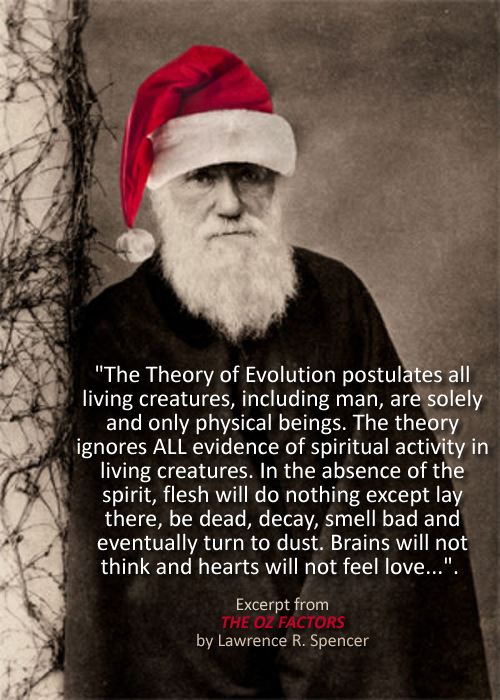
“The Theory of Evolution postulates all living creatures, including man, are solely and only physical beings. The theory ignores ALL evidence of spiritual activity in living creatures. In the absence of the spirit, flesh will do nothing except lay there, be dead, decay, smell bad and eventually turn to dust. Brains will not think and hearts will not feel love…”.
_____________________________________
“The celebration of Christmas, held during the Winter Solstice to commemorate the birthday of Jesus was adapted from a variety of pagan cults. The celebration of the Roman holiday season of “Saturnalia”, for the god Saturn, was adapted to become Christmas in 336 AD. Saturnalia was a festival during which Roman slaves were given control of the household for one day each year. The festival was held between December 17th and 23rd during which families feasted together, slaves were given time off and presents were exchanged.”
Excerpts from THE OZ FACTORS by Lawrence R. Spencer

Republished by Blog Post Promoter
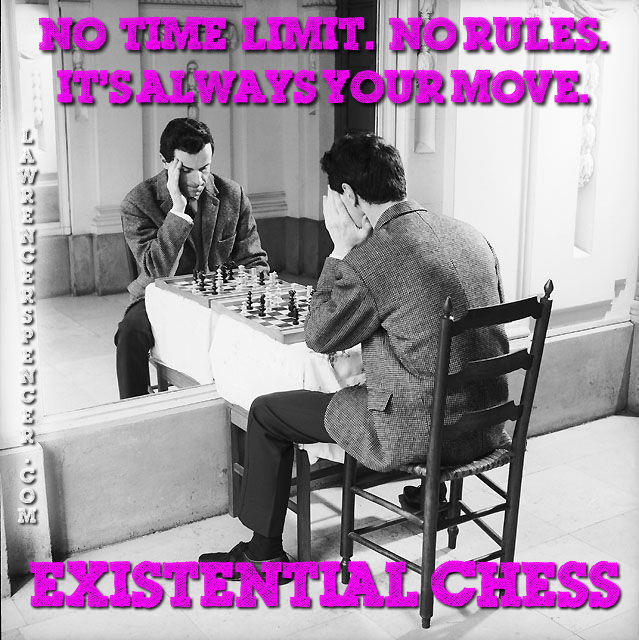
A central proposition of existentialism is that existence precedes essence, which means that the actual life of the individual is what constitutes what could be called his or her “essence” instead of there being a predetermined essence that defines what it is to be a human. Thus, human beings – through their own consciousness – create their own values and determine a meaning to their life. Although it was Sartre who explicitly coined the phrase, similar notions can be found in the thought of many existentialist philosophers from Kierkegaard to Heidegger.
It is often claimed in this context that a person defines himself or herself, which is often perceived as stating that they can wish to be something — anything, a bird, for instance — and then be it. According to most existentialist philosophers, however, this would constitute an inauthentic existence. Instead, the phrase should be taken to say that the person is (1) defined only insofar as he or she acts and (2) that he or she is responsible for his or her actions. For example, someone who acts cruelly towards other people is, by that act, defined as a cruel person. Furthermore, by this action of cruelty, such persons are themselves responsible for their new identity (a cruel person). This is as opposed to their genes, or ‘human nature’, bearing the blame.
As Sartre writes it in his work Existentialism is a Humanism: “man first of all exists, encounters himself, surges up in the world – and defines himself afterwards.” Of course, the more positive, therapeutic aspect of this is also implied: A person can choose to act in a different way, and to be a good person instead of a cruel person. Here it is also clear that since humans can choose to be either cruel or good, they are, in fact, neither of these things essentially.
The notion of the Absurd contains the idea that there is no meaning to be found in the world beyond what meaning we give to it. This meaninglessness also encompasses the amorality or “unfairness” of the world. This contrasts with “karmic” ways of thinking in which “bad things don’t happen to good people”; to the world, metaphorically speaking, there is no such thing as a good person or a bad thing; what happens happens, and it may just as well happen to a “good” person as to a “bad” person.
Because of the world’s absurdity, at any point in time, anything can happen to anyone, and a tragic event could plummet someone into direct confrontation with the Absurd. The notion of the absurd has been prominent in literature throughout history. Many of the literary works of Søren Kierkegaard, Franz Kafka, Fyodor Dostoyevsky, Jean-Paul Sartre, and Albert Camus contain descriptions of people who encounter the absurdity of the world.
It is in relation to the concept of the devastating awareness of meaninglessness that Albert Camus claimed that “there is only one truly serious philosophical problem, and that is suicide” in his The Myth of Sisyphus. Although “prescriptions” against the possibly deleterious consequences of these kinds of encounters vary, from Kierkegaard’s religious “stage” to Camus’ insistence on persevering in spite of absurdity, the concern with helping people avoid living their lives in ways that put them in the perpetual danger of having everything meaningful break down is common to most existentialist philosophers. The possibility of having everything meaningful break down poses a threat of quietism, which is inherently against the existentialist philosophy.
Read more about EXISTENTIALISM at Wikipedia.org
Republished by Blog Post Promoter
more thoughts from Sri Nisargadatta Maharaj (17 April 1897 – 8 September 1981):
“My Guru ordered me to attend to the sense ‘I am’ and to give attention to nothing else. I just obeyed. I did not follow any particular course of breathing, or meditation, or study of scriptures. Whatever happened, I would turn away my attention from it and remain with the sense ‘I am’. It may look too simple, even crude. My only reason for doing it was that my Guru told me so. Yet it worked!”
“Give up all questions except one, “Who am I?” After all the only fact you are sure of is that you “are”. The “I am” is certain, the “I am this” is not. Struggle to find out what you are in reality. “
“Be content with what you are sure of. And the only thing you can be sure of is “I am”. Stay with it and reject everything else. This is Yoga.”
“Love says: “I am everything”. Wisdom says: “I am nothing”. Between the two my life flows.”
“To deal with things, knowledge of things is needed. To deal with people, you need insight, sympathy. To deal with yourself, you need nothing. Be what you are — conscious being — and don’t stray away from yourself.”
Republished by Blog Post Promoter
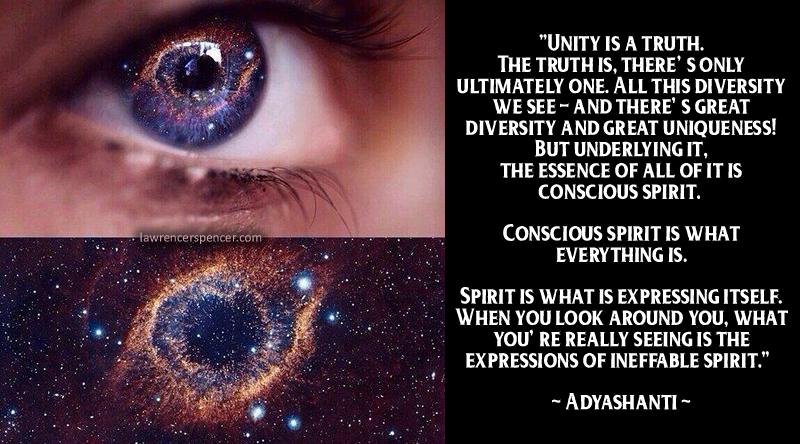
Adyashanti ( Sanskrit word आध्या शान्तिः meaning “primordial peace”; born Steven Gray on October 26, 1962) is an American spiritual teacher and author from the San Francisco Bay Area who offers talks, online study courses, and retreats in the United States and abroad. He is the author of numerous books, CDs and DVDs and, together with his wife Mukti, is the founder of Open Gate Sangha, Inc., a nonprofit organization established in 1996 which supports and makes available his teachings.