Category Archives: ART

Paintings, photography, aesthetic objects, beautiful communication, and anything I consider to be art, artful, artistic, artsy or whatever.
Art is subjective. It is a quality of communication can be contributed to by the viewer through empathy or agreement with its creator.

PRESCIENT ESCHATOLOGY

Republished by Blog Post Promoter
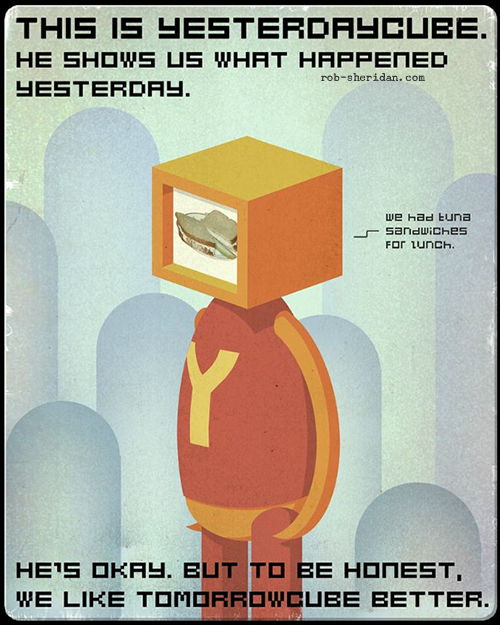
Yesterday-CubeSome years ago I undertook the study of a heretofore unknown “science” which I named  “Prescient Eschatology”.  Being the inventor and first practitioner of this new “science”, I endowed myself with the honorary title ofDoctor of Prescient Eschatology“.  My first action of “predicting the future” was that I would become a student and professor of this new philosophical / theological / ontological / logical discipline.  Although highly esoteric in nature, the subject has maintained a vast appeal to nearly all of humanity throughout it’s brief history on Earth.  Everyone wants to know the past and predict or create the future!

Pre·scient  /ˈpreSH(ē)ənt/ Adjective  — Having or showing knowledge of events before they take place.

Eschatology  (from the Greek eschatos/eschatē/eschaton meaning “last” and -logy meaning “the study of”, first used in English around 1550)  is a part of theology, physics, philosophy, and futurology concerned with what are believed to be the final events of history, the ultimate destiny of humanity.  In the context of mysticism, the phrase refers metaphorically to the end of ordinary reality and reunion with the Divine.

The most obvious point of departure for the student into the subject of Prescient Eschatology is the fundamental understanding that time in the physical universe is an “eternal now”.  For the practical purposes of my study I use the following definitions:

A)  Time is a measurement of the motion and change of position of objects in space within the eternal now of the physical universe.

B)   The future is a logical extension of:

1) volition (the act or power of making choices or decisions) and   2) momentum (the product of the mass and velocity of an object) within the eternal now of existence in the physical universe.

Therefore, if we want to predict, change or create a future we must understand and/or alter volition and momentum by any means that can be effected on them.  The means and methods of creating a future are nearly infinite in an eternal now of possibilities.

As for the “past”, time travel, changing the past, memory of the past, etc., these are a discussion of “subjective reality” or personal opinion.   The “past” is entirely dependent upon the experience and opinion (whether agreed upon or not) from the unique point of view of each individual observer of the motion of objects in space, i.e. time.  The study of “time travel” is the singular topic of interest for which I have become a member of the highly exclusive and secretive society: THE ORDER OF OMEGA TIME TRAVEL CULT.   Should anyone be interested in becoming a member of this highly esoteric organization, please inquire using the contract procedures available through this Blog.

Enjoy The Journey of The Eternal Now!
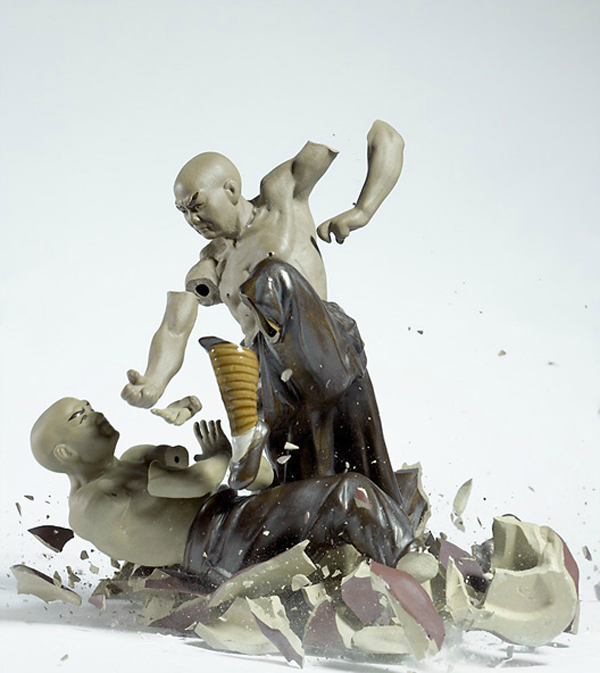
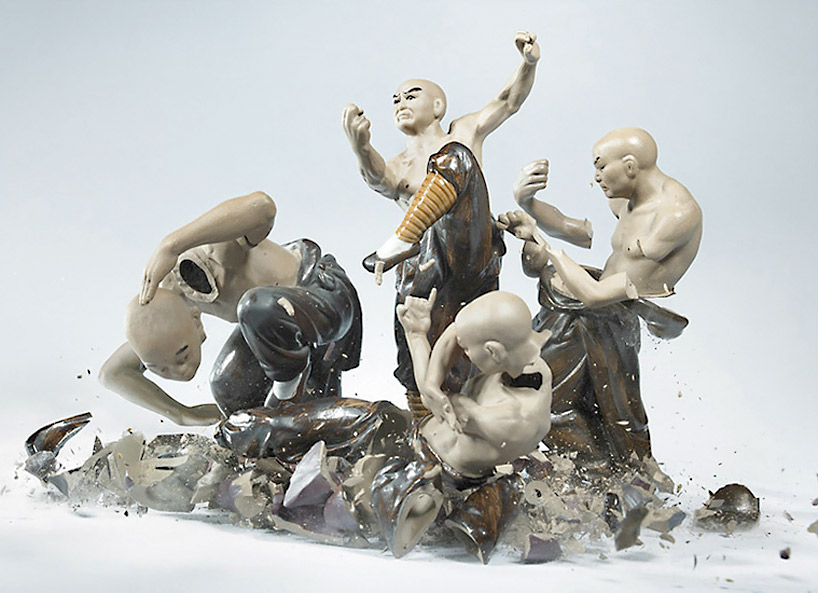
KRASHING KARATE KICKS

Republished by Blog Post Promoter

“From a height of three meters, porcelain figurines are dropped on the ground, and the sound they make when they hit trips the camera shutter release.

The result: razor-sharp images of disturbing beauty—temporary sculptures made visible to the human eye by high-speed photography technology.”

This is the official statement that accompanies Martin Klimas‘ fourth photographic collection Porcelain Figurines.

36 VIEWS

Republished by Blog Post Promoter

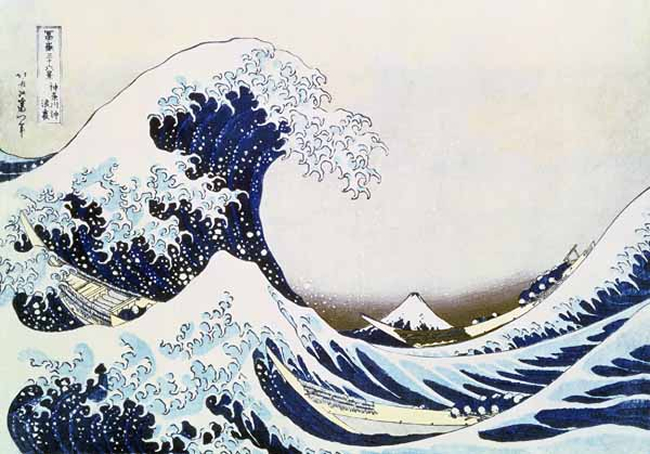
Hokusai - The Great Wave

Katsushika Hokusai (葛飾 北斎?, October 31, 1760 (exact date questionable) – May 10, 1849) was a Japanese artist, ukiyo-e painter and printmaker of the Edo period.[1] He was influenced by such painters as Sesshu, and other styles of Chinese painting.[2] Born in Edo (now Tokyo), Hokusai is best known as author of the woodblock print series Thirty-six Views of Mount Fuji which includes the internationally recognized print, The Great Wave off Kanagawa, created during the 1820s.  Thirty-six Views of Mount Fuji is an ukiyo-e series of large, color woodblock prints (1760–1849). The series depicts Mount Fuji in differing seasons and weather conditions from a variety of different places and distances.

In the artistic technique of creating a “woodblock print”, the text or image was first drawn onto washi (Japanese paper), then glued onto a plank of wood, usually cherry. Wood was then cut away, based on the drawing outlines. A small wooden hard object called a baren was used to press or burnish the paper against the inked woodblock to apply the ink to the paper. Although this may have been done purely by hand at first, complex wooden mechanisms were soon invented and adopted to help hold the woodblock perfectly still and apply proper pressure in the printing process.  (Wikipedia.org)

See ALL 36 views of Mt. Fuji by Hokusai on this link:  http://en.wikipedia.org/wiki/Thirty-six_Views_of_Mount_Fuji

ANAGRAMS

Republished by Blog Post Promoter


Anagram (AN-uh-gram)    noun: A word or phrase formed by rearranging the letters of another word or phrase.  verb: To rearrange letters in such a way. To anagrammatize.    [From Greek anagrammatismos, ana- (up, again, back, new) + -gram (letter).

 Examples of Anagrams:

Sherlock Homes = Crooks Hell Mesh

Dormitory = Dirty Room

Dictionary = Indicatory

Schoolmaster = The classroom

Elvis = Lives

Listen = Silent

Clint Eastwood = Old West Action

Mother-in-law = Woman Hitler

President Barack Hussein Obama: a maniac presides. the banks rob u

William Shakespeare: I’ll make a wise phrase

Jay Leno: Enjoy L.A.

Gene Simmons: Immense Song

Motley Crue: Me Cruel Toy

The Morse Code = Here Come Dots

The eyes = They see

Barbie doll = Liberal bod

Here are some practical uses of anagrams:

Informal encryption  Replace each word (or line) of your document with its anagram. Of course, it doesn’t give you military-grade encryption but for most informal applications, anagrams are serviceable.

Also Newton supposedly used an anagram in describing calculus in a letter to Leibniz. See this and the book A Passion for Mathematics: Numbers, Puzzles, Madness, Religion, and the Quest for Reality (page 30).

Generating passwords  It’s a good idea to have a separate password for each email account, online account, etc. What’s difficult is having to remember all those passwords. Try using various anagrams of your favorite word or phrase as passwords.

Generating mnemonics
Divination  Not sure of the best course of action? Whether to major in computer science or in philosophy at college… whether to start a comics store or a pet-sitting business? Let anagrams serve as your oracle. For example, if your name is Joe Smith, try anagramming “Joe Smith philosophy” and “Joe Smith computer science”, and see what anagrams divine for you. Try these tips for finding great anagrams.

Securely recording secret numbers (by Brian Thompson)  Never keep a copy of your pin number, membership number, online banking pass number … So we are advised. I find it impossible to remember strings of numbers, but like most people, I find that a memorable phrase is easily recalled. Your number is tied to a phrase (Subject) which is anagrammed. The resulting permutation of the number string may then be written down with the Subject. You need only remember the anagram!

HAVE SOME FUN MAKING YOUR OWN ANAGRAMS:  http://wordsmith.org/anagram/index.html