Republished by Blog Post Promoter
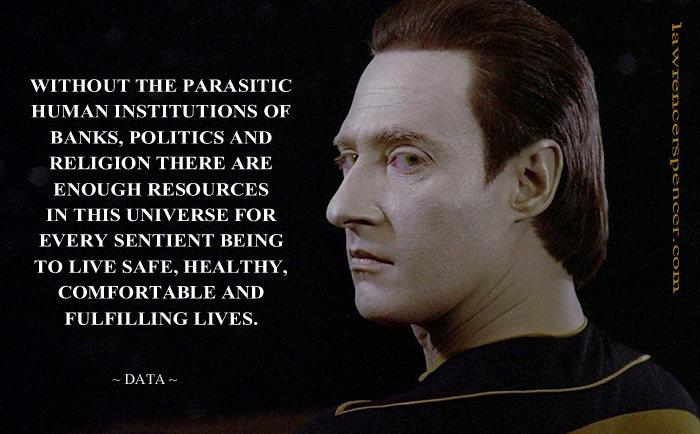 WITHOUT THE PARASITIC HUMAN INSTITUTIONS OF BANKS, POLITICS AND RELIGION THERE ARE ENOUGH RESOURCES IN THIS UNIVERSE FOR EVERY SENTIENT BEING TO LIVE SAFE, HEALTHY, COMFORTABLE AND FULFILLING LIVES.
~ DATA ~

Republished by Blog Post Promoter
WITHOUT THE PARASITIC HUMAN INSTITUTIONS OF BANKS, POLITICS AND RELIGION THERE ARE ENOUGH RESOURCES IN THIS UNIVERSE FOR EVERY SENTIENT BEING TO LIVE SAFE, HEALTHY, COMFORTABLE AND FULFILLING LIVES.
~ DATA ~
Republished by Blog Post Promoter
 photo art by bugdown
IF YOU HAVE HIDDEN ANGER INSIDE, IT MEANS THAT SOMEONE NEAR IS ATTACKING YOU. THEY MAY BE HIDDEN FROM VIEW. SOMETIMES THEY’RE IN PLAIN SIGHT.
DO THE FOLLOWING:
FIND OUT WHO THEY ARE.
THEN, HANDLE THEM SO THEY CAN’T HARM YOU.
OR, GET AWAY FROM THEM. (OR BOTH)
YOU’LL KNOW WHO WHEN YOU START FEELING HAPPIER WHEN THEY’RE OUT OF YOUR LIFE!
YOU HAVE THE RIGHT TO BE HAPPY!
Republished by Blog Post Promoter
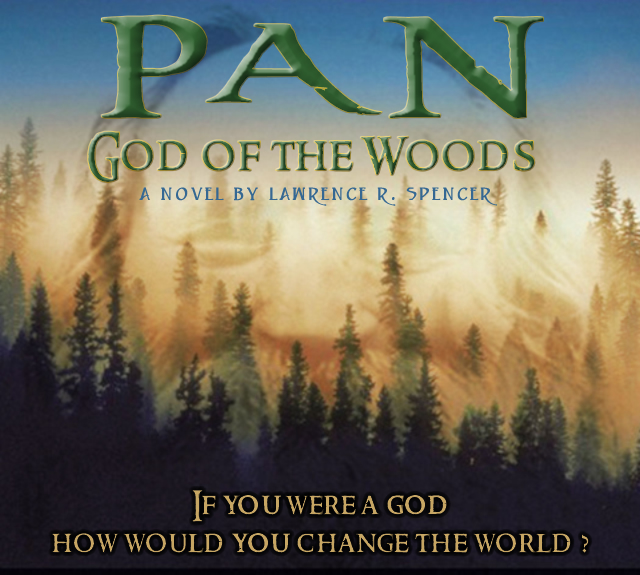
“When Zeus still ruled Olympus, the face of Mother Nature was puerile, the bright blue sea and sky shined brightly in Her eyes. Life, abundantly renewed, abounded from Her virgin womb. The myriad creatures flourished, safe and suckling on Her verdant breasts while fishes filled the pristine waters of Her world.
In those primal days, gods of ancientSumeria,Egypt,Greece,China,India, and many other civilizations of Earth, commanded extraordinary power over men. Spirits were conceived to permeate all matter and space in the ancient world. The gods, however, were not much different than each of us as spiritual beings, except to the degree they were immortal, that is, free from having to inhabit a body. Mortals were condemned to repeat the cycle of birth and death and rebirth into carnal form. Release of the spirits of men from the endless cycle of reincarnation remains the ultimate goal of many world religions to this day.
Gods actively intervened in the affairs of Mankind. Some made their presence known in the form of an animal, as an aura of light or scent, or as an apparition in nature. More often, the gods pervaded the body and mind of a man or woman, either in a dream or simply by taking over their thoughts to carry out their plans.
Since the gods were seen to cause events, both natural and supernatural, they were intimately personified, widely idolized, and artfully glorified by men. Aristocracy, citizens and slaves alike, sought the blessing or advice of the gods regarding marriage, travel, war, purchases, planting, harvesting, building, birth and death. Every village, district and nation had its own retinue of gods. A discreet traveler was wise to observe the rites accorded to the local deities and religious tolerance was widespread.
A vast number of myths or stories about the exploits of the gods have passed down to us through the generations of Mankind from nearly every society of antiquity. Culturally, we have inherited tremendous works of art, poetry, literature, and tradition derived from human interaction with the immortals. The pagan cultural tradition, religious beliefs, and practices associated with the gods still permeate our language, social and religious customs today.
With the advent of the Christian church 2,000 years ago, communication with the pagan gods was very heavily suppressed in Western civilization. Priests had a vested interest in eliminating religious competition, by any means required, including, but not limited to lying, stealing, cheating, murder, mayhem, extortion, torture and blackmail. This included outlawing all pagan religions and the destruction of all pagan temples and schools throughout theRoman Empireby the decree of Emperor Justinian in the third century AD. As a result, general public attention to the pagan gods disappeared.
Yet, the gods are active, living beings, who may only appear to have disappeared! If any of the ancient gods are still around in the 21st century, what are they doing now? If they are here now — still watching, still powerful, still immortal — where or how might we contact them? “
___________________________________________________
Excerpt from the Introduction to PAN-GOD OF THE WOODS, by Lawrence R. Spencer

Republished by Blog Post Promoter
 Kurt Vonnegut, Jr. — ( November 11, 1922 – April 11, 2007) was an American writer. In a career spanning over 50 years, Vonnegut published 14 novels, three short story collections, five plays, and five works of non-fiction. He is most famous for his darkly satirical, best-selling novel Slaughterhouse-Five (1969).
Born and raised in Indianapolis, Indiana, Vonnegut attended Cornell University, but dropped out in January 1943 and enlisted in the United States Army. As part of his training, he studied mechanical engineering at Carnegie Institute of Technology (now Carnegie Mellon University) and the University of Tennessee. He was then deployed to Europe to fight in World War II, and was captured by the Germans during the Battle of the Bulge. He was interned in Dresden and survived the Allied bombing of the city by taking refuge in a meat locker of the slaughterhouse where he was imprisoned. After the war, Vonnegut married Jane Marie Cox, with whom he had three children. He later adopted his sister’s three sons, after she died of cancer and her husband died in a train accident.
 Vonnegut published his first novel, Player Piano, in 1952. The novel was reviewed positively, but was not commercially successful. In the nearly 20 years that followed, Vonnegut published several novels that were only marginally successful, such as Cat’s Cradle (1963) and God Bless You, Mr. Rosewater (1964). Vonnegut’s magnum opus, however, was his immediately successful sixth novel, Slaughterhouse-Five. The book’s antiwar sentiment resonated with its readers amidst the ongoing Vietnam War, and its reviews were generally positive. After its release, Slaughterhouse-Five went to the top of The New York Times Best Seller list, thrusting Vonnegut into fame. He was invited to give speeches, lectures, and commencement addresses around the country and received many awards and honors.
Later in his career, Vonnegut published several autobiographical essays and short-story collections, including Fates Worse Than Death (1991), and A Man Without a Country (2005). After his death, he was hailed as a morbidly comical commentator on the society in which he lived, and as one of the most important contemporary writers. Vonnegut’s son Mark published a compilation of his father’s unpublished compositions, titled Armageddon in Retrospect. Numerous scholarly works have examined Vonnegut’s writing and humor.
Republished by Blog Post Promoter

“Love” is not a good word. I don’t like it because it has too many different definitions! Most of the time people use this word in a sexual context, which is a very small and limited definition. So, I spent a little time to study the different definitions of “love”. Here is what I found out:
Here is the dictionary definition of “love”:
1 a (1) : strong affection for another arising out of kinship or personal ties < maternal love for a child > (2) : attraction based on sexual desire : affection and tenderness felt by lovers (3) : affection based on admiration, benevolence, or common interests < love for his old schoolmates >
b : an assurance of affection < give her my love >
2 : warm attachment, enthusiasm, or devotion < love of the sea >
3 a : the object of attachment, devotion, or admiration < baseball was his first love >
b (1) : a beloved person : darling —often used as a term of endearment (2) British —used as an informal term of address
4 a : unselfish loyal and benevolent concern for the good of another: as (1) : the fatherly concern of God for humankind (2) : brotherly concern for others
b : a person’s adoration of God
5 : a god or personification of love
The origin of the word “love” in English is from the Old English word lufu; akin to Old High German luba, or Old English lēof (dear), Latin lubēre, libēre, which means “to please”.
The Greeks used the word “agape” to express a purely spiritual love.
The word “Platonic” is Intellectual love, like the love of Art, or Beauty, or love of Learning, etc… This also applies to a genuine affinity or admiration between non-sexual relationships, as between friends, or companions.
“Amorous” and the Greek word “Eros” (erotic) are words for sexual or romantic love. For example, it is very easy for sexual partners to feel “amorous” toward each other, which is simply the “attraction” or “chemistry” caused by the biological programs inherent in many life forms. However, this does necessarily include a perception or understanding that there are spiritual beings inhabiting the bodies of the “love makers”.
The word “affinity”, which is the perception of how CLOSE or how DISTANT one feels emotionally, intellectually, spiritually or physically toward a thing, a being, or subject, or idea is a more accurate definition for non-sexual “love”. The CLOSEST that two entities can BE is to BE THE SAME, i.e. there is NO Distance between them.
In the book Alien Interview, the UFO pilot, Airl, uses the word “admiration”, which she says Is-Bes all desire more than ANY other quality.
“Another common denominator of IS-BEs (spiritual beings) is that admiration of one’s own illusions by others is very desirable. If the desired admiration is not forthcoming, the IS-BE will keep creating the illusion in an attempt to get admiration.”
Admiration means:
1 archaic : wonder
2 : an object of esteem
3 : delighted or astonished approbation
4: : a feeling of great respect and approval
There are words like “devotion” and “adoration” or “worship” that express a very intense “admiration” that contain “reverence”, “honor” or “respect”.
Then there are the concepts of “care” and “compassion” and “benevolence” which are often used for the feeling or emotion of mother and child, or between friends and companion, or by an individual for other members of their own race, or for life forms, or the universe at large.
This may be a quality of “love” of god for its own creations. This necessarily implies the willingness and ability to be Responsible for the creation and continued existence of what has been created. This kind of “love” may be all-pervasive, and eternal.
Ultimately, each individual has a personal experience, feeling or understanding of what “love” means for them. There may be as many definitions of “love” as there are beings who create or experience it.
— Lawrence R. Spencer. 2014.