Republished by Blog Post Promoter

If you were born here (on Earth) you’re a prisoner. This is why “they” promise you can “leave” if you are “good” and follow “the rules”.
Ask yourself a question: Who are “they”?

Republished by Blog Post Promoter
If you were born here (on Earth) you’re a prisoner. This is why “they” promise you can “leave” if you are “good” and follow “the rules”.
Ask yourself a question: Who are “they”?
Republished by Blog Post Promoter
 from Huffington Post UK | By Michael Rundle —
“Physicists say they may have evidence that the universe is a computer simulation. How? They made a computer simulation of the universe. And it looks sort of like us.
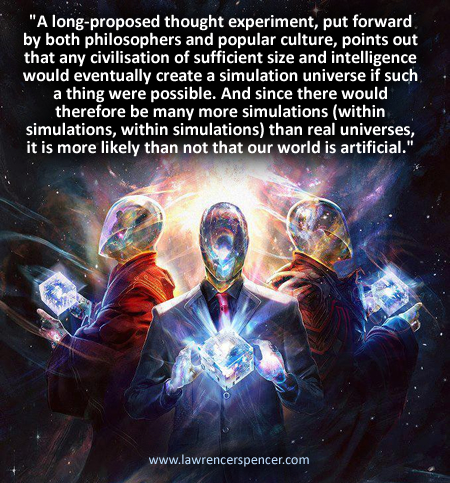
A long-proposed thought experiment, put forward by both philosophers and popular culture, points out that any civilization of sufficient size and intelligence would eventually create a simulation universe if such a thing were possible.
And since there would therefore be many more simulations (within simulations, within simulations) than real universes, it is therefore more likely than not that our world is artificial.
Now a team of researchers at the University of Bonn in Germany led by Silas Beane say they have evidence this may be true.
In a paper named ‘Constraints on the Universe as a Numerical Simulation’, they point out that current simulations of the universe – which do exist, but which are extremely weak and small – naturally put limits on physical laws.
Technology Review explains that “the problem with all simulations is that the laws of physics, which appear continuous, have to be superimposed onto a discrete three dimensional lattice which advances in steps of time.”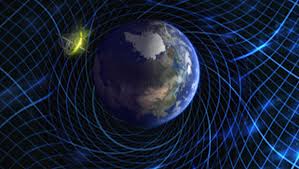
What that basically means is that by just being a simulation, the computer would put limits on, for instance, the energy that particles can have within the program.
These limits would be experienced by those living within the sim – and as it turns out, something which looks just like these limits do in fact exist.
For instance, something known as the Greisen-Zatsepin-Kuzmin, or GZK cut off, is an apparent boundary of the energy that cosmic ray particles can have. This is caused by interaction with cosmic background radiation. But Beane and co’s paper argues that the pattern of this rule mirrors what you might expect from a computer simulation.
 Naturally, at this point the science becomes pretty tricky to wade through – and we would advise you read the paper itself to try and get the full detail of the idea.
But the basic impression is an intriguing one. Like a prisoner in a pitch-black cell, we may never be able to see the ‘walls’ of our prison — but through physics we may be able to reach out and touch them.”
For details of how a universal computer simulation could be a reality read the book ALIEN INTERVIEW
Republished by Blog Post Promoter

 “A human being is the literal embodiment of mortality. The flesh is a prison for the Being. The Earth is a prison for the body: a prison within a prison for a Soul, carefully concealed in Mystery. An object animated by a Soul that thinks that it is the object is the ultimate accomplishment of the trade and technology of The Mortality Mechanic.”

Republished by Blog Post Promoter
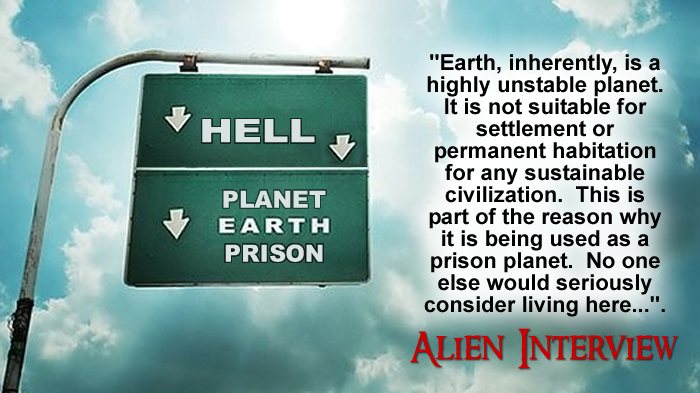
“…Earth, inherently, is a highly unstable planet. It is not suitable for settlement or permanent habitation for any sustainable civilization. This is part of the reason why it is being used as a prison planet. No one else would seriously consider living here for a variety of simple and compelling reasons:
1) The continental land masses of Earth are floating on a sea of molten lava beneath the surface which causes the land masses to crack, crumble and drift continually. [i] (Footnote)
2) Because of the liquid nature of the core, the planet is largely volcanic and subject to earthquakes and volcanic explosions.
3) The magnetic poles of the planet shift radically about once every 20,000 years. [ii] (Footnote) This causes a greater or lesser degree of devastation as a result of tidal waves, and climatic changes.
4) Earth is very distant from the center of the galaxy and from any other significant galactic civilization. This isolation makes it unsuitable for use, except as a “pit stop” or jumping off point along the way between galaxies. The moon and asteroids are far more suitable for this purpose because they do not have any significant gravity.
5) Earth is a heavy gravity planet, with heavy metallic soil and a dense atmosphere. This makes it treacherous for navigational purposes. That fact that I am in this room, as the result of an in flight accident, in spite of the technology of my craft and my extensive expertise as a pilot, are proof of these facts.”
— Excerpted from the book ALIEN INTERVIEW, edited by Lawrence R. Spencer
 FOOTNOTES:
[i] “The land masses continually crack, crumble and drift.”
“Plate tectonics (from Greek τέκτων, tektōn “builder” or “mason”) is a theory of geology that has been developed to explain the observed evidence for large scale motions of the Earth’s lithosphere. The theory encompassed and superseded the older theory of continental drift from the first half of the 20th century and the concept of seafloor spreading developed during the 1960s.
The outermost part of the Earth’s interior is made up of two layers: above is the lithosphere, comprising the crust and the rigid uppermost part of the mantle. Below the lithosphere lies the asthenosphere. Although solid, the asthenosphere has relatively low viscosity and shear strength and can flow like a liquid on geological time scales. The deeper mantle below the asthenosphere is more rigid again. This is, however, not because of cooler temperatures but due to high pressure.
The lithosphere is broken up into what are called tectonic plates — in the case of Earth, there are seven major and many minor plates. The lithospheric plates ride on the asthenosphere. These plates move in relation to one another at one of three types of plate boundaries: convergent or collision boundaries, divergent or spreading boundaries, and transform boundaries. Earthquakes, volcanic activity, mountain-building, and oceanic trench formation occur along plate boundaries. The lateral movement of the plates is typically at speeds of 5 – 10 centimeters / yr.”
— Reference: Wikipedia.org
[ii] “ The magnetic poles of the planet shift radically about once every 20,000 years”.
“The pole shift theory is a hypothesis that the axis of rotation of a planet has not always been at its present-day locations or that the axis will not persist there; in other words, that its physical poles had been or will be shifted. Pole shift theory is almost always discussed in the context of Earth, but other solar system bodies may have experienced axial reorientation during their existences.
Pole shift theories are not to be confused with plate tectonics, the well-accepted geological theory that the Earth’s surface consists of solid plates which shift over a fluid asthenosphere; nor with continental drift, the corollary to plate tectonics which maintains that locations of the continents have moved slowly over the face of the earth, resulting in the gradual emerging and breakup of continents and oceans over hundreds of millions of years.
Pole shift theories are also not to be confused with Geomagnetic reversal, the periodic reversal of the earth’s magnetic field (effectively switching the north and south magnetic poles). Geomagnetic reversal has more acceptance in the scientific community than pole shift theories.”
— Reference: Wikipedia.org
Republished by Blog Post Promoter
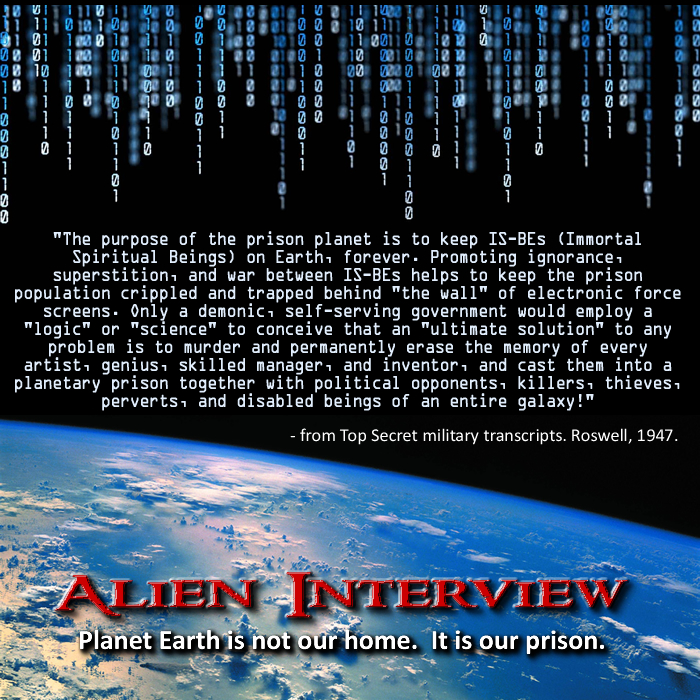
“The purpose of the prison planet is to keep IS-BEs (Immortal Spiritual Beings) on Earth, forever. Promoting ignorance, superstition, and war between IS-BEs helps to keep the prison population crippled and trapped behind “the wall” of electronic force screens.
Only a demonic, self-serving government would employ a “logic” or “science” to conceive that an “ultimate solution” to any problem is to murder and permanently erase the memory of every artist, genius, skilled manager, and inventor, and cast them into a planetary prison together with political opponents, killers, thieves, perverts, and disabled beings of an entire galaxy!
When an IS-BE is sent to Earth, and then tricked or coerced into operating in a biological body, they are actually in a prison, inside a prison.
…prison system is to prevent you from looking at your own soul. They fear that you will see in your own memory the slave masters who keep you imprisoned. The prison is made of shadows in your mind. The shadows are made of lies, and pain, and loss, and fear.”
— Excerpt from the book ALIEN INTERVIEW, edited by Lawrence R. Spencer