ILLUSIONS OF SENTIENCE

Republished by Blog Post Promoter
In the philosophy of consciousness, “sentience” can refer to the ability of any entity to have subjective perceptual experiences.  This is distinct from other aspects of the mind and consciousness, such as creativity, intelligence, sapience, self-awareness, and intentionality (the ability to have thoughts that mean something or are “about” something). Sentience is a minimalistic way of defining “consciousness“, which is otherwise commonly used to collectively describe sentience plus other characteristics of the mind.

Eastern religions including Hinduism, Buddhism, Sikhism, and Jainism recognize non-humans as sentient beings.According to Buddhism, sentient beings made of pure consciousness are possible. In Buddhism, the concept is related to the Bodhisattva, an enlightened being devoted to the liberation of others. The first vow of a Bodhisattva states: “Sentient beings are numberless; I vow to free them.”  Sentience in Buddhism is the state of having senses (sat + ta in Pali, or sat + tva in Sanskrit). In Buddhism, the senses are six in number, the sixth being the subjective experience of the mind. Thus, an animal qualifies as a sentient being.

In Buddhism the skandhas (or aggregates in English) are the five functions or aspects that constitute the human being.  The Buddha teaches that nothing among them is really “I” or “mine”.  Suffering arises when one identifies with or clings to an aggregate. Suffering is extinguished by relinquishing attachments to aggregates.

The five skandhas:

  1. “form” or “matter”  external and internal matter. Externally, is the physical world. Internally, this  includes the material body and the physical sense organs.
  2. “sensation” or “feeling”, sensing an objectas either pleasant or unpleasant or neutral.
  3. “perception”, “conception”, “apperception”, “cognition”, or “discrimination”, registers whether an object is recognized or not (for instance, the sound of a bell or the shape of a tree).
  4. “mental formations”, “impulses”, “volition”, or “compositional factors”, all types of mental habits, thoughts, ideas, opinions, prejudices, compulsions, and decisions triggered by an object.
  5. “consciousness” or “discernment”

The Buddhist literature describes the aggregates as arising in a linear or progressive fashion, from form to feeling, to perception, to mental formations to consciousness.  In the early texts, the scheme of the five aggregates is not meant to be an exhaustive classification of the human being. Rather it describes various aspects of the way an individual manifests.

  1. Understanding suffering: the five aggregates are the “ultimate referent” in the Buddha’s elaboration on suffering in his First Noble Truth: “Since all four truths revolve around suffering, understanding the aggregates is essential for understanding the Four Noble Truths as a whole.”
  2. Clinging causes future suffering: the five aggregates are the substrata for clinging and thus “contribute to the causal origination of future suffering”.
  3. Release from samsara: clinging to the five aggregates must be removed in order to achieve release from samsara, literally meaning “continuous flow”, is the repeating cycle of birth, life, death and rebirth (reincarnation)

— I HAVE EXCERPTED THE TEXT ABOVE FROM VARIOUS ARTICLES AND LINKS FOUND IN WIKIPEDIA.ORG  (LRS)

VESTED INTERESTS

Republished by Blog Post Promoter

“The river of human history is clogged with the putrid refuse of unworkable solutions to the mysteries and problems of Life: war, ruined civilizations, insanity, mental anguish, drugs, despair, murder, disease, criminality and starvation. We are victims of our individual and collective inability to find workable solutions to these unwanted conditions.

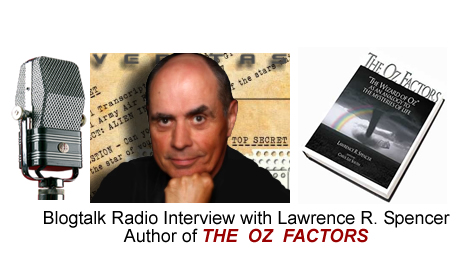
The Oz Factors, by Lawrence R. SpencerOur humanity has long since been exceeded by the power of the wicked witches of science and government to destroy all life with nuclear weapons, alter our DNA and control our minds with psychotropic drugs and our lives with media lies.

Our thoughts and conjectures about life and the universe are often based on assumptions, unproven theories, hearsay, rumors and misinformation. Decisions we make in life may be based on ancient attitudes and archaic practices. Marketing spin replaces honesty when the financial, political or religious vested interest of wizards and witches are more important than freedom, sanity and survival.

There are 12 common denominators that prevent observation, understanding, and workable solutions to problems of existence. How do each of these “Oz Factors” influence our history, science, philosophy, our lives and our future?   We can chose our own Yellow Brick Road. We can pull back the curtain of rhetoric and dogma. We can build a better Emerald City for ourselves and our children.

Do you really want to go back to Kansas?”

Definition: Vested Interest–1/ a survival or non-survival plan or agenda which has been “clothed” to make it seem like something other than what it actually is; 2/ any person, group or entity which prevents or controls communication to serve their own purposes.

Support independent publishing: Buy this book on Lulu.


DOWNLOAD THE AUDIOBOOK

Example: Governments control communication between the people of their country. You must get a passport to travel to another country. You must pass through a customs’ inspection in order to enter the country. You must pay taxes (money is a form of communication). You must get a license to get married or go into business.

Example: Religions prevent and control communication between people and the gods, saints and spirits. You have to pay the priest money for him to “bless” you or to “absolve” you of “sin” as a supposed representative of the god(s).

Example: A husband usually tries to prevent communication between his wife and other potential lovers.

What would happen if you could safely communicate with everything and everyone?

Political, religious and financial vested interests, typically, DO NOT want people to answer this question. The reason is simple: if you could safely communicate with anyone or anything, they would be out of business!

Such institutions very frequently determine what we are allowed to believe by feeding us their version of “the truth”. Our “belief” in their version of “the truth” is usually backed up by the threat of death, imprisonment, excommunication or bankruptcy.

All human beings have flesh bodies. Flesh bodies require food, shelter, clothing and as many other goods and creature comforts as one can buy, borrow or pillage. This seems to be a common denominator of survival. It is also a source of illogical thinking which has tended to clog the water mains of our minds with all manner of unspeakable refuse: namely, our vested interest in survival.

Survival requires stuff, and stuff costs money and money takes work. This often means that we must each pretend to “like” someone or “believe” in something–that we could actually care less about–for the sake of “earning a living”.

— Lawrence R. Spencer, from The Oz Factors