Republished by Blog Post Promoter


Republished by Blog Post Promoter
Republished by Blog Post Promoter
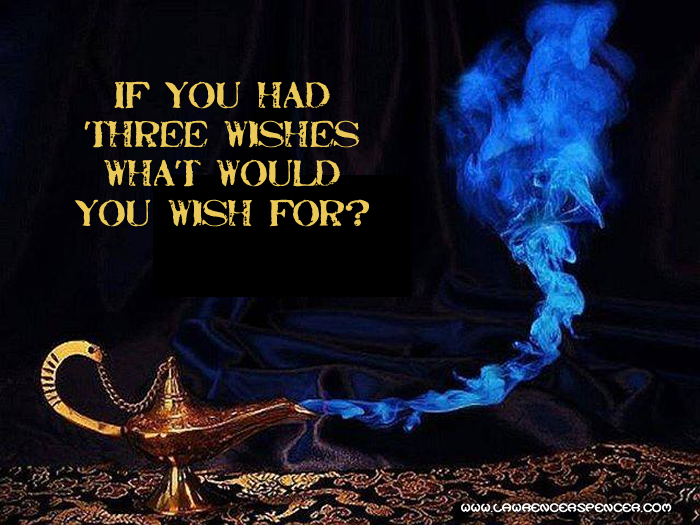
A wish is a hope or desire for a thing or person to appear, for an immaterial thing to become real, for a condition to change, or any of an unlimited number of desires for change. Traditionally, a wish is request from a supernatural being to cause something to be changed or created. A template for fictional wishes could be The Book of One Thousand and One Nights, specifically the tale of Aladdin, although in the tale of Aladdin the actual wishes were only part of the tale. Classically the wish provider is often a spirit, Genie or similar entity, bound or constrained within an object, like Aladdin’s oil lamp for example.
In the case of the Magic Lamp, there are several steps to getting your wish fulfilled:
What are the odds that all of these circumstances will ever exist? You do the math….
However, there are other forms of “wishing” or asking for something from a supernatural being. The most common kind of “wishing” is prayer. Another kind of wishing is daydreaming, or imagination or meditation. Another kind of wishing is figuring out how to make something happen and working hard, and persisting long enough to MAKE it happen!
This is almost always the most reliable way of making a wish come true. And, YOU are a Supernatural Being that can make YOUR wishes come true.
— Lawrence R. Spencer. 2013.
Republished by Blog Post Promoter
Listening to the sound of thunder and rain is one of the most soothing things to do at night while I’m looking for interesting things to write about or pictures to post on my Blogs.
Click HERE to listen to 75 MINUTES of wonderful rain and thunder….

Republished by Blog Post Promoter
If you’re living in the physical universe, especially on planet Earth, you are probably here because you’re bored. So, here’ something you can do to amuse yourself….until you get bored with it, of course. Then, you’re on your own. Good luck….
Republished by Blog Post Promoter
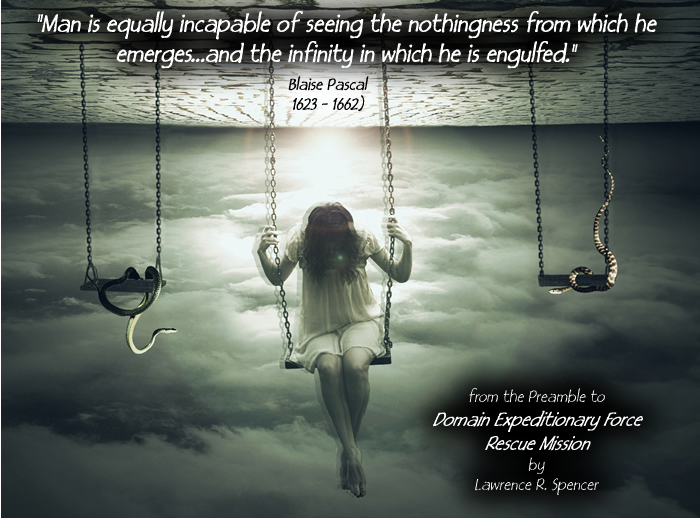
from the Preamble to the book: Domain Expeditionary Force Rescue Mission, a Science Fiction Novel by Lawrence R. Spencer, based on the book ALIEN INTERVIEW
“Once the IS-BEs expelled from the “Old Empire” arrived on Earth, they were given amnesia, and hypnotically tricked into thinking that something else had happened to them. The next step was to implant the IS-BEs into biological bodies on Earth. The bodies became the human populations of “false civilizations” which were designed and installed in the minds of IS-BEs to look completely unlike the “Old Empire”. All of the IS-BEs of India, Egypt, Babylon, Greece, Rome, and Medieval Europe were guided to pattern and build the cultural elements of these societies based on standard patterns developed by the IS-BEs of many earlier, similar civilizations on “Sun Type 12, Class 7” planets that have existed for trillions of years throughout the universe.” — excerpted from Top Secret government interview transcripts published in the book, “Alien Interview”
_____________________
 “Through clever and constant application of propaganda, people can be made to see paradise as hell, and also the other way round, to consider the most wretched sort of life as paradise.” — Adolph Hitler (20 April 1889 – 30 April 1945)
_____________________
The evil of the world is made possible by nothing but the sanction you give it.” — Ayn Rand (January 20, 1905 – March 6, 1982)
_____________________
“When you think of the long and gloomy history of man, you will find more hideous crimes have been committed in the name of obedience than have ever been committed in the name of rebellion.” — C. P. Snow (15 October 1905–1 July 1980)
_____________________
“Man is equally incapable of seeing the nothingness from which he emerges and the infinity in which he is engulfed.” — Blaise Pascal (1623 – 1662)
_____________________
“We are the people our parents warned us about.”
– Jimmy Buffett (December 25, 1946 — )

LISTEN TO A SAMPLE OF THE AUDIOBOOK The Domain Expeditionary Force Rescue Mission