Category Archives: VERMEER REVEALED

Vermeer: Portraits of A Lifetime explores the life of the world famous Dutch artist, Johannes Vermeer. This book reveals observations that have never before been made about his paintings, his life, his friends and his family. Dedicated to revealing observations about the life and paintings of Vermeer, and the women featured in his painting — his family.

The Virus that Destroyed the Dutch Economy

Republished by Blog Post Promoter
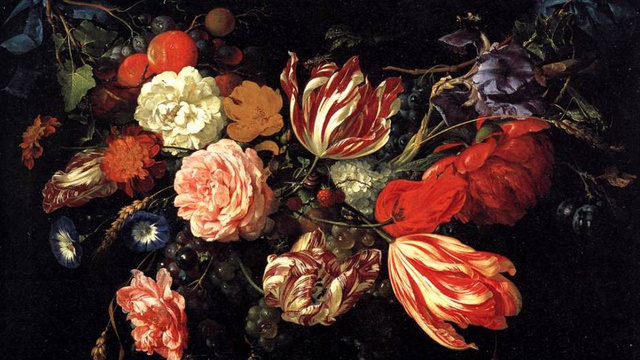
Famously, the tulip speculation that happened in the late 1600s brought down the Dutch economy. But did you know that it wasn’t botany that brought down Holland, it was virology? The thing that sent speculators into despair wasn’t a flower, but a virus.

Tulip speculation was rampant in Holland in the 1600s. Brought over from Asia Minor, the flowers enlivened the Dutch landscape. They were sought after just at a time when money was pouring in to the Dutch economy, preparing people to spend their new found wealth on silly things. Prices climbed high and fast, and entire businesses were sold or traded at auction for a single bulb. Anything that gave people the opportunity to make money in a single transaction was valuable in and of itself, so tulip bulbs became a sensible thing to speculate on, right up until they weren’t. Suddenly people realized that they didn’t have the intrinsic value that everyone seemed to believe they did, and prices collapsed. Everyone old enough to read this has seen a crash or two in their time, so we can’t look on with too much smug superiority.

Well, maybe a little. After all, they’re just tulips. They can’t do anything except make more tulips, which should, if anything bring the price of tulips down. There doesn’t seem to be a reason for that kind of price range.

It turns out, though, that there was something that turned tulips into gold. Some tulips turned out to have a special quality that sent their worth through the roof. Some tulips, for no apparent reason, erupted from a solid color into a swirled, feathery bloom that was incredibly exotic and beautiful. No one seemed to know why any single bulb did this, and no one was able to establish a pattern for the change. The trade turned from an exchange of pricey luxury items to speculating on eagle eggs, on the understanding that sometimes, for no readily apparent reason, an egg hatched a griffin instead of an eagle.

But there was a reason, and it was called the Tulip Breaking Virus, or mosaic virus. It was transmitted either by contact with the bulb of an infected tulip or by different species of aphids. It changes pigmentation by affecting the distribution of anthocyanin, a pigment that can appear different colors depending on the pH of its area.

Of course, since that wasn’t known at the time, the Dutch dumped everything from pigeon droppings to dish water on their bulbs, all the while keeping prized bulbs away from the aphids or the other tulips which might actually have gotten them to break.
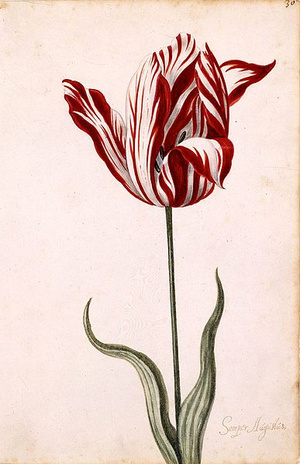
Sadly, the virus did what viruses generally do — it killed the tulip after a few blooming seasons, driving up the price for a newly-broken bulb even higher. The virus turned tulips into lottery tickets , and so it was understandable that people paid too much for them. Semper Augustus, pictured to the left, was famous for being the most expensive bulb sold during the period. It cost 13000 florins, at a time when one could get a house and garden for a third of that price. But the rampant speculation one which bulb was a winner, mocked even at the time, could only be kept up for so long. The economy collapsed, and what caused tulips to break remained a mystery until the 1900s.

The Tulip Breaking Virus is one of the many four viruses that cause flower ‘breaking’ that are still around today, with other strains affecting lilies. Gardeners now are cautioned to watch for these once-priceless flowers, and carefully weed them out of any gardens. Since the collapse of tulip speculation and the rise of tulip agriculture, botanists have selectively bred ‘Rembrandt Tulips,’ which mimic the swirled colors of breaking — without the degenerative virus. The name comes from the famous Dutch painter, since many owners of broken tulips would pay artists to make permanent copies of their fragile purchases. The paintings, of course, tend to be the priceless things now.

 ( via i09 )

Top Image: Web Gallery of Art

Semper Augustus Image: Norton Simon Image

Via SGM and Yard Smart.

8:9:10: 11/12/13

Republished by Blog Post Promoter


8 9 10 11 12 13 Date Time Convergence

“If you only knew the magnificence of the 3, 6 and 9, then you would have a key to the universe.”

–  Nikola Tesla

8:9:10 11/12/13 – The 8th Second of The 9th Minute of The 10th Hour of The 11th Day of The 12th Month of The 13th Year of The Century

Wednesday, 11 December 2013 by 

Second : Minute : Hour; Day / Month / Year
Sequential time and date convergence, smallest to largest increments.

A similar sequence occurred at 8:09:10 on November 12 2013, but this one rocks. Unless I’m missing something, we’ll have no more great time/date convergences for a very long time.

Adding the numbers and dividing by 21 (the number of the current Century for those of you not keeping track) results in the Number 3, the minimum number of points to describe a circle, a plane and a non-collapsible polygon; the noblest of all digits according to Pythagoras and one of only 9 Heegner Numbers, the Atomic Number of Lithium (3rd in line after Hydrogen and Helium), the number of physical dimensions we’re able to sense,  and it’s also a crowd.

REPOSTED FROM: Tacky Raccoons | Stray Polyps from the Internest.

GIRL IN THE VERMEER PAINTINGS

Republished by Blog Post Promoter

stunning_painting_objects_5

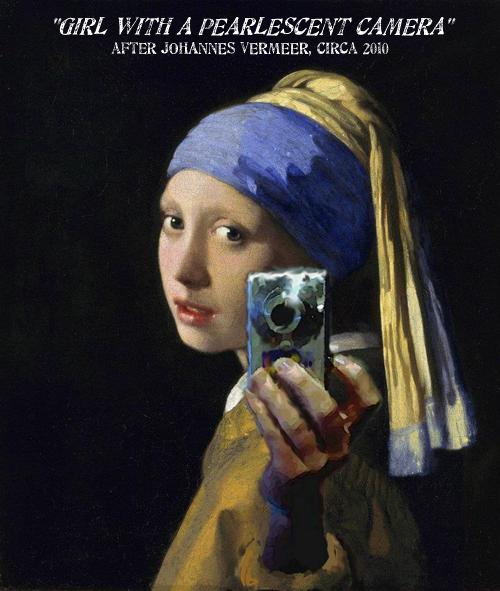
This picture is a modern spoof on the world famous painting by the 16th century Dutch artist Johannes Vermeer.   The girl in the legendary painting (as well as in several other of his paintings) is his second daughter, Elizabeth!  Vermeer never hired models — he painted only family and friends.  It doesn’t take a cosmetic surgeon to compare the features of the women in the majority of his paintings to observe that the same women are being painted in their own home, again and again in different poses, settings, lighting and clothing.  Most of his paintings feature his wife, Catharina, who was not only his constant accomplice in creating a family, she was his foremost ally in his life as an artist!

The painting named (by others), “Girl with a pearl earring“, as well as “The girl with a red hat”, and “The girl with a flute”, and others, are all of his second daughter, Elizabeth, who was a teenager when they were painted.  He used her as the model for a series of very small “tronie” or facial portraits, which were popular at the time.

These miniature “head shots” were especially well suited to the use of the camera obscura to create what we know now to have a photographic quality, rendering the light and perspective differently than the unaided lens of the human eye perceives it.

To learn all of the details about the women who posed for Johannes Vermeer in all of his famous paintings, read the book VERMEER: PORTRAITS OF A LIFETIME, by Lawrence R. Spencer.

DOWNLOAD THIS BOOK FROM iTUNES
http://itunes.apple.com/us/book/vermeer/id443800993?mt=11 

Support independent publishing: Buy this e-book on Lulu.

GIRL WITH A PEARLESCENT CAMERA

Republished by Blog Post Promoter

 This picture is a modern spoof on the world famous painting by the 16th century Dutch artist Johannes Vermeer.   The girl in the legendary painting (as well as in several other of his paintings) is his second daughter, Elizabeth!  Vermeer never hired models — he painted only family and friends.  It doesn’t take a cosmetic surgeon to compare the features of the women in the majority of his paintings to observe that the same women are being painted in their own home, again and again in different poses, settings, lighting and clothing.  Most of his paintings feature his wife, Catharina, who was not only his constant accomplice in creating a family, she was his foremost ally in his life as an artist!

The painting named (by others), “Girl with a pearl earring”, as well as “The girl with a red hat”, and “The girl with a flute”, and others, are all of his second daughter, Elizabeth, who was a teenager when they were painted.  He used her as the model for a series of very small “tronie” or facial portraits, which were popular at the time.

These miniature “head shots” were especially well suited to the use of the camera obscura to create what we know now to have a photographic quality, rendering the light and perspective differently than the unaided lens of the human eye perceives it.

To learn all of the details about the women who posed for Johannes Vermeer in all of his famous paintings, read the book VERMEER: PORTRAITS OF A LIFETIME, by Lawrence R. Spencer.

DOWNLOAD THIS BOOK FROM iTUNES
http://itunes.apple.com/us/book/vermeer/id443800993?mt=11 


DEAD PORTRAITS

Republished by Blog Post Promoter

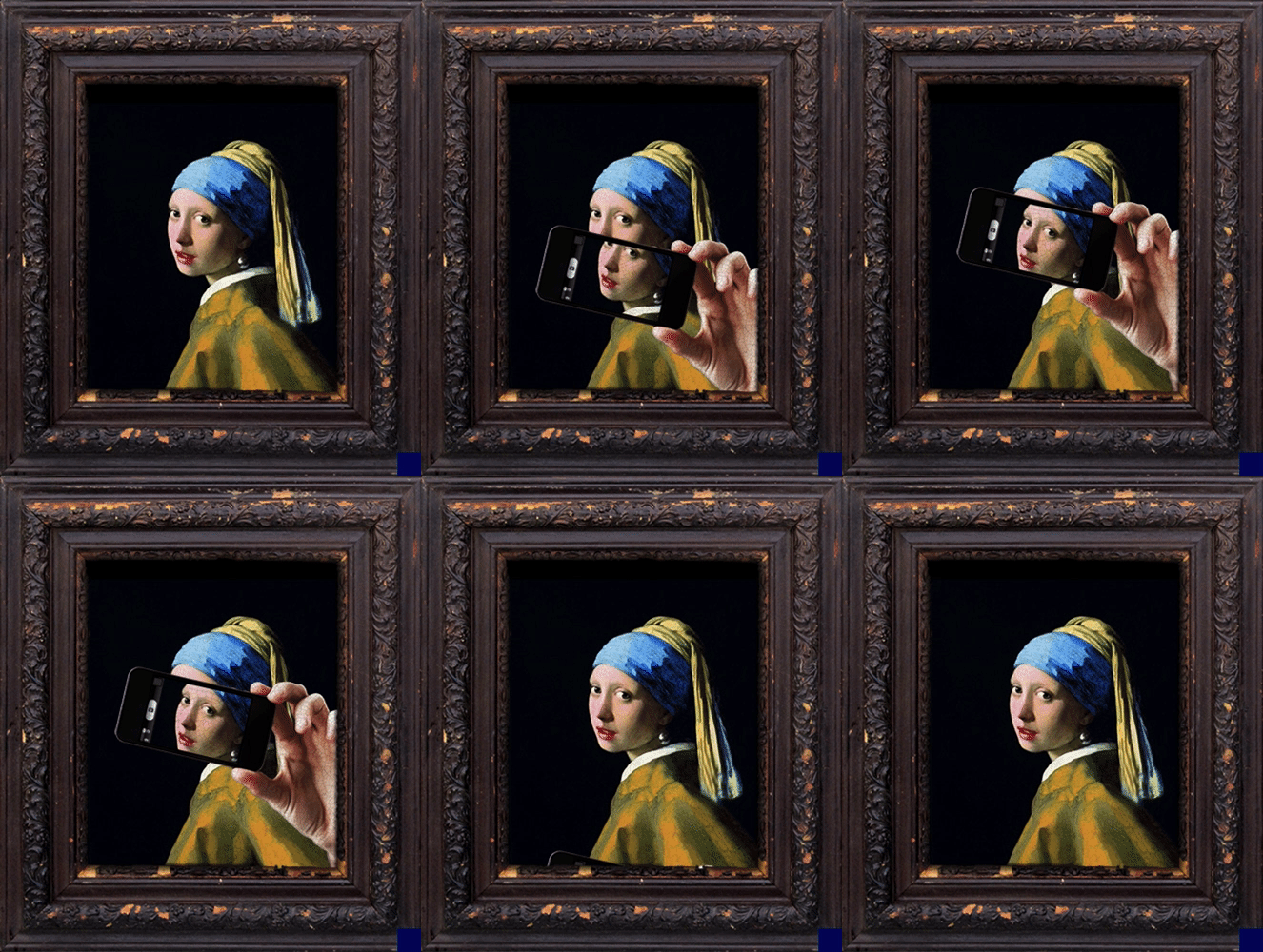
giphy500 years ago the Dutch painter created a portrait of one of his daughters using brushes, oil, crushed pigments, cloth canvas, decades of training, hundreds of hours of patient observation of light, texture, color,  capturing the spiritual essence of the model with meticulous artistry.    Now a portrait is as simple as a button touch, and just a meaningless.

Support independent publishing: Buy this e-book on Lulu.LEARN MORE ABOUT THE VERMEER WOMEN