Republished by Blog Post Promoter
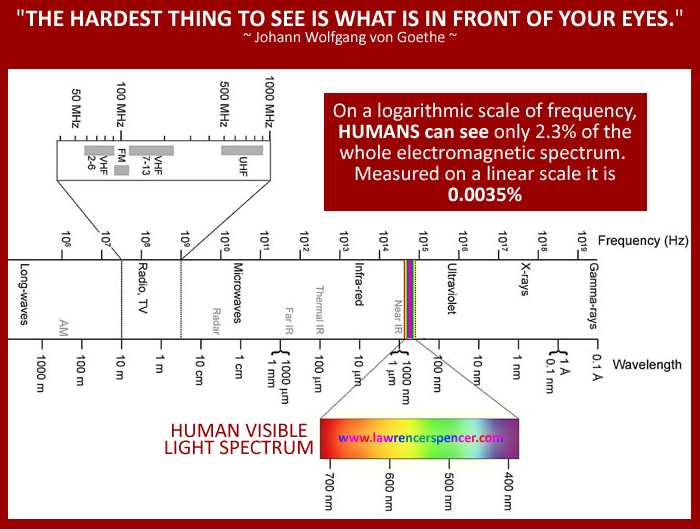
Like the man said, humans can’t see with their eyes….

Universes are comprised of thoughts, ideas, dreams, illusions, delusions, which may also include stars, space, time, energy and objects. Or not. These are the universes of the author Lawrence R. Spencer, and others for whom he has an affinity.
Republished by Blog Post Promoter

The evolutionary biologist J.B.S. Haldane Is famous for having repeatedly said that “the Creator must have an inordinate fondness for beetles, for the simple reason that there are just so many varieties of beetles on Earth.” (He also noted that the Creator also was “endowed with a passion for stars” – again, because there are just so darn many of them.)
Stephen Jay Gould added to this by noting:
“God is most likely to take trouble over reproducing his own image, and his 400,000 attempts at the perfect beetle contrast with his slipshod creation of man. When we meet the Almighty face to face he will resemble a beetle (or a star).”
The Coleoptera /koʊliːˈɒptərə/ order of insects is commonly called beetles. The word “coleoptera” is from the Greek κολεός,koleos, meaning “sheath”; and πτερόν, pteron, meaning “wing”, thus “sheathed wing. The Coleoptera include more species than any other order, constituting almost 25% of all known types of animal life-forms. About 40% of all described insect species are beetles (about 400,000 species), and new species are discovered frequently. Some estimates put the total number of species, described and undescribed, at as high as 100 million, but a figure of one million is more widely accepted. ————–
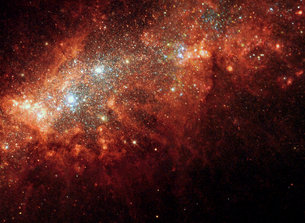
According to astronomers, there are probably more than 170 billion galaxies in the observable Universe, stretching out
into a region of space 13.8 billion light-years away from us in all directions. And so, if you multiply the number of stars in our galaxy by the number of galaxies in the Universe, you get approximately 1024 stars. That’s a 1 followed by twenty-four zeros. That’s a septillion stars. But there could be more than that.
It’s been calculated that the observable Universe is a bubble of space 47 billion years in all directions. This is a minimum value, the Universe could be much bigger – it’s just that we can’t ever detect those stars because they’re outside the observable Universe. It’s even possible that the Universe is infinite, stretching on forever, with an infinite amount of stars. So add a couple more zeros. Maybe an infinite number of zeroes. That’s a lot of stars in the Universe.
Read more: http://www.universetoday.com/102630/how-many-stars-are-there-in-the-universe/#ixzz2uK83T2IZ
Republished by Blog Post Promoter
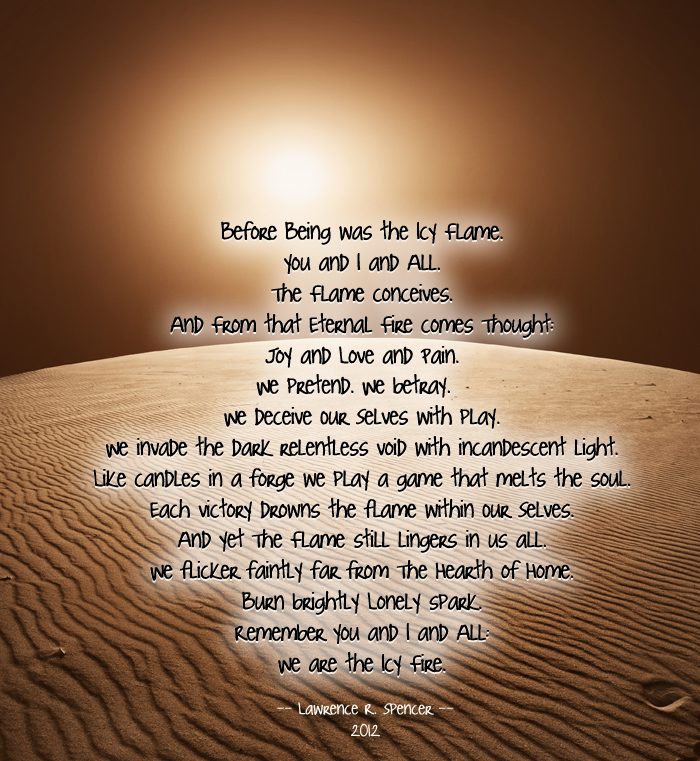
Before Being was the Icy Flame.
You and I and All.
The Flame conceives.
And From that Eternal Fire comes Thought:
Joy and Love and Pain.
We pretend. We betray.
We deceive Our Selves with play.
We invade the dark relentless void with incandescent Light.
Like candles in a forge we play a game that melts the soul.
Each victory drowns the flame within Our Selves.
And yet The Flame still lingers in us all.
We flicker faintly far from The Hearth of Home.
Burn brightly Lonely spark.
Remember You and I and All:
We are the Icy Fire.
— Lawrence R. Spencer, 2012 —
Republished by Blog Post Promoter
(According to Earth “scientists”), genes are the fundamental units of inheritance in living organisms. Together, they hold all the information necessary to reproduce a given organism and to pass on genetic traits to its offspring.
Biologists have long debated what constitutes a gene in molecular terms but one useful definition is a region of DNA that carries that code necessary to make a molecular chain called a polypeptide. These chains link together to form proteins and so are the bricks and mortar out of which all organism are constructed.
Given this crucial role, it is no surprise that an ongoing goal in biology is to work out the total number of protein-coding genes necessary to construct a given organism. Biologists think the yeast genome contains about 5300 coding genes and a nematode worm genome contains about 20,470.
But the number for humans has been the subject of constant revision since biologists first began the task of estimating them in the 1960s. Then, they believed humans could have as many as 2 million protein-coding genes. But by the time the human genome project began in the late 1990s, the highest estimates put the number at 100,000 and the number has continued to shrink.
That’s an interesting result that is partly a reflection of the state of genomics. The human genome is by no means fully defined and biologists are still in the process of refining their gene models and withdrawing genes in the process.
Indeed, in the most recent update of the genome release, geneticists have withdrawn 328 of the 2000 genes that Ezkurdia, Tress and co identify as potentially non-coding.
And on this evidence, the human genome is set to get smaller still. “Our evidence suggests that the final number of true protein coding genes in the reference genome may lie closer to 19,000 than to 20,000.”
Which means that humans have fewer protein-coding genes even than nematode worms.
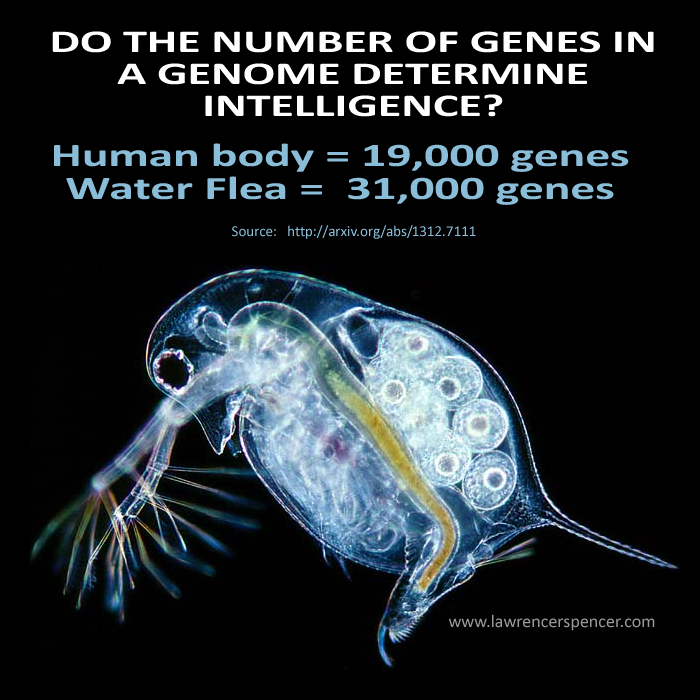
Geneticists long ago debunked the idea that more complex organisms require more genes. The water flea, for example, has 31,000 genes, the most in any animal, while the organism with the largest genome is thought to be the Paris jabonica, a rare flowering plant native to Japan.
The fact that the human genome is so parsimonious raises an interesting question. What exactly is it about the human genome that gives rise to our staggering complexity, in the brain for example, compared to other animals such as monkeys, worms or even water fleas?
A good answer to that question will win prizes!
Ref: arxiv.org/abs/1312.7111 : The Shrinking Human Protein Coding Complement: Are There Fewer Than 20,000
Republished by Blog Post Promoter

“Jiddu Krishnamurti was born on 11 May 1895 in Madanapalle, a small town in south India. He and his brother were adopted in their youth by Dr Annie Besant, then president of the Theosophical Society. Dr Besant and others proclaimed that Krishnamurti was to be a world teacher whose coming the Theosophists had predicted. To prepare the world for this coming, a world-wide organization called the Order of the Star in the East was formed and the young Krishnamurti was made its head.
In 1929, however, Krishnamurti renounced the role that he was expected to play, dissolved the Order with its huge following, and returned all the money and property that had been donated for this work. From then, for nearly sixty years until his death on 17 February 1986, he travelled throughout the world talking to large audiences and to individuals about the need for a radical change in mankind.
Krishnamurti is regarded globally as one of the greatest thinkers and religious teachers of all time. He did not expound any philosophy or religion, but rather talked of the things that concern all of us in our everyday lives, of the problems of living in modern society with its violence and corruption, of the individual’s search for security and happiness, and the need for mankind to free itself from inner burdens of fear, anger, hurt, and sorrow. He explained with great precision the subtle workings of the human mind, and pointed to the need for bringing to our daily life a deeply meditative and spiritual quality.
Krishnamurti belonged to no religious organization, sect or country, nor did he subscribe to any school of political or ideological thought. On the contrary, he maintained that these are the very factors that divide human beings and bring about conflict and war. He reminded his listeners again and again that we are all human beings first and not Hindus, Muslims or Christians, that we are like the rest of humanity and are not different from one another. He asked that we tread lightly on this Earth without destroying ourselves or the environment. He communicated to his listeners a deep sense of respect for nature. His teachings transcend man-made belief systems, nationalistic sentiment and sectarianism. At the same time, they give new meaning and direction to mankind’s search for truth. His teaching, besides being relevant to the modern age, is timeless and universal.” — http://www.jkrishnamurti.org/