
Category Archives: SOUNDS

Music, video or voice recordings that relate to Life, Universes and Other Stuff

CREATING LIFE FROM MATTER

Republished by Blog Post Promoter
Metropolis is a 1927 German expressionist epic science fiction drama film directed by Fritz Lang. The film was written by Lang and his wife Thea von Harbou, and starred Brigitte Helm, Gustav Fröhlich, Alfred Abel and Rudolf Klein-Rogge. A silent film, it was produced by Erich Pommer in the Babelsberg Studios by Universum Film A.G.. It is regarded as a pioneering work of science fiction genre in movies, being among the first feature length movies of the genre.

Made in Germany during the Weimar Period, Metropolis is set in a futuristic urban dystopia, and follows the attempts of Freder, the wealthy son of the city’s ruler, and Maria, a poor worker, to overcome the vast gulf separating the classes of their city. Metropolis was filmed in 1925, at a cost of approximately five million Reichsmarks, making it the most expensive film ever released up to that point.

In this film, the mad inventor Rotwang kidnaps the heroine, Maria.  You see he’s created a robot to be a replacement for a woman he loved.  But it needs a soul!  So when the need to get Maria out of the way in the general run of the plot presents itself, he imprints the image of Maria onto his Robot.lang-metropolis The lady is in a confined little bed-thing with a big steel helmet on her head with wires coming out.  Rotwang throws switches and levers.  Chemicals boil, electricity flies, the robot on her throne is surrounded by energy and suddenly changes into the image of Maria.  Though when she opens her emotionless eyes, they seem to glow with an inner light.  IT’S ALIVE!

 This revolutionary film addresses the subject of animating inanimate organisms.  Biological engineering and animation of bodies by spiritual beings is thoroughly discussed in the book ALIEN INTERVIEW:

“How else can you explain the source of spiritual animation which defines every living creature? To say it is the work of “god”, is far too broad. Every IS-BE has many names and faces in many times and places. Every IS-BE is a god. When they inhabit a physical object they are the source of Life.”

Metropolis (short synopsis of the film)

MetropolisposterSometime in the future. Johann Fredersen is mastermind of Metropolis, a gigantic high-tech city, under whose surface masses of workers lead an archaic slave existence. His son, Freder, is witness to the inhumane working conditions and rebels against his despotic father, discovering a spiritual community in the catacombs of the city: Maria, a young woman, preaches the virtues of love and reconciliation. But Fredersen discovers Maria as well and conjures up a sinister plan. He commissions the scientist Rotwang to develop a robot form of Maria, which he will use to gain influence over the workers. The plan works, but Freder and Maria are able to hinder the catastrophe in the last minute. The mass hysteria turns and directs its rage toward the robot Maria, who is burned at the stake. Freder and Maria form a new brotherly community among the classes – Fredersen offers his hand in reconciliation, true to the motto of the film: “the mediator between the hand and the brain must be the heart”.

AMOUR

Republished by Blog Post Promoter

The loss of the person whom you love and cherish the most in your life is an agony beyond imagining. Yet, to allow them to endure interminable suffering, is the most brutal cruelty, and insantity.  If you truly love someone, the only sane and merciful act is to free them from their pain.  This pain may be imprisonment within an unwanted relationship, or from a crippled and decaying body.  

In Life, and in Death, Freedom is more important than Love.

OPCC_01_AMOUR_8.14_Layout 1

Amour (pronounced: [a.muʁ]; French for “Love”) is a 2012 French-language drama film.  The narrative focuses on an elderly couple, Anne and Georges, who are retired music teachers with a daughter who lives abroad. Anne suffers a stroke which paralyses her on one side of her body. The film was screened at the 2012 Cannes Film Festival, where it won the Palme d’Or. It won the Academy Award for Best Foreign Language Film at the 85th Academy Awards, and was nominated in four other categories: Best Picture, Best Actress in a Leading Role (Emmanuelle Riva), Best Original Screenplay (Michael Haneke) and Best Director (Michael Haneke).  At the age of 85, Emmanuelle Riva is the oldest nominee for the Best Actress in a Leading Role.  At the 25th European Film Awards, it was nominated in six categories, winning in four, including Best Film and Best Director. At the 47th National Society of Film Critics Awards it won the awards for Best Film, Best Director and Best Actress. At the 66th British Academy Film Awards it was nominated in four categories, winning for Best Leading Actress and Best Film Not in the English Language. Emmanuelle Riva became the oldest person to win a BAFTA. At the 38th César Awards it was nominated in ten categories, winning in five, including Best Film, Best Director, Best Actor and Best Actress.

THEY LIVE

Republished by Blog Post Promoter

OBEYThey Live is a 1988 American science fiction-horror film directed by John Carpenter.  The film follows a nameless drifter referred to as “Nada”, who discovers the ruling class within the moneyed elite are in fact aliens managing human social affairs through the use of a signal on top of the TV broadcast, concealing their appearance and subliminal messages in mass media.   This is a clip from the famous “sunglasses” scene: “I have come here to chew bubble gum and kick ass.  And, I’m all out of bubble bum….”

The idea for They Live came from two sources: a short story called “Eight O’Clock in the Morning” by Ray Nelson, originally published in The Magazine of Fantasy and Science Fiction in the 1960s, involving an alien invasion in the tradition of Invasion of the Body Snatchers, and a story called “Nada” from the Alien Encounters comic book.  John Carpenter describes Nelson’s story as “…a D.O.A. type of story, in which a man is put in a trance by a stage hypnotist. When he awakens, he realizes that the entire human race has been hypnotized, and that alien creatures are controlling humanity. He has only until eight o’clock in the morning to solve the problem.

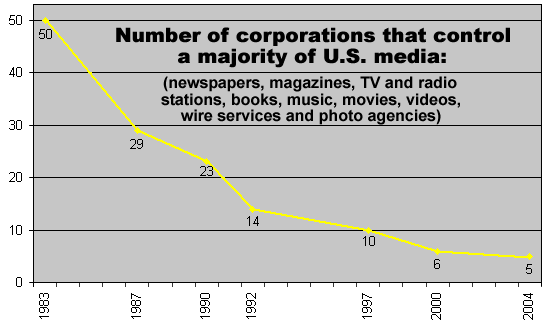
The more political elements of the film are derived from Carpenter’s growing distaste with the ever-increasing commercialization of 1980s popular culture and politics. He remarked, “I began watching TV again. I quickly realized that everything we see is designed to sell us something… It’s all about wanting us to buy something. The only thing they want to do is take our money.” To this end, Carpenter thought of sunglasses as being the tool to seeing the truth, which “is seen in black and white. It’s as if the aliens have colorized us. That means, of course, that Ted Turner is really a monster from outer space.” (Turner had received some bad press in the 1980s for colorizing classic black-and-white movies.) The director commented on the alien threat in an interview, “They want to own all our businesses. A Universal executive asked me, ‘Where’s the threat in that? We all sell out every day.’ I ended up using that line in the film.” The aliens were deliberately made to look like ghouls according to Carpenter, who said: “The creatures are corrupting us, so they, themselves, are corruptions of human beings.”

Because the screenplay was the product of so many sources: a short story, a comic book, and input from cast and crew, Carpenter decided to use the pseudonym “Frank Armitage,” an allusion to one of the filmmaker’s favorite writers, H. P. Lovecraft (Frank Armitage is a character in Lovecraft’s The Dunwich Horror). Carpenter has always felt a close kinship with Lovecraft’s worldview and according to the director, “Lovecraft wrote about the hidden world, the “world underneath.” His stories were about gods who are repressed, who were once on Earth and are now coming back. The world underneath has a great deal to do with They Live.” — (Wikipedia.org)