
Category Archives: POETIC NONSENSE

Poetry by Lawrence R. Spencer. Poetic nonsense by Lawrence R. Spencer and others. Haiku poems by Lawrence R. Spencer.

THE WAY OF ALL-MOTHER

Republished by Blog Post Promoter
“The primary difference between IS-BEs of The Domain and those of the physical universe is the condition known as “games”.  In The Domain it has long been observed that in order for each individual IS-BE to remain free from intrusion or tyranny imposed on them by more powerful, or less ethical IS-BEs, we must cooperate to defend and nurture each other.  A principle of benevolent mutual respect for all IS-BEs, and the universes they create / occupy, is referred to as “All-Mother”.

“All-Mother” is a philosophy in which the behavior or conduct of an individual and groups of IS-BEs is adjudicated based on the logical premise that in order to sustain optimum freedom, order and serenity for all IS-BEs, each IS-BE must serve all IS-BEs.

This premise is not intended to eliminate disagreements between IS-BEs, but to mitigate destruction or chaotic behavior between them.

“All-Mother” assures the inherent right of an individual IS-BE to approach, depart from, or not interact, with other IS-BEs while maintaining an optimum serenity.

The purpose of The Domain is to defend the right of an individual or group of IS-BEs to create a universe, or not, at their own discretion.

It has been observed that when responsibility for maintaining organization within the co-created universe shared by all IS-BEs is not defended and preserved, each individual IS-BE is deprived of the freedom assured by the power of a collaborative, creative will and combined power.

The Omniscient and Omnipotent Matriarch (abbrev: Omnimat) is an IS-BE who acts as magistrate of The Domain.

  • Through preeminent power, wisdom and benevolence, Omnimat supervises and enforces the principle of All-Mother within The Domain.
  • Omnimat does not create, destroy or alter universes.
  • Omnimat may, or may not, enforce penalties or restrictions upon IS-BEs when violations of the principle of All-Mother occur within The Domain.
  • The discretion and judgment of Omnimat are inviolate.
  • Omnimat enforces all judgments.

To the degree that IS-BEs of The Domain do not need or desire admiration, and are not compelled to “play” a game at all times, the power, stability and serenity of The Domain remains relatively stable, when compared to the physical universe.

(The physical universe is, by definition, an infinite, icy void cluttered with random sources of savage energy combined with mindless chunks of matter.  The massive and chaotic construction of the physical universe is utterly antipathetic to the spiritual “nothingness” which is the intelligent source of life forms and of universes.)

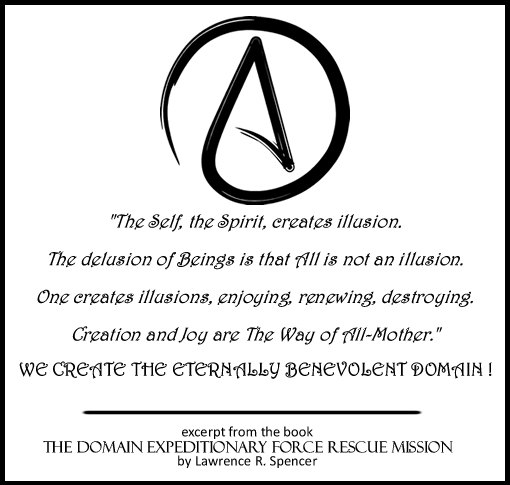
WE CREATE THE ETERNALLY BENEVOLENT DOMAIN!”

“The Self, the Spirit, creates illusion.

The delusion of Beings is that All is not an illusion.

One creates illusions, enjoying, renewing, destroying.

Creation and Joy are The Way of All-Mother.”

I am present, as Omnimat is present, in the eternal now. ”

_______________

Excerpt from THE DOMAIN EXPEDITIONARY FORCE RESCUE MISSION, by Lawrence R. Spencer

LET’S PRETEND

Republished by Blog Post Promoter

LET’S PRETEND

When we’re young we run
and play “let’s pretend” to be
anything and everything – just for fun.
Our imagination is the key.
As we grow up we are told
by others who are very serious
That reality is time and space and gold;
that games and visions are delirious.
Life goes on and we agree
what other people think is best:
to play our part in reality
just like them and all the rest.
Every game has a start,
a middle and conclusion.
When the time comes to depart
just make a new illusion!
You are Spirit ! Life Eternal !
You’ll make a future and new friends !
Through your dreams you are immortal;
like children playing “let’s pretend”.

— by Lawrence R. Spencer

VISIT TO PICASSO

Republished by Blog Post Promoter

I own a video cassette copy of a film (The Mystery of Picasso) showing Pablo Picasso painting on a plate of glass, filmed from the opposite side.  As an oil painter myself, I found it utterly mesmerizing!  I was delighted when I found an earlier film on YouTube (in 2 parts below) showing similar footage of Picasso at work in his studio sixty-three year ago, in 1949.  (This film is nearly as old as I am!)

Visit to Picasso is a Belgian documentary film from 1949 directed by Belgian filmmaker Paul Haesaerts. In an effort to capture the nature of Picasso’s creative process, Paul Haesaerts asked the Spanish painter to apply his magical brushstrokes to large glass plates as Haesaerts filmed from the other side. This actually predates the more famous art film The Mystery of Picasso (1956) by Henri-Georges Clouzot in which Picasso also paints to large transparent canvases as the director films from the other side. The filming took place in Picasso’s studio in Vallauris. In 1951 Visit to Picasso was nominated for best documentary by the British Academy of Film and Television Arts (BAFTA).  Even if you are not an artist or art connoisseur, you may appreciate this film.

Vivre la vie avec un esprit de l’art de!

WITHHOLD A PIECE FOR PEACE, LADIES

Republished by Blog Post Promoter

A synopsis of the play “LYSISTRATA” by the Greek poet and play writer, Aristophanes ( 411 B.C.E.)

The Peloponnesian War has been dragging on for eighteen long years, and the beautiful Lysistrata, in common with the other wives of Athens, is heartily tired of the intermittent absence of their warrior husbands. She decides that it is time to bring an end to this situation. The only solution, she concludes, is a boycott to deprive the husbands of their wives’ love.

Lysistrata sets out to enlist the other women in the plan, but finds them somewhat reluctant. One thinks that to so punish their husbands would be punishing themselves; others offer similar excuses. Lysistrata tells them that they are cowards and that the poets’ jibes about women’s frailty are well deserved.

But she perseveres in her determination, and convinces the women at last that peace surely will come if they all dress, powder and perfume themselves irresistibly, then withhold their favors from their men unless they promise to take steps to end the war forthwith. The wives agree to try the scheme, and, for a start, seize the public funds. The old men of Athens try to burn them out of the treasury, but the embattled women retaliate with pitchers of water upon their heads. The President of the Senate arrives at this juncture, ordering the arrest of “that traitress,” Lysistrata.

The women win the scuffle that follows, the President admitting defeat; but he asks an explanation for the feminine onslaught upon the treasury. Lysistrata blandly explains their purpose: to save the public money so that the men won’t fight any wars over it. The President protests the absurdity of their fancy that the war is being fought over mere money. Lysistrata assures him that of course it is; that every war is for the sake of money–else why are politicians always manufacturing wars? Merely as an occasion to steal, she says.

Then Lysistrata announces that, from now on, things are going to be different: the men won’t be able to get any money for fighting because the women are going to take over the treasury. And why not? They manage the household finances. But household finances, the President tolerantly explains, are quite different; the public money is necessary for the fighting. To this Lysistrata readily agrees, but adds that the fighting itself is hardly necessary.

The listening women, weary of the argument by this time, seize the President, unclothe him and dress him as a woman. They tell him that they are going to take the state into their own hands, rescue it from the muddling of men, unravel the knots of war just as they straighten out a skein of wool, and unite all nations into a single thread of peace and good will.

But the President persists: war, after all, is the business of men, he says. Nothing of the kind, Lysistrata replies, it is the business of women–for who suffers most in the loss on the battlefields of sons and husbands? To end the debate, the women again seize the official and garb him as a corpse. He retreats in terror.

After a time, the wives of the enemy city of Sparta join in the boycott. The plan is a success: the husbands of both cities surrender to their wives, and, to recapture their love, agree to end the war. Here a male chorus observes that it was a wise philosopher who called women the paradoxical sex: you cannot live with them and you cannot live without them. A female chorus replies that, say what you will and do what you will, the women always have the last word, for theirs is the unanswerable argument. Together the choruses agree that there has been enough of idle quarrels: they urge that the discord cease.

Lysistrata is chosen as intermediary between the Athenian and Spartan envoys for formal termination of the conflict, and she lectures them soundly at the start of their conference. She is a woman, she says, but hopes that she is not without some sense; she reminds them that they are all of the same blood, the same gods and the same language. Why, then, do they kill each other? Why should they not come to terms? She agrees that it may be necessary for animals to fight, but certainly not for men–particularly for Greek men–to fight among themselves while barbarians are looking on.

A Spartan delegate announces that his side is ready to make peace if it gets what it wants, and an Athenian observes that what both the Spartans and Athenians want is to get their wives back again. Lysistrata sees some feasibility in this, but orders that first the former enemies must go off to a feast to repair their friendship. After that, she says, each warrior may take his woman home.

The warriors try Lysistrata’s program, and at length return as bosom friends. This accomplished, she bids them each take his woman, and all join in a dance of peace as the chorus pleads:A Spartan seconds this idea, proposing further, that they all get drunk–a suggestion not unpleasant to one Athenian who notes that people are surliest when most sober. If there were more drinking bouts among diplomats, he thinks, there would be no war; they would drown their quarrels in wine, have some singing together, and decide that, after all, an enemy could still be a good fellow.

“O let us prayTo the gods today
While in peace we eatOur bread and our meat.
That every fieldMay its harvest yield,
O Venus, arrayed in love, restore
The hopes and joys we have lost in the war…
Let the sword be forgotten for evermore.”