
Republished by Blog Post Promoter
Category Archives: POETIC NONSENSE
Poetry by Lawrence R. Spencer. Poetic nonsense by Lawrence R. Spencer and others. Haiku poems by Lawrence R. Spencer.
ALPHABET DEATHS
Republished by Blog Post Promoter
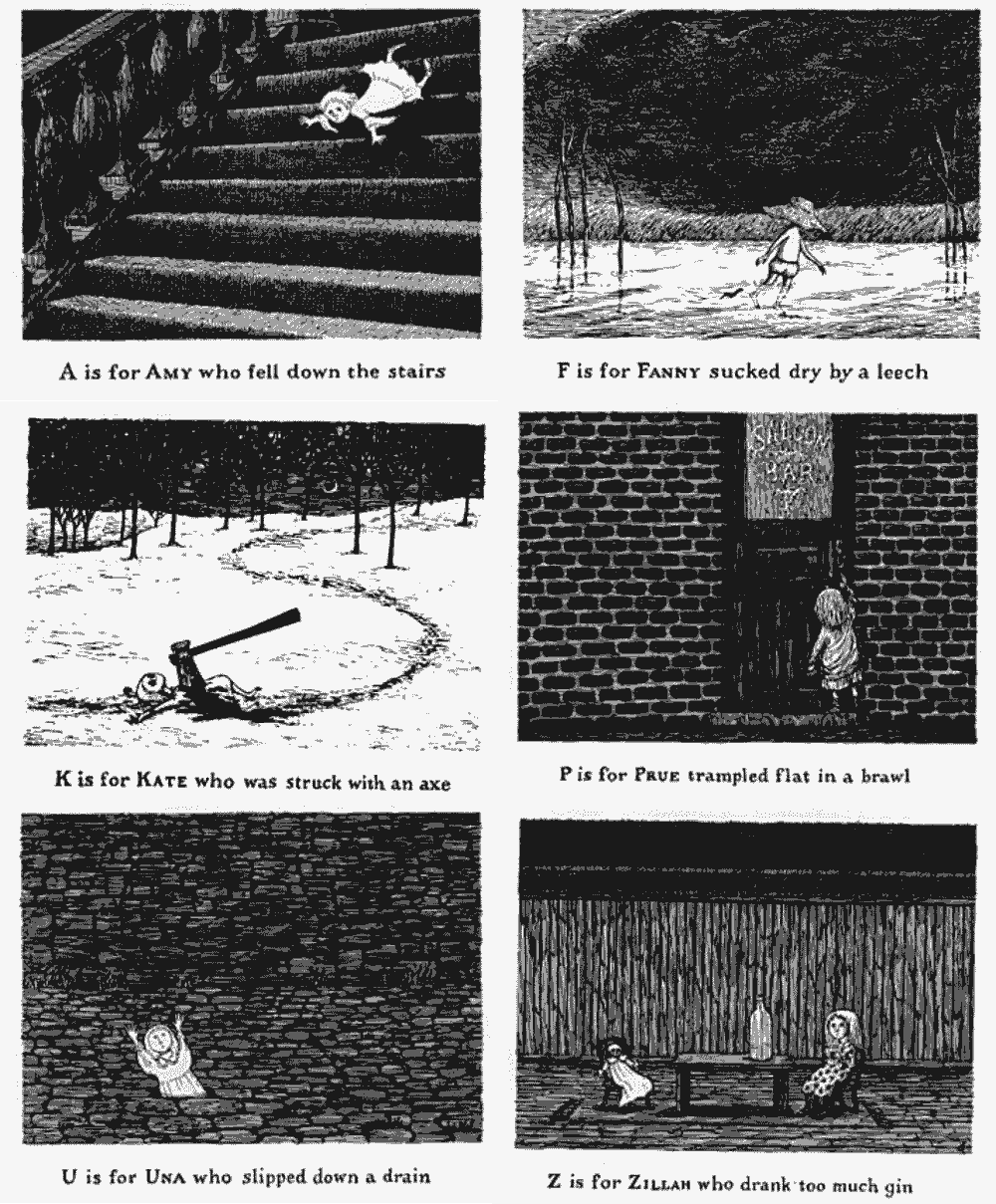
“The Gashlycrumb Tinies is an abecedarian book written by Edward Gorey that was first published in 1963. Gorey tells the tale of 26 children (each representing a letter of the alphabet) and their untimely deaths in rhyming dactylic couplets, accompanied by the author’s distinctive black and white illustrations.” (Wikipedia.org)
SANE CRAZY PEOPLE
Republished by Blog Post Promoter

WHAT IS LOVE?
Republished by Blog Post Promoter

“Love” is not a good word. I don’t like it because it has too many different definitions! Most of the time people use this word in a sexual context, which is a very small and limited definition. So, I spent a little time to study the different definitions of “love”. Here is what I found out:
Here is the dictionary definition of “love”:
1 a (1) : strong affection for another arising out of kinship or personal ties < maternal love for a child > (2) : attraction based on sexual desire : affection and tenderness felt by lovers (3) : affection based on admiration, benevolence, or common interests < love for his old schoolmates >
b : an assurance of affection < give her my love >
2 : warm attachment, enthusiasm, or devotion < love of the sea >
3 a : the object of attachment, devotion, or admiration < baseball was his first love >
b (1) : a beloved person : darling —often used as a term of endearment (2) British —used as an informal term of address
4 a : unselfish loyal and benevolent concern for the good of another: as (1) : the fatherly concern of God for humankind (2) : brotherly concern for others
b : a person’s adoration of God
5 : a god or personification of love
The origin of the word “love” in English is from the Old English word lufu; akin to Old High German luba, or Old English lēof (dear), Latin lubēre, libēre, which means “to please”.
The Greeks used the word “agape” to express a purely spiritual love.
The word “Platonic” is Intellectual love, like the love of Art, or Beauty, or love of Learning, etc… This also applies to a genuine affinity or admiration between non-sexual relationships, as between friends, or companions.
“Amorous” and the Greek word “Eros” (erotic) are words for sexual or romantic love. For example, it is very easy for sexual partners to feel “amorous” toward each other, which is simply the “attraction” or “chemistry” caused by the biological programs inherent in many life forms. However, this does necessarily include a perception or understanding that there are spiritual beings inhabiting the bodies of the “love makers”.
The word “affinity”, which is the perception of how CLOSE or how DISTANT one feels emotionally, intellectually, spiritually or physically toward a thing, a being, or subject, or idea is a more accurate definition for non-sexual “love”. The CLOSEST that two entities can BE is to BE THE SAME, i.e. there is NO Distance between them.
In the book Alien Interview, the UFO pilot, Airl, uses the word “admiration”, which she says Is-Bes all desire more than ANY other quality.
“Another common denominator of IS-BEs (spiritual beings) is that admiration of one’s own illusions by others is very desirable. If the desired admiration is not forthcoming, the IS-BE will keep creating the illusion in an attempt to get admiration.”
Admiration means:
1 archaic : wonder
2 : an object of esteem
3 : delighted or astonished approbation
4: : a feeling of great respect and approval
There are words like “devotion” and “adoration” or “worship” that express a very intense “admiration” that contain “reverence”, “honor” or “respect”.
Then there are the concepts of “care” and “compassion” and “benevolence” which are often used for the feeling or emotion of mother and child, or between friends and companion, or by an individual for other members of their own race, or for life forms, or the universe at large.
This may be a quality of “love” of god for its own creations. This necessarily implies the willingness and ability to be Responsible for the creation and continued existence of what has been created. This kind of “love” may be all-pervasive, and eternal.
Ultimately, each individual has a personal experience, feeling or understanding of what “love” means for them. There may be as many definitions of “love” as there are beings who create or experience it.
— Lawrence R. Spencer. 2014.
BHAGAVAD GITA
Republished by Blog Post Promoter
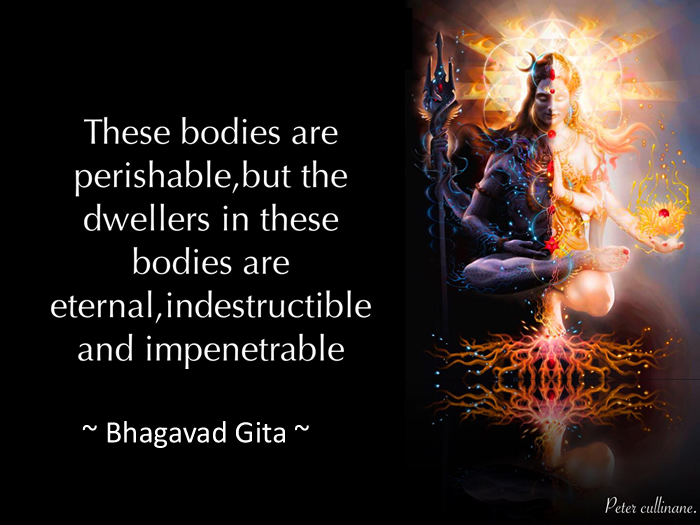 Background — The date of composition of the text of the Bhagavad Gita is not known with certainty, but is widely accepted as 5000 years ago.
Overview — The Srimad Bhagavad Gita is a dialogue between Lord Krishna and Arjuna, narrated in the Bhishma Parva of the Mahabharata. It comprises eighteen discourses of a total of 701 Sanskrit verses. A considerable volume of material has been compressed within these verses. On the battlefield of Kurukshetra, Sri Krishna, during the course of His most instructive and interesting talk with Arjuna, revealed profound, sublime and soul-stirring spiritual truths, and expounded the rare secrets of Yoga, Vedanta, Bhakti and Karma.
 |
|
| Bhagavad Gita |
|---|
http://www.bhagavad-gita.org/index-english.html