Republished by Blog Post Promoter
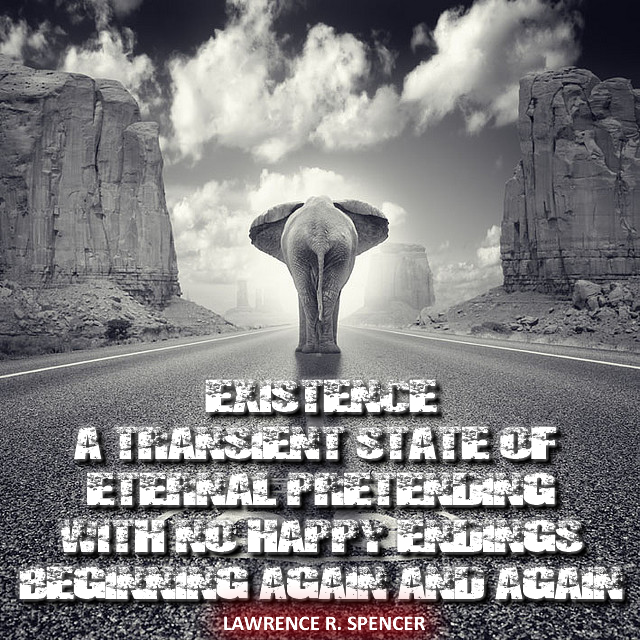
EXISTENCE:
A TRANSIENT STATE OF
ETERNAL PRETENDING
WITH NO HAPPY ENDINGS
BEGINNING AGAIN AND AGAIN

Picture Poems a poems written for, and pasted on, pictures, paintings or graphic art. The poem describes or emulated the picture in verse.
Republished by Blog Post Promoter
EXISTENCE:
A TRANSIENT STATE OF
ETERNAL PRETENDING
WITH NO HAPPY ENDINGS
BEGINNING AGAIN AND AGAIN
Republished by Blog Post Promoter
Republished by Blog Post Promoter
_______________________
lawrence r. spencer
2013
Republished by Blog Post Promoter
Republished by Blog Post Promoter
The Tao Te Ching, Daodejing, or Dao De Jing (道德經: 道 dào “way”; 德 dé “virtue”; 經 jīng “classic” or “text”) is simply referred to as the Laozi. According to tradition, it was written around 6th century BC by the sage Laozi (or Lao Tzu, “Old Master”), a record-keeper at the Zhou Dynasty court, by whose name the text is known in China. The text’s true authorship and date of composition or compilation are still debated, although the oldest excavated text dates back to the late 4th century BC.
Many different translations, versions and interpretations of The Tao have been produced through the past 2,500 years, or so, since the original appearance. Like any “religion”, the “opinions” and “interpretations” of “priests” MODIFY and INTRODUCE FASLE IDEAS into the original. Therefore, I suggest that anyone who wished to sincerely study The Tao as a Body of Wisdom, study many difference translations in order to DECIDE FOR YOURSELF what is “true” or not.