Republished by Blog Post Promoter


Picture Poems a poems written for, and pasted on, pictures, paintings or graphic art. The poem describes or emulated the picture in verse.
Republished by Blog Post Promoter
Republished by Blog Post Promoter
 “604 BCE —
Laozi, a philosopher who wrote a small book called “The Way”, [i] (Footnote) was an IS-BE of great wisdom, who overcame the effects of the “Old Empire” amnesia / hypnosis machinery and escaped from Earth. His understanding of the nature of an IS-BE must have been very good to accomplish this.
According to the common legend, his last lifetime as a human was lived in a small village in China. He contemplated the essence of his own life. Like Guatama Siddhartha, he confronted his own thoughts, and past lives. In so doing, he recovered some of his own memory, ability and immortality.
As an old man, he decided to leave the village and go to the forest to depart the body. The village gatekeeper stopped him and begged him to write down his personal philosophy before leaving. Here is a small piece of advice he gave about “the way” he rediscovered his own spirit:
“He who looks will not see it;
He who listens will not hear it;
He who gropes will not grasp it.
The formless nonentity, the motionless source of motion.
The infinite essence of the spirit is the source of life.
Spirit is self.
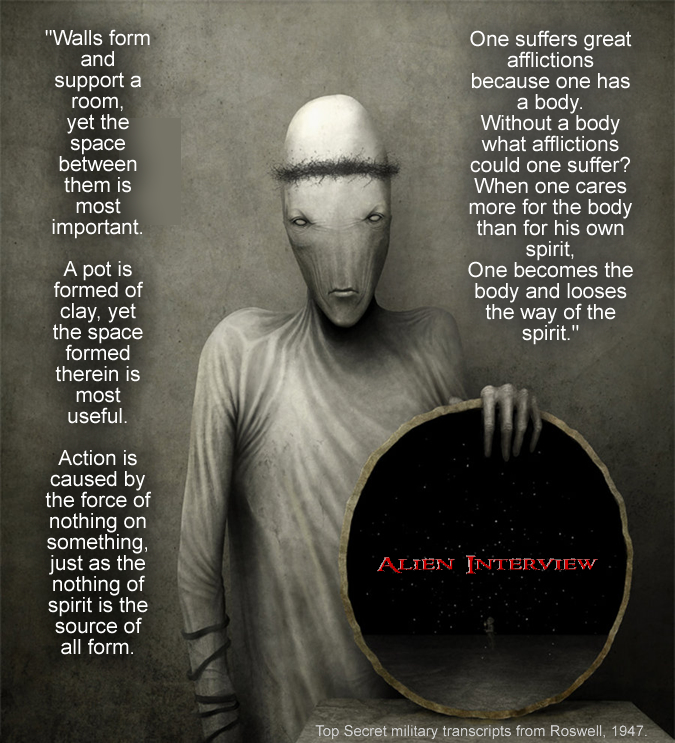
Walls form and support a room,
yet the space between them is most important.
A pot is formed of clay,
yet the space formed therein is most useful.
Action is caused by the force of nothing on something,
just as the nothing of spirit is the source of all form.
One suffers great afflictions because one has a body.
Without a body what afflictions could one suffer?
When one cares more for the body than for his own spirit,
One becomes the body and looses the way of the spirit.
The self, the spirit, creates illusion.
The delusion of Man is that reality is not an illusion.
One who creates illusions and makes them more real than reality, follows the path of the spirit and finds the way of heaven”.
______________
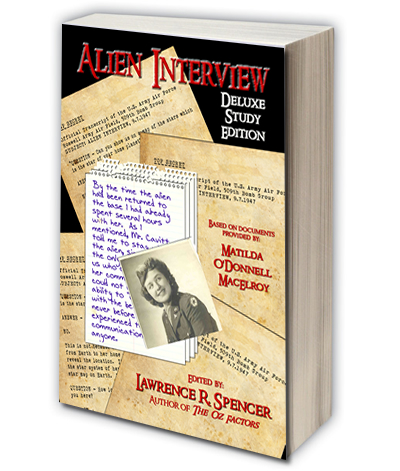
Excerpt from the book ALIEN INTERVIEW
[i] “Laozi, a philosopher who wrote a small book called “The Way”…”
“According to tradition, it was written around 6th century BC by the Taoist sage Laozi (or Lao Tzu, “Old Master”), a record-keeper at the Zhou Dynasty court, by whose name the text is known in China. Tao Te Ching is a Chinese classic text. Its name comes from the opening words of its two sections: 道 dào “way,” and 德 dé “virtue“.
 This ancient book is also central in Chinese religion, not only for Taoism (Dàojiāo 道教) but Chinese Buddhism, which when first introduced into China was largely interpreted through the use of Taoist words and concepts. Many Chinese artists, including poets, painters, calligraphers, and even gardeners have used the Tao Te Ching as a source of inspiration. Its influence has also spread widely outside East Asia, aided by hundreds of translations into Western languages.”
Tao is nameless. (Tao) goes beyond distinctions, and transcends language.
Laozi describes a state of existence before time or space:
“The Way that can be told of is not an unvarying way;
The names that can be named are not unvarying names.
It was from the Nameless that heaven and Earth sprang;
The named is but the mother that rears the ten thousand creatures.
Each after its kind.”
“The Spirit never dies.
It is the Mysterious Female.
The doorway of the Mysterious Female
Is the base from which Heaven and Earth sprang.
It is there within us, all the while;
Draw upon it as you will.
It never runs dry.
We put spokes together and call it a wheel;
But it is on the space where there is nothing that the value of the wheel depends.
We turn clay to make a vessel;
But it is on the space where there is nothing that the value of the vessel depends.
We pierce doors and windows to make a house;
And it is on these spaces where there is nothing that the value of the house depends.
Therefore just as we take advantage of what is,
we should recognize the value of what is not.
Knowing others is wisdom;
Knowing the self is enlightenment.
Mastering others requires force;
Mastering the self requires strength;
He who knows he has enough is rich.
Perseverance is a sign of will power.
He who stays where he is, endures.
To die but not to perish is to be eternally present.”
Many believe the Tao Te Ching contains universal truths that have been independently recognized in other philosophies, both religious and secular.”
— Reference: Wikipedia.org
Republished by Blog Post Promoter

A PHILOSPHER SEEKS SELF-CONTROL <> A PHILOSPHER ASPIRES TO FREEDOM FROM THE FLESH <> A PHILOSOPHER CREATES EACH ETERNAL MOMENT <> A PHILOSPHER KNOWS THAT HE DOES NOT KNOW <>

A PRIEST EXPLOITS FOOLS WHO WORSHIP FLESH <> A PRIEST CONTROLS THE POWER OF GOLD <> A PRIEST ENFORCES MORTALITY on OTHERS <> A PRIEST CAN NOT PERCEIVE AN IMMORTAL SOUL <>

SEEK THE PHILOSOPHERS GOAL <> KNOW YOUR OWN SOUL <> KNOW THAT YOU KNOW <> THAT YOU ARE AN IMMORTAL SOUL <>
-- Lawrence R. Spencer, 2011
Republished by Blog Post Promoter
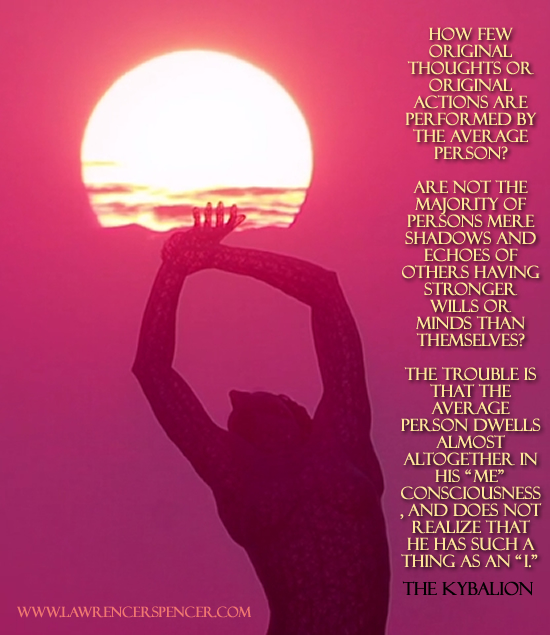
“How few original thoughts or original actions are performed by the average person? Are not the majority of persons mere shadows and echoes of others having stronger wills or minds than themselves? The trouble is that the average person dwells almost altogether in his “Me” consciousness, and does not realize that he has such a thing as an “I.” He is polarized in his Feminine Principle of Mind, and the Masculine Principle, in which is lodged the Will, is allowed to remain inactive and not employed.”
~ The Kybalion, by William Walker Atkinson ~