Republished by Blog Post Promoter
SOCIAL MEDIA SUMMARIZED:

Picture Poems a poems written for, and pasted on, pictures, paintings or graphic art. The poem describes or emulated the picture in verse.
Republished by Blog Post Promoter

Without seeking, one may know all under heaven;
Without finding, one may know the way of heaven.
The wise man knows without searching,
Understands without thinking, accomplishes without acting.
To know when one does not understand is a virtue;
Failing to know that one does not understand is an error.
One becomes more perfect each time an error is corrected.
But One who knows but does not act accordingly, does not know
Be honest with those who are honest. Also be honest
With those who are dishonest; thus is honesty attained.
All beings as basically good. However, prevent those who
do evil from harming others for even they are basically good.
What separates goodness and badness ?
What difference is there between yes and no ?
What distinguishes beauty and ugliness ?
Front and rear join in the center.
Being and non-being are a circle of decision.
The way of heaven conquers without war,
Speaks little but answers well, is always present
Without being summoned, is not rushed but is well planned.
The wise man is skilled in all of his undertakings.
He who is skilled at counting needs no counting devices.
He who is fluid in speech needs no script to guide him.
A man of skill practices skill and conquers reality.
A man who fails practices failure and is conquered.
Walls form and support a room, yet the space between them is most important.
A pot is formed of clay, yet the space formed thereby is most useful.
Action is caused by the force of nothing on something,
just as the nothing of spirit animates the flesh.
One suffers great afflictions because one has a body.
Without a body what afflictions could one suffer?
When one cares more for the body than for the spirit
One becomes the body and looses the way of heaven.
He who looks will not see it; he who listens will not hear it;
He who gropes will not grasp it.
___________________________
Poem “Laotzu is that you?” from “PAN-GOD OF THE WOODS” by Lawrence R. Spencer. Copyright © 2011. All Rights Reserved.
Photo was taken on April 21, 2010 in Bohinjsko Jezero, Radovljica, SI © 2010 Mitja Kobal-Cwithe @ www.fotohikari.com
Republished by Blog Post Promoter
 As people grow older conditions of life often become increasingly painful. We must decide for ourselves when the game is over, and consider our options. The lyrics to this song repeat the timeless question: to be, or not to be? Who should answer the question: You or the body you animate?
Republished by Blog Post Promoter
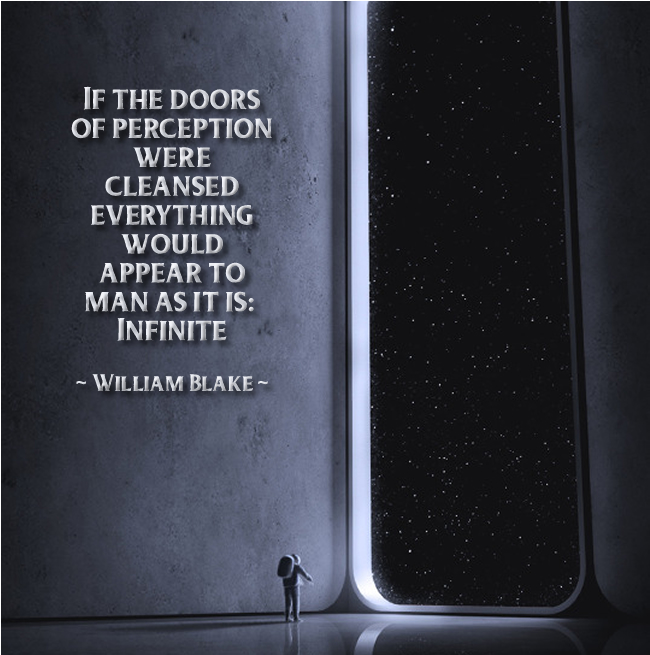 Human beings are able to perceive only about one three-hundreds of one percent of the total electromagnetic spectrum on Earth. Without the blindness imposed by biological bodies, the Beings who animate the body may be able to perceive the entire spectrum of energy, and beyond the finite energy of the physical universe. — LRS
_________________________________
William Blake (28 November 1757 – 12 August 1827) was an English poet, painter, and printmaker. Largely unrecognized during his lifetime, Blake is now considered a seminal figure in the history of the poetry and visual arts.
Republished by Blog Post Promoter
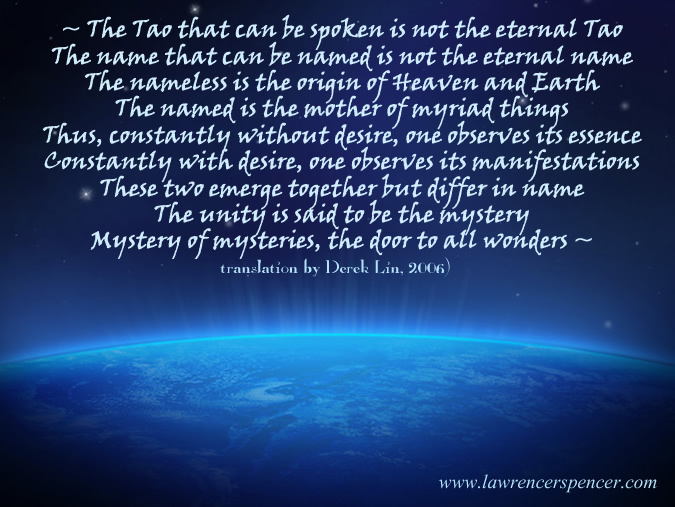
~ The Tao that can be spoken is not the eternal Tao
The name that can be named is not the eternal name
The nameless is the origin of Heaven and Earth
The named is the mother of myriad things
Thus, constantly without desire, one observes its essence
Constantly with desire, one observes its manifestations
These two emerge together but differ in name
The unity is said to be the mystery
Mystery of mysteries, the door to all wonders ~
_________________
Laozi, author of a small book titled “Tao Te Ching” (literally, “The Way”), lived during the 6th or 5th century BCE. His surname was Li and his personal name was Er or Dan. He was an official in the imperial archives and wrote a book in two parts before departing to the west. In another, Laozi was a different contemporary of Confucius titled Lao Laizi (老莱子) and wrote a book in 15 parts. In a third, he was the court astrologer Lao Dan who lived during the 4th-century BCE reign of Duke Xian of Qin.[20][21] The oldest text of the Tao Te Ching so far recovered was written on bamboo slips and dates to the late 4th century BCE.
According to traditional accounts, Laozi was a scholar who worked as the Keeper of the Archives for the royal court of Zhou. This reportedly allowed him broad access to the works of the Yellow Emperor and other classics of the time. The stories assert that Laozi never opened a formal school but nonetheless attracted a large number of students and loyal disciples. (Wikipedia)