Republished by Blog Post Promoter
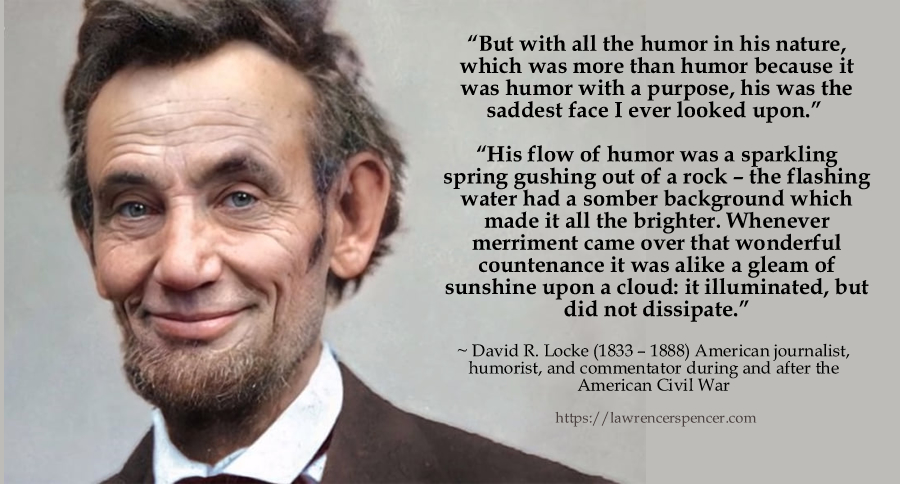 “Today we think of Abraham Lincoln as a great leader—perhaps our greatest. We recall his eloquent speeches, his dedication to the Union, and his superior leadership. We honor his devotion to duty, sacrifice, and honesty.
What we don’t think of today when we think of Abraham Lincoln is “a good joke.” In Lincoln’s day, however, he was a well known humorist and story teller. The anecdote about two Quaker women discussing Lincoln and Confederate president Jefferson Davis at the beginning of the Civil War is illustrative: The first Quaker lady said, after some contemplation, that she believed the Confederacy would win the war because “Jefferson Davis is a praying man.” “But Abraham Lincoln is a praying man too,” the second Quaker lady protested. “Yes,” the first admitted, “but the Lord will think Abraham is joking.”
Lincoln inherited his penchant for jokes and story telling from his father, Thomas Lincoln. When Abe was a child he loved to listen to his father and other men swap yarns around the woodstove. As he grew older he became increasingly adept at telling and re-telling humorous stories, frequently modifying them to accommodate each situation. When Lincoln became a lawyer, he used his jokes and stories to gain the good will of juries, and more than once his opposing counsel would complain to the judge that Lincoln’s stories were irrelevant and distracting to the jury. The trouble for them was that Eighth Circuit Judge David Davis loved Lincoln’s jokes more than anyone else in the court room.
Typical of a joke Judge Davis loved was one which Lincoln told to poke fun at himself: I feel like I once did when I met a woman riding horseback in the woods. As I stopped to let her pass, she also stopped, and, looking at me intently, said: “I do believe you are the ugliest man I ever saw.” Said I, “Madam, you are probably right, but I can’t help it!” “No,” said she, “you can’t help it, but you might stay at home!”
Another one of Lincoln’s 8th Circuit yarns was the one about a man in Cortlandt county who had raised a hog of such tremendous size that people came from miles around to see it. One of the people saw the hog’s owner and inquired about the animal. “W’all, yes,” the old fellow said: “I’ve got such a critter, mighty big un, but I guess I’ll have to charge you about a dollar for lookin’ at him.” The stranger glared at the old man for a minute or so, handed him the desired money, and started to walk away. “Hold on,” said the old man, “don’t you want to see the hog?” “No,” said the stranger. “Lookin at you, I’ve seen as big a hog as I ever want to see!”
He told another story of a time he was splitting rails when a man carrying a rifle walked up to him and demanded that Lincoln look him directly in the eye. Lincoln stopped his work and obliged the man, who continued to silently stare at him for some minutes. Finally the man told Lincoln that he “had promised himself years ago that if he ever met a man uglier than himself, he would shoot him.” Lincoln looked at the man’s rifle mischeviously and said nothing. Finally Lincoln pulled open his shirt, threw out his chest, and exclaimed, “If I am uglier than you, go ahead and shoot—because I don’t want to live!”
As a politician, Lincoln made excellent use of his humorous stories. His long time political opponent Stephen A. Douglas complained that Lincoln’s jokes were “like a slap across my back. Nothing else—not any of his arguments or any of his replies to my questions—disturbs me. But when he begins to tell a story, I feel that I am to be overmatched.” More than once Douglas and other political opponents of Lincoln’s saw their eloquently presented arguments forgotten by the audience after Lincoln followed up their speeches with a homely story or anecdote. At Alton, Illinois, during the last of the “great debates” with Douglas, Lincoln told a story that illustrated how he felt about a political feud that was currently raging between Democratic senator Douglas and the head of the Democratic Party. He said he felt like the old woman that, not knowing who was going to win a brawl between her husband and a bear, decided to cheer for both of them: “Go it husband, go it bear!”
In another instance Lincoln got a tremendous laugh from the audience when he said one of Senator Douglas’’ arguments was “as thin as the homeopathic soup that was made by boiling the shadow of a pigeon that had starved to death.”
When Lincoln became president, he used his jokes for a different purpose. He would frequently use them to get rid of visitors that had over-stayed their alotted visiting time. In these situations he would use a funny story to illustrate a point he was trying to make, and then—while the listeners were laughing—would ease them out the door.
This happened once when Lincoln was asked what he was going to do with a general that had failed several assignments. Anxious to get rid of his questioners, he told them that the question reminded him of a blacksmith he knew back in New Salem. One day, when the blacksmith didn’t have much to do, he started his fire and began heating up a piece of soft iron. When he got it hot he carried it to the anvil and began to hammer it, thinking he would weld it into an agricultural implement. He pounded away for some time until he got it fashioned into some shape, but discovered that the iron was not big enough for the implement he had in mind. He then put it back into the forge, heated it up again, and recommenced hammering, having decided to make a claw hammer. After a while he concluded that there was too much iron for a hammer. So again he heated it, this time thinking he would form an axe. After hammering and welding it into shape, he concluded there was not enough iron left to make an axe. He was now getting tired and disgusted at the result of his various failures. So finally he filled his forge full of coal, worked up a tremendous heat, and brought the remaining lump of iron to a white heat. With his tongs he lifted it from the bed of coals, and thrusting it into a tub of water near by, exclaimed with an oath, “Well, if I can’t make anything else of you, I will make you into a big fizzle, anyhow!” After he escorted his laughing visitors out the door, Lincoln decided to send the general out west to fight Indians.
Another example of Lincoln’s humor during the war was when he talked about Confederate General John B. Hood’s army after it had been annihilated in the battle of Nashville, Tennessee. Lincoln said “I think Hood’s army is about in the fix of Bill Sykes’s dog, down in Sangamon county. Bill Sykes had a long, yaller dog, that was forever getting into the neighbors’ meat houses and chicken coops. They had tried to kill it a hundred times, but the dog was always too smart for them. Finally, one of them got a bladder of a coon, and filled it up with powder, tying the neck around a piece of punk. When he saw the dog coming he fired the punk, split open a hot biscuit and put the bladder in, then buttered it all nicely and threw it out. The dog swallowed it at a gulp. Pretty soon there was an explosion. The head of the dog lit on the porch, the fore-legs caught astraddle the fence, the hind-legs fell in the ditch, and the rest of the dog lay around loose. Pretty soon Bill Sykes came along, and the neighbor said; “Bill I guess there ain’t much of that dog of your’n left.” “Well, no,” said Bill; “I see plenty of pieces, but I guess that dog, as a dog, ain’t of much more account.” Lincoln concluded that although there were still pieces of Hood’s army left, the army, as an army, wasn’t of much more account.
As the responsibilities of the office of president became more unendurable, Lincoln used humor for self-therapy. He wanted to lessen the tensions in himself and those around him, and he frequently pointed fun at pompous generals when doing this. He said that he once saw a short, fat general that reminded him of a man he knew in Springfield whose name was Enoch. He said Enoch’s legs were so short that when he walked through the snow the seat of his trousers wiped out his footprints.
Lincoln told of the preacher that said, during his sermon, that although the Lord was the only perfect man, the Bible never mentioned a perfect woman. A woman in the rear of the congregation called out “I know a perfect woman, and I’ve heard of her every day for the last six years.” “Who was she?” asked the surprised minister. “My husband’s first wife,” came the reply.
Listening to two groups of men that came to argue as to whether or not a St. Louis church should be closed as a result of statements of disloyalty from its minister, Lincoln said that the situation reminded him of a story. He said that a man in Sangamon County had a melon patch that kept getting ruined by a wild hog. Finally he and his sons decided to take their guns and track the animal down. They followed the tracks to the neighboring creek, where they disappeared. They discovered them on the opposite bank, and waded through. They kept on the trail a couple of hundred yards, when the tracks again went into the creek, and promptly turned up on the other side. Out of breath and patience, the farmer said “John you cross over and go up on that side of the creek, and I’ll keep up on this side, because I believe that hog is on both sides of the creek!” “Gentlemen,” concluded Lincoln, “that is just where I stand in regard to your controversies in St. Louis. I am on both sides. I can’t allow my Generals to run the churches, and I can’t allow your ministers to preach rebellion.”
One cannot truly appreciate Lincoln without understanding his humorous side. Lincoln certainly deserves the credit he’s received for what he accomplished in the way of preservation of the Union and freeing the slaves. But Lincoln had a lighter side, also, and he used his jokes and stories both for the purpose of winning over his audience and relieving the tremendous pressure he experienced as President during the terrible Civil War.”
For further reading:
See my latest book on Lincoln’s Humor: Abe Lincoln’s Gift: How Humor Shaped Lincoln’s Life and Legacy by web author Gordon Leidner.