
Category Archives: INSIDE THE BOOK

Inside the book, Vermeer: Portraits of A Lifetime. Analysis of all the paintings of Johannes Vermeer. The book reveals for the first time that the women featured in the paintings of Johannes Vermeer were members of his own family, his daughters, his wife and mother-in-law, Maria Thins.

THE PRICIPLE OF GENDER

Republished by Blog Post Promoter
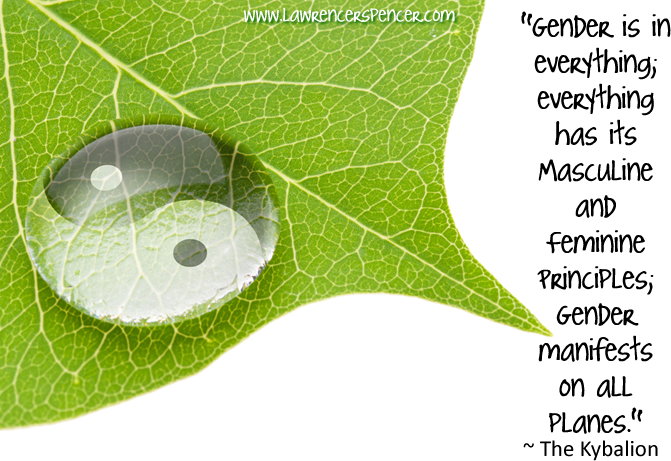
GENDER

  “This Principle embodies the truth that there is GENDER manifested in everything–the Masculine and Feminine Principles ever at work. This is true not only of the Physical Plane, but of the Mental and even the Spiritual Planes. On the Physical Plane, the Principle manifests as SEX, on the higher planes it takes higher forms, but the Principle is ever the same. No creation, physical, mental or spiritual, is possible without this Principle. An understanding of its laws will throw light on many a subject that has perplexed the minds of men. The Principle of Gender works ever in the direction of generation, regeneration, and creation. Everything, and every person, contains the two Elements or Principles, or this great Principle, within it, him or her. Every Male thing has the Female Element also; every Female contains also the Male Principle. If you would understand the philosophy of Mental and Spiritual Creation, Generation, and Re-generation, you must understand and study this Hermetic Principle. It contains the solution of many mysteries of Life. We caution you that this Principle has no reference to the many base, pernicious and degrading lustful theories, teachings and practices, which are taught under fanciful titles, and which are a prostitution of the great natural principle of Gender. Such base revivals of the ancient infamous forms of Phallicism tend to ruin mind, body and soul, and the Hermetic Philosophy has ever sounded the warning note against these degraded teachings which tend toward lust, licentiousness, and perversion of Nature’s principles. If you seek such teachings, you must go elsewhere for them–Hermeticism contains nothing for you along these lines. To the pure, all things are pure; to the base, all things are base.”

— The Kybalion: Hermetic Philosophy is a 1908 book claiming to be the essence of the teachings of Hermes Trismegistus, published anonymously by a group or person under the pseudonym of “The Three Initiates”.

Who Were The Women in The Paintings of Vermeer?

Republished by Blog Post Promoter

Women in the paintings of Vermeer

“Exhaustive research conducted by a wide range of investigators during the 300 years since his death proves that Vermeer had no other studio outside of his home in which to paint.  The logical extension of this fact, inasmuch as Vermeer and his wife Catharina produced 15 children during his short life, what that he must have been constantly, and continually surrounded by his family in the house while he painted!  By extrapolation, is it not obvious, even at the most casual investigation, that the most readily available models for his paintings would be his own family members?   This observation is compounded and ratified by the fact that nearly every one of his surviving paintings features young women as the principle model! 

Therefore, it is reasonable to assume that Vermeer worked at home, and that he painted pictures of the women in his own family.

It is clearly documented that Vermeer had 5 daughters old enough to be the women shown in the paintings.  Also, his wife and mother-in-law, are very likely candidates to be women shown in his paintings.  A very thorough comparison of the faces of each of the women shown in his paintings reveals the obvious observation that the same women are being painted again and again. “

— Excerpted from the book, “Vermeer: Portraits of A Lifetime”, by Lawrence R. Spencer

This question, and many other unsolved mysteries of the Vermeer paintings are addressed, with proposed resolutions, in the book, “Vermeer: Portraits of A Lifetime”  (click here to visit the publisher website to learn more.)

EXPERIENCE

Republished by Blog Post Promoter

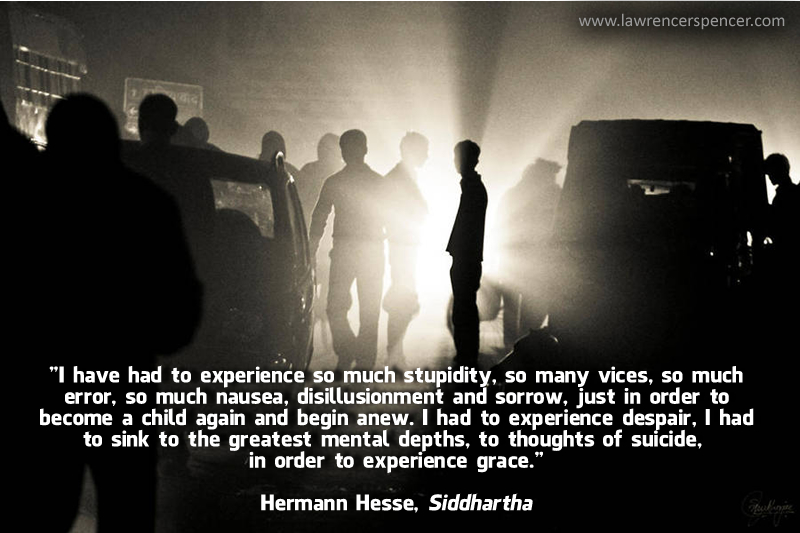
Siddhartha is a novel by Hermann Hesse that deals with the spiritual journey of self-discovery of a man named Siddhartha during the time of the Gautama Buddha.  The word Siddhartha is made up of two words in Sanskrit language, siddha (achieved) + artha (what was searched for), which together means “he who has found meaning (of existence)” or “he who has attained his goals”. In fact, the Buddha’s own name, before his renunciation, was Siddhartha Gautama, Prince of Kapilavastu. In this book, the Buddha is referred to as “Gotama”.  — Wikipedia.org

Download the e-Book for Free:  http://www.gutenberg.org/ebooks/2500

DUMB / SMART

Republished by Blog Post Promoter

A quote by Douglas Adams from the publication, The Salmon of Doubt: Hitchhiking the Galaxy One Last Time is a posthumous collection of previously published and unpublished material by Douglas Adams. It consists largely of essays about technology and life experiences, but its major selling point is the inclusion of the incomplete novel on which Adams was working at the time of his death, The Salmon of Doubt (from which the collection gets its title, a reference to the Irish myth of the Salmon of Knowledge).

FORCES OF THE HEAVENS WITHIN OURSELVES

Republished by Blog Post Promoter

“When I investigate and when I discover that the forces of the heavens and the planets are within ourselves, then truly I seem to be living among the gods.”

— Leon Battista Alberti (c. 1404 – 1472) Italian architect, philosopher, poet

(from the Introduction the Chapter VIII of the book

PAN – GOD OF THE WOODS

by Lawrence R. Spencer