Republished by Blog Post Promoter

Free Advice about Life, Universe and Other Stuff from Lawrence R. Spencer
Republished by Blog Post Promoter
Republished by Blog Post Promoter
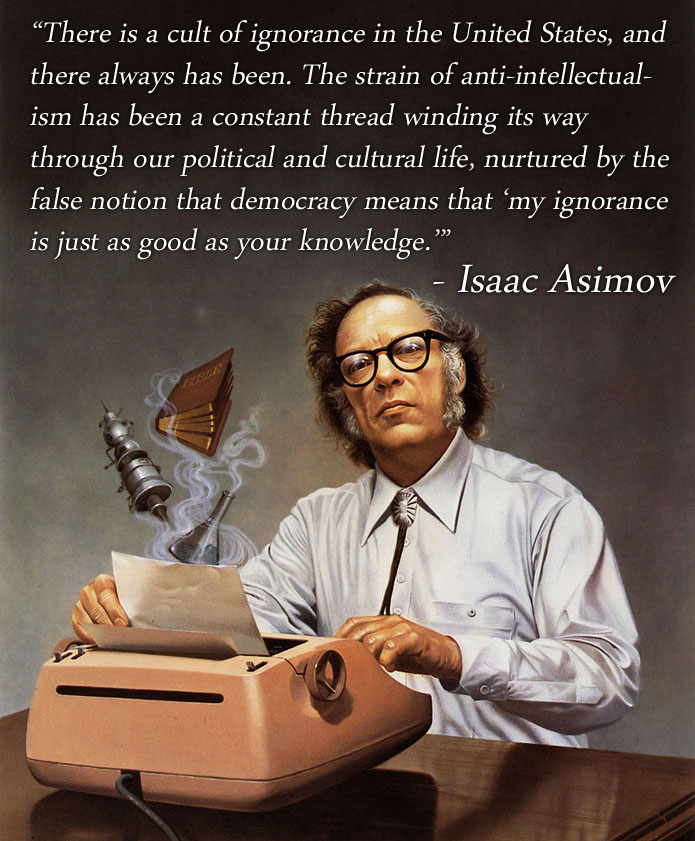
“(January 2, 1920 – April 6, 1992) Isaac Asimov was a Russian American author and professor of biochemistry at Boston University, best known for his works of science fiction and for his popular science books. Asimov was one of the most prolific writers of all time, having written or edited more than 500 books and an estimated 90,000 letters and postcards. His works have been published in all ten major categories of the Dewey Decimal System Asimov’s career can be divided into several time periods. His early career, dominated by science fiction, began with short stories in 1939 and novels in 1950. This lasted until about 1958, all but ending after publication of The Naked Sun. He began publishing nonfiction in 1952, co-authoring a college-level textbook called Biochemistry and Human Metabolism. Following the brief orbit of the first man-made satellite Sputnik I by the USSR in 1957, his production of nonfiction, particularly popular science books, greatly increased, with a consequent drop in his science fiction output. Over the next quarter century, he wrote only four science fiction novels. Starting in 1982, the second half of his science fiction career began with the publication of Foundation’s Edge. From then until his death, Asimov published several more sequels and prequels to his existing novels, tying them together in a way he had not originally anticipated, making a unified series. There are, however, many inconsistencies in this unification, especially in his earlier stories.
Asimov believed that his most enduring contributions would be his “Three Laws of Robotics” and the Foundation Series (see Yours, Isaac Asimov, p. 329). Furthermore, the Oxford English Dictionary credits his science fiction for introducing the words positronic (an entirely fictional technology), psychohistory (which is also used for a different study on historical motivations) and robotics into the English language. Asimov coined the term robotics without suspecting that it might be an original word; at the time, he believed it was simply the natural analogue of words such as mechanics and hydraulics, but for robots. Unlike his word psychohistory, the word robotics continues in mainstream technical use with Asimov’s original definition. Star Trek: The Next Generation featured androids with “positronic brains” giving Asimov full credit for “inventing” this fictional technology.” (Wikipedia.org)
Republished by Blog Post Promoter
Republished by Blog Post Promoter

“When any government, or any church for that matter, undertakes to say to its subjects, “This you may not read, this you must not see, this you are forbidden to know,” the end result is tyranny and oppression, no matter how holy the motives. Mighty little force is needed to control a man whose mind has been hoodwinked; contrariwise, no amount of force can control a free man, a man whose mind is free. No, not the rack, not fission bombs, not anything — you can’t conquer a free man; the most you can do is kill him.”
— If This Goes On (1940) by Robert Anson Heinlein (7 July 1907 – 8 May 1988) was one of the most popular, influential, and controversial authors of science fiction of the 20th Century.