Republished by Blog Post Promoter
 Naturally, an healthy life organism acts to increase the well-being, health, good-fortune, sustainability and longevity of itself and others who are inter-dependent for mutual survival. On Earth, the “food chain” in nature dictates a “hierarchy of evil” (depending on the point of view of the eater vs the eaten). When a sea lion kills and eats a penguin this is “normal”. No “crime” has been committed — from the point of view of the sea lion.
In human society, when one man kills another, or steals his possessions, it is conceived that this man is “evil” and has committed a “crime” — from the point of view of the victim. If entire nations of killers invade a defenseless people who are unable to invoke “law” or “justice” or “revenge”, then no “crime” has been committed — from the point of view of the killers.
Examples of “evil” behavior and activities of this kind are “normal” through the entire history of human society, whether conducted by brutal military conquest, religious indoctrination or financial swindle, theft or deception.
Logically, if “evil” or “crime” is “normal for human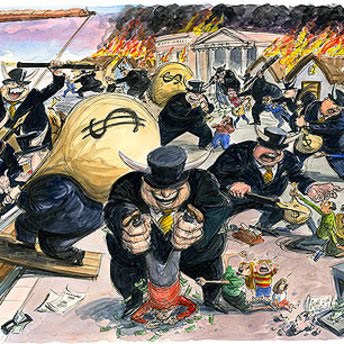
Definition of “CRIME”
noun: an evil act not necessarily punishable by law
Definition of “EVIL”
noun: that which causes harm or destruction or misfortune
adjective: having or exerting a malignant influence
http://www.rhymezone.com
Therefor, by extrapolation, the definition of “CRIMINAL” would be:
An individual, entity, organization or group of individual entities acting or prohibiting action, which acts or exerts malignant influences to create destruction, harm and misfortune, whether or not these influences or actions are punishable by law — from the point of view of the victim.
Therefor, by logical extension, the greater the magnitude of harm, destruction or misfortune caused indicates the degree to which a person, or entity is criminal. Historically, on Earth, the very BIG criminals can usually be observed to operate and control several fundamental human activities:
1- Finance, 2- Culture/Education/Religion, 3 – Legislation/Government, 4- Industry/Commerce, 5- Military, 6- Labor, 7- Natural Resources (consumed by humans), and 8- Geographic Territory (occupied by humans), 9- Technology.
Historically, as in current “civilization”, one could apply this definition of “criminal” to Bankers, Educators, Religions, Legislators, Politicians, Industrialists, Corporations, Energy/Food/Materials Suppliers, Government Contractors, Military leaders, Soldiers, Employers, Real Estate Owners, Scientists and Engineers, as well a individual people.
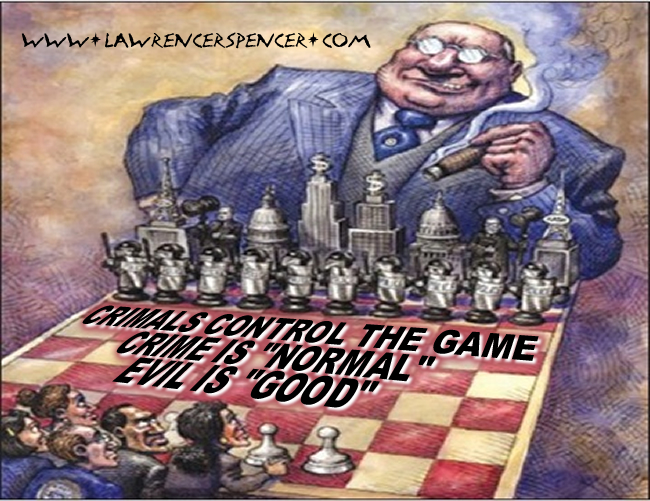
When the “criminals” control playing board and make up their own rules, there is no “evil”. “Crime” is “normal”.
— Lawrence R. Spencer. 2015.