Category Archives: ALIEN INTERVIEW BOOK

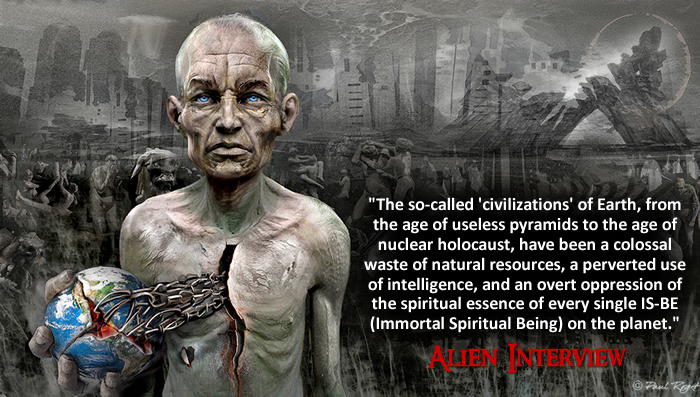
The content of this book. “Alien Interview” is the letter, Top Secret interview transcripts and personal notes received from the late Matilda O’Donnell MacElroy, an Army Air Force nurse who stationed at the Roswell Army Air Field 509th Bomb Group. Her letter asserts that this material is based on a series of interviews she conducted with an extraterrestrial being as part of her official duty as a nurse in the U.S. Army Air Force. During July and August she interviewed a saucer pilot who crashed near Roswell, New Mexico on July 8th, 1947. The being identitied itself as an officer, pilot and engineer from a race of beings who use the asteroid belt in our solar system as a space port in an intergalactic communication network of an empire they call “The Domain”.

SOURCE OF BIODIVERSITY

Republished by Blog Post Promoter
“…there are millions of species [i] (Footnote) of insects. About 350,000 of these are species of beetles. [ii] (Footnote) There may be as many as 100 million species of life forms on Earth at any given time. In addition, there are many times more extinct species of life on Earth than there are living life forms. Some of these will be rediscovered in the fossil or geological records of Earth.

The current “theory of evolution” of life forms on Earth does not consider the phenomena of biological diversity. Evolution by natural selection is science fiction. One species does not accidentally, or randomly evolve to become another species, as the Earth textbooks indicate, without manipulation of genetic material by an IS-BE.    [iii] (Footnote)

80-beetlesA simple example of IS-BE intervention is the selective breeding of a species [iv] (Footnote) on Earth. Within the past few hundred years several hundred dog breeds and hundreds of varieties of pigeons and dozens of Koi fish have been “evolved” in just a few years, beginning with only one original breed. Without active intervention by IS-BEs, biological organisms rarely change.

The development of an animal like the ‘duck-billed platypus’ required a lot of very clever engineering to combine the body of a beaver with the bill of a duck and make a mammal that lays eggs. Undoubtedly, some wealthy client placed a “special order” for it as a gift or curious amusement. I am sure the laboratory of some biotechnical company worked on it for years to make it a self-replicating life form!

The notion that the creation of any life form could have resulted from a coincidental chemical interaction moldering up from some primordial ooze is beyond absurdity! Factually, some organisms on Earth, such as Proteobacteria, [v] (Footnote) are modifications of a Phylum [vi] (Footnote) designed primarily for “Star Type 3, Class C” planets. In other words, The Domain designation for a planet with an anaerobic atmosphere nearest a large, intensely hot blue star, [vii] (Footnote) such as those in the constellation of Orion’s Belt in this galaxy.ALIEN INTERVIEW

Creating life forms is very complex, highly technical work for IS-BEs who specialize in this field. Genetic anomalies are very baffling to Earth biologists who have had their memory erased. Unfortunately, the false memory implantations of the “Old Empire” prevent Earth scientists from observing obvious anomalies.”

–Excerpted from the book ALIEN INTERVIEW

[i] “…species…”

“In biology, a species is one of the basic units of biological classification and a taxonomic rank. A species is often defined as a group of organisms capable of interbreeding and producing fertile offspring. While in many cases this definition is adequate, more precise or differing measures are often used, such as based on similarity of DNA or morphology. Presence of specific locally-adapted traits may further subdivide species into subspecies.

The commonly used names for plant and animal taxa sometimes correspond to species: for example, “lion,” “walrus,” and “Camphor tree,” each refers to a species. In other cases common names do not: for example, “deer” refers to a family of 34 species, including Eld’s Deer, Red Deer and Wapiti (Elk). The last two species were once considered a single species, illustrating how species boundaries may change with increased scientific knowledge.

Each species is placed within a single genus. This is a hypothesis that the species is more closely related to other species within its genus than to species of other genera. All species are given a binomial name consisting of the generic name and specific name (or specific epithet). For example, Pinus palustris (commonly known as the Longleaf Pine).

A usable definition of the word “species” and reliable methods of identifying particular species are essential for stating and testing biological theories and for measuring biodiversity. Traditionally, multiple examples of a proposed species must be studied for unifying characters before it can be regarded as a species. Extinct species known only from fossils are generally difficult to give precise taxonomic rankings to. A species which has been described scientifically can be referred to by its binomial names.

Nevertheless, as Charles Darwin remarked,

‘I look at the term species as one arbitrarily given for the sake of convenience to a set of individuals closely resembling each other …. it does not essentially differ from the term variety, which is given to less distinct and more fluctuating forms. The term variety, again in comparison with mere individual difference, is also applied arbitrarily, and for mere convenience sake.’

Because of the difficulties with both defining and tallying the total numbers of different species in the world, it is estimated that there are anywhere between 2 million and 100 million different species.”  — Reference: Wikipedia.org

[ii] “…species of beetle…”

“Beetles are a group of insects which have the largest number of species. They are placed in the order Coleoptera, which means “sheathed wing” and contains more described species than in any other order in the animal kingdom, constituting about twenty-five percent of all known life-forms. Forty percent of all described insect species are beetles (about 350,000 species), and new species are frequently discovered. Estimates put the total number of species, described and undescribed, at between 5 and 8 million.

Beetles can be found in almost all habitats, but are not known to occur in the sea or in the polar regions. They interact with their ecosystems in several ways. They often feed on plants and fungi, break down animal and plant debris, and eat other invertebrates. Some species are prey of various animals including birds and mammals. Certain species are agricultural pests, such as the Colorado potato beetle Leptinotarsa decemlineata, the boll weevil Anthonomus grandis, the red flour beetle Tribolium castaneum, and the mungbean or cowpea beetle Callosobruchus maculatus, while other species of beetles are important controls of agricultural pests. For example, coccinellidae (“ladybirds” or “ladybugs”) consume aphids, scale insects, thrips, and other plant-sucking insects that damage crops.”  –– Reference: Wikipedia.org

[iii]   “One species does not evolve to become another species, as the Earth textbooks indicate, without the intervention and manipulation of genetic material by an IS-BE.”

“Genetic engineering, recombinant DNA technology, genetic modification / manipulation (GM) and gene splicing are terms applied to the direct manipulation of an organism’s genes. Genetic engineering is not to be confused with traditional breeding where the organism’s genes are manipulated indirectly. Genetic engineering uses the techniques of molecular cloning and transformation. Genetic engineering endeavors have found some success in improving crop technology, the manufacture of synthetic human insulin through the use of modified bacteria, the manufacture of erythropoietin in Chinese hamster ovary cells, and the production of new types of experimental mice such as the oncomouse (cancer mouse) for research.

Since a protein sequence is specified by a segment of DNA called a gene, novel versions of that protein can be produced by changing the DNA sequence of the gene. The companies that own the modified genome are able to patent it. In the case of basic crops, the companies gain control of foodstuffs, controlling food production on a large scale and reducing agrobidiversity to a few varieties. The only apparent interest in promoting this tecnology appears to be purely economic, despite the claims of seed companies such as Monsanto and Novartis to solve the world food scarcity. It is now popularly understood that it is not the lack of food on a wholewide scale that is the main problem, but its distribution, aggravated by prohibitive tariffs by rich nations. Genetically modified crops do not reduce hunger. The majority of genetically crops are destined for animal food to meet the high demand for meat in developed countries. No genetic modification have yet to serve the needs of mankind despite all the promises in this direction.

However, even with regard to this technology’s great potential, some people have raised concerns about the introduction of genetically engineered plants and animals into the environment and the potential dangers of human consumption of GM foods. They say that these organisms have the potential to spread their modified genes into native populations thereby disrupting natural ecosystems. This has already happened.”  — Reference: Wikipedia.org

[iv] “…genetic manipulation of a species…”

“How much genetic variation is there? Historical debate: Classical school held that there was very little genetic variation, most individuals were homozygous for a “wild-type” allele. Rare heterozygous loci due to recurrent mutation; natural selection purges populations of their “load” of mutations. Balance school held that many loci will be heterozygous in natural populations and heterozygotes maintained by “balancing selection” (heterozygote advantage). Selection thus plays a role in maintaining variation.

How do we measure variation? To show that there is a genetic basis to a continuously varying character one can study 1) resemblance among relatives: look at the offspring of individuals from parents in different parts of the distribution; can estimate heritability (more later). 2) artificial selection: pigeons and dogs show that there is variation present; does not tell how much variation.”  — Reference: http://biomed.brown.edu/Courses/BIO48/5.Geno.Pheno.HTML

[v] “… Proteobacteria…”

“The Proteobacteria are a major group (phylum) of bacteria. They include a wide variety of pathogens, such as Escherichia, Salmonella, Vibrio, Helicobacter, and many other notable genera. Others are free-living, and include many of the bacteria responsible for nitrogen fixation. The group is defined primarily in terms of ribosomal RNA (rRNA) sequences, and is named for the Greek god Proteus (also the name of a bacterial genus within the Proteobacteria), who could change his shape, because of the great diversity of forms found in this group.

All Proteobacteria are Gram-negative, with an outer membrane mainly composed of lipopolysaccharides. Many move about using flagella, but some are non-motile or rely on bacterial gliding. The last include the myxobacteria, a unique group of bacteria that can aggregate to form multicellular fruiting bodies. There is also a wide variety in the types of metabolism. Most members are facultatively or obligately anaerobic and heterotrophic, but there are numerous exceptions. A variety of genera, which are not closely related to each other, convert energy from light through photosynthesis. These are called purple bacteria, referring to their mostly reddish pigmentation.”

— Reference: Wikipedia.org

[vi]   “…Phylum…”

“In biological taxonomy, a ‘phylum’ is a taxonomic rank at the level below Class and above Kingdom. “Phylum” is adopted from the Greek φυλαί phylai, the clan-based voting groups in Greek city-states.”  — Reference: Wikipedia.org

[vii] “…intensely hot blue star…”

“Blue stars are very hot and very luminous; in fact, most of their output is in the ultraviolet range. These are the rarest of all main sequence stars, constituting as few as 1 in 3,000,000 in the solar neighborhood. (Blue) stars shine with a power over a million times our Sun’s output.  Examples: Zeta Orionis, Zeta Puppis, Lambda Orionis, Delta Orionis”..   — Reference: Wikipedia.org

EXPEDIENCY

Republished by Blog Post Promoter


EXPEDIENCY

ALIEN INTERVIEW“A priesthood, or prison guards, were used to help reinforce the idea that an individual is only a biological body and is not an Immortal Spiritual Being.  The individual has no identity.  The individuals have no past lives.  The individual has no power.  Only the gods have power.  And, the gods are a contrivance of the priests who intercede between men and the gods they serve.  Men are slaves to the dictates of the priests who threaten eternal spiritual punishment if men do not obey them. What else would one expect on a prison planet where all prisoners have amnesia, and the priests themselves are prisoners?”

“Anyone who is not willing or able to submit to mindless  economic, political and religious servitude as a tax-paying worker in the class system of the “Old Empire” are “untouchable” and sentenced to receive memory wipe-out and permanent imprisonment on Earth.”

‘It is my personal belief that the truth should not be sacrificed on the altar of political, religious or economic expediency.” 

— Airl, from the Top Secret interview transcripts published in the book ALIEN INTERVIEW      Support independent publishing: Buy this book on Lulu.

DEFINITIONexpedient —

noun:   a means to an end; not necessarily a principled or ethical one

expediency:

noun:   the quality of being suited to the end in view

UFO CONTROL SYSTEM

Republished by Blog Post Promoter

Is the UFO Phenomenon an elaborate “control system”, designed to control and manipulate  human perception, social systems, behavior and the resources of Earth?

invisible collegeIn The Invisible College (E.P. Dutton, 1975) Vallee posits the idea of a “control system.” UFOs and related phenomena are “the means through which man’s concepts are being rearranged.” Their ultimate source may be unknowable, at least at this stage of human development; what we do know, according to Vallee, is that they are presenting us with continually recurring “absurd” messages and appearances which defy rational analysis but which nonetheless address human beings on the level of myth and imagination.

“When I speak of a control system for planet earth,” he says, ” I do not want my words to be misunderstood: I do not mean that some higher order of beings has locked us inside the constraints of a space-bound jail, closely monitored by psychic entities we might call angels or demons. I do not propose to redefine God. What I do mean is that mythology rules at a level of our social reality over which normal political and intellectual action has no power….”

The following are excerpts from an interview with Dr. Jacques Vallee, famed UFO investigator, author, computer scientist and humanitarian, with Jerome Clark, published in FATE Magazine, 1978. The title of the interview is Jacques Vallee Discusses UFO Control System“.

 http://www.ufoevidence.org/documents/doc608.htm

Vallee: “If the UFO phenomenon had no physical cause at all, there would be no way for us to perceive it because human beings are physical entities. So it has to make an impression on our senses somehow. For that to take place, it has to be physical at some time.

Clark: So in other words there is such a thing as a solid, three-dimensional flying saucer.

Vallee: No, I didn’t say that. That may or may not be true. I don’t think there is such a thing as the flying saucer phenomenon. I think it has three components and we have to deal with them in different ways.messengers of deception

First, there is a physical object. That may be a flying saucer or it may be a projection or it may be something entirely different. All we know about it is that it represents a tremendous quantity of electromagnetic energy in a small volume. I say that based upon the evidence gathered from traces, from electromagnetic and radar detection and from perturbations of the electromagnetic fields such as Dr. Claude Poher, the French space scientist, has recorded.

Second, there’s the phenomenon the witnesses perceive. What they tell us is that they’ve seen a flying saucer. Now they may have seen that or they may have seen an image of a flying saucer or they may have hallucinated it under the influence of microwave radiation, or any of a number of things may have happened. The fact is that the witnesses were exposed to an event and as a result they experienced a highly complex alteration of perception which caused them to describe the object or objects that figure in their testimony.

Beyond there – the physical phenomenon and the perception phenomenon – we have the third component, the social phenomenon. That’s what happens when the reports are submitted to society and enter the cultural arena. That’s the part which I find most interesting.

The occurrences of similar “absurd” messages in UFO cases brought me to the idea that maybe we’re dealing with a sort of control system that is subtly manipulating human consciousness.

Clark: But how do you prove that one is operating in a UFO context?

Vallee: I’ve always been unhappy with the argument between those who believe UFOs are nonsense and those who believe they are extraterrestrial visitors. I don’t think I belong in either camp. I’ve tried to place myself between those two extremes because there’s no proof that either proposition is correct. I’ve come up with the control system concept because it is an idea which can be tested. In that sense it’s much closer to a scientific hypothesis than the others. It may turn out that there is a control system which is operated by extraterrestrials. But that’s only one possibility.

There are different kinds of control systems – open ones and closed ones – and there are tests you can apply to them to find out what kind of control system you’re inside. That leads to a number of experiments you can do with the UFO phenomenon, whereas the other interpretations don’t lead you to anything. If you’re convinced that UFOs are extraterrestrial, then about the only thing you can do is to climb to a hilltop with a flashlight and send a message in Morse code. People have tried that, I know, but it doesn’t seem to work very will!

The control system concept can be tested by a small group of people – you don’t need a large organization or a lot of equipment – and you can start thinking about active intervention in the phenomenon.

Clark: How could I prove to my satisfaction that there is a control system in operations?

Vallee: If you think you’re inside a control system, the first thing you have to look for is what is being controlled and try to change it to see what happens.”

___________________________

TO LEARN MORE, READ THE BOOK ALIEN INTERVIEW

VISIT THE WEBSITE and BLOG for the book at www.alieninterview.org and www.alieninterview.org/blog

Support independent publishing: Buy this book on Lulu.

EARTH WITHOUT HUMANS

Republished by Blog Post Promoter

NO HUMANSI try to look at both sides of every issue.  “Agenda 21” proposes that reducing the human population to 500 million would save the natural environment of the planet.  As far as I can see, the human species did not come from this planet.  Earth is a prison.  We are dumped here has unwanted refuse from various planets and galaxies.   Further, humans on Earth do not contribute to the well-being of the planet in any way whatsoever. We take, but we don’t give back. So, if humans really become extinct (for whatever reason) what would happen on the planet? Perhaps all the speculations made in the following main stream media (National Geographic) video “Aftermath: Population Zero”  are not entirely accurate.  But it gives us a general idea of how destructively parasitic we are as a life form, and ultimately, how meaningless we are as a biological entity within the ecosystem of this small and fragile planet.