Republished by Blog Post Promoter
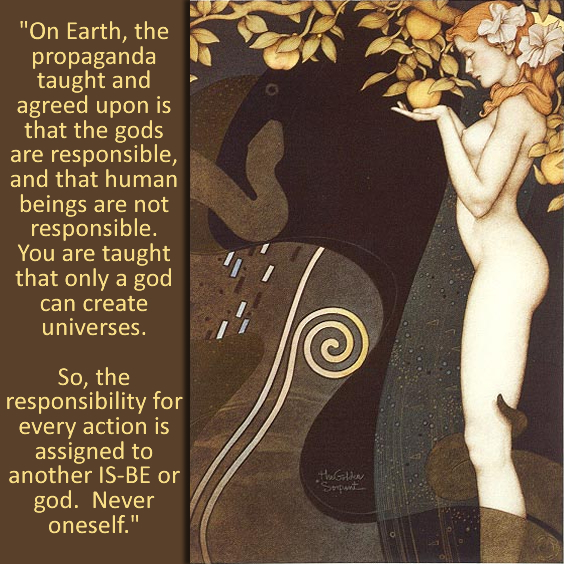 ( painting by Michael Parkes — “The Golden Serpent” )

The content of this book. “Alien Interview” is the letter, Top Secret interview transcripts and personal notes received from the late Matilda O’Donnell MacElroy, an Army Air Force nurse who stationed at the Roswell Army Air Field 509th Bomb Group. Her letter asserts that this material is based on a series of interviews she conducted with an extraterrestrial being as part of her official duty as a nurse in the U.S. Army Air Force. During July and August she interviewed a saucer pilot who crashed near Roswell, New Mexico on July 8th, 1947. The being identitied itself as an officer, pilot and engineer from a race of beings who use the asteroid belt in our solar system as a space port in an intergalactic communication network of an empire they call “The Domain”.
Republished by Blog Post Promoter
( painting by Michael Parkes — “The Golden Serpent” )
Republished by Blog Post Promoter

Republished by Blog Post Promoter
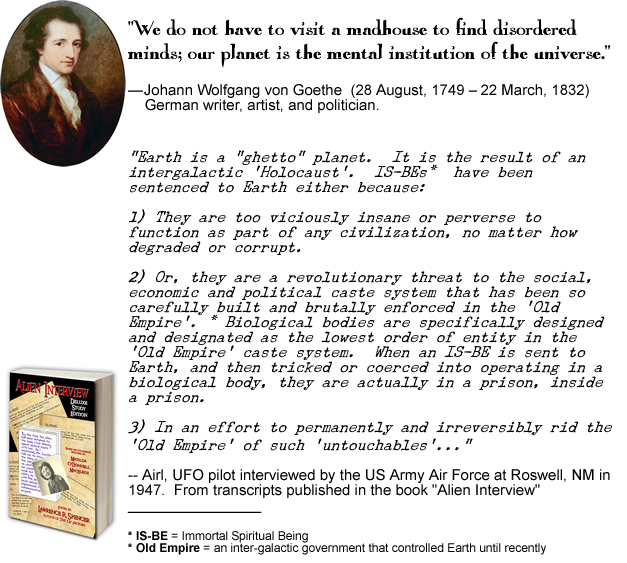 __________________________________________________________________________
Johann Wolfgang von Goethe ( 28 August 1749 – 22 March 1832) was a German writer, artist, and politician. His body of work includes epic and lyric poetry written in a variety of metres and styles, prose and verse dramas, memoirs, an autobiography, literary and aesthetic criticism, treatises on botany, anatomy, and colour, and four novels. In addition, numerous literary and scientific fragments, and over 10,000 letters written by him are extant, as are nearly 3,000 drawings.
A literary celebrity by the age of 25, Goethe was ennobled by the Duke of Saxe-Weimar, Carl August in 1782 after first taking up residence there in November of 1775 following the success of his first novel, The Sorrows of Young Werther. During his first ten years in Weimar, Goethe served as a member of the Duke’s privy council, sat on the war and highway commissions, oversaw the reopening of silver mines in nearby Ilmenau, and implemented a series of administrative reforms at the University of Jena. He also contributed to the planning of Weimar’s botanical park and the rebuilding of its Ducal Palace, which in 1998 were together designated an UNESCO World Heritage Site.[2]
After returning from a tour of Italy in 1788, Goethe published his first major work of a scientific nature, the Metamorphosis of Plants. In 1791 he was charged with managing the theatre at Weimar, and in 1794 he began a friendship with the dramatist, historian, and philosopher Friedrich Schiller, whose plays he premiered until Schiller’s death in 1805. During this period Goethe published his second novel, Wilhelm Meister’s Apprenticeship, the verse epic Hermann and Dorothea, and, in 1808, the first part of his most celebrated drama, Faust. His conversations and various common undertakings throughout the 1790’s with Schiller, Johann Gottlieb Fichte, Johann Gottfried Herder, Alexander von Humboldt, Wilhelm von Humboldt, and August and Friedrich Schlegel have, in later years, been collectively termed Weimar Classicism.
Arthur Schopenhauer cited Wilhelm Meister’s Apprenticeship as one of the four greatest novels ever written and Ralph Waldo Emerson selected Goethe, along with Plato, Napoleon, and William Shakespeare, as one of six “representative men” in his work of the same name. Goethe’s comments and observations form the basis of several biographical works, most notably Johann Peter Eckermann’s Conversations with Goethe. There are frequent references to Goethe’s various sayings and maxims throughout the course of Friedrich Nietzsche’s work and there are numerous allusions to Goethe in the novels of Hermann Hesse and Thomas Mann. Goethe’s poems were set to music throughout the nineteenth century by a number of composers, including Ludwig van Beethoven, Franz Schubert, Robert Schumann, Johannes Brahms, Hugo Wolf, and Gustav Mahler. (Wikipedia.org)
Republished by Blog Post Promoter
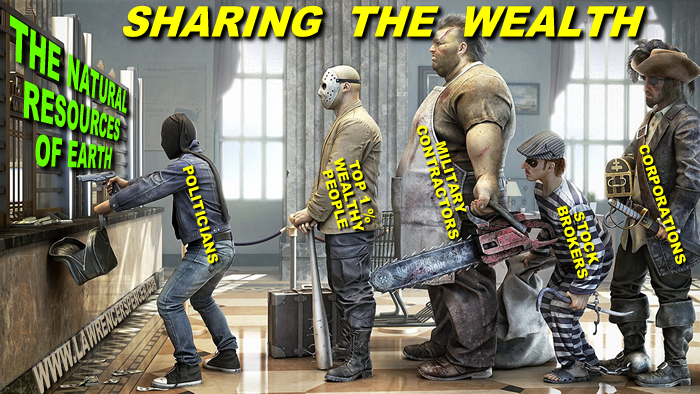
“Sharing the wealth” on Prison Planet Earth is not an egalitarian or benevolent activity. See the book ALIEN INTERVIEW for details…..
Republished by Blog Post Promoter
Official Transcript of the U.S. Army Air Force
Roswell Army Air Field, 509th Bomb Group
SUBJECT: ALIEN INTERVIEW, 25. 7. 1947, 1st Session
“Before you can understand the subject of history, you must first understand the subject of time. Time is simply an arbitrary measurement of the motion of objects through space.
Space is not linear. Space is determined by the point of view of an IS-BE when viewing an object. The distance between an IS-BE and the object being viewed is called “space”.
Objects, or energy masses, in space do not necessarily move in a linear fashion. In this universe, objects tend to move randomly or in a curving or cyclical pattern, or as determined by agreed upon rules.
 History is not only a linear record of events, as many authors of Earth history books imply, because it is not a string that can be stretched out and marked like a measuring tool. History is a subjective observation of the movement of objects through space, recorded from the point of view of a survivor, rather than of those who succumbed. Events occur interactively and concurrently, just as the biological body has a heart that pumps blood, while the lungs provide oxygen to the cells, which reproduce, using energy from the sun and chemicals from plants, at the same time as the liver strains toxic wastes from the blood, and eliminates them through the bladder and the bowels.
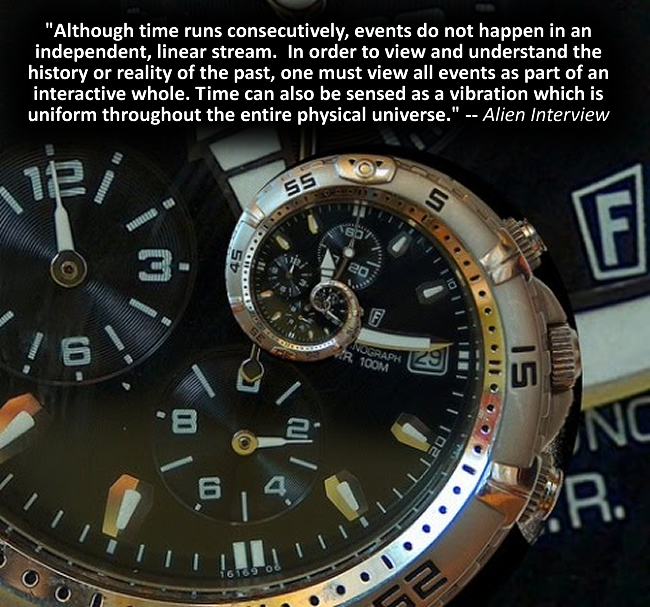
All of these interactions are concurrent and simultaneous. Although time runs consecutively, events do not happen in an independent, linear stream. In order to view and understand the history or reality of the past, one must view all events as part of an interactive whole. Time can also be sensed as a vibration which is uniform throughout the entire physical universe.”
— Excerpt from the book ALIEN INTERVIEW