Tag Archives: truth

THE WAY

Republished by Blog Post Promoter
“The river of human history is clogged and fouled with the putrid refuse of unworkable solutions to the mysteries and problems of life: war, ruined civilizations, insanity, mental anguish, drugs, despair, murder, disease, criminality and starvation. We are the victims of our individual and collective inability to find workable solutions to these unwanted conditions. Our sciences, religion, government and education systems, which should be held responsible, have failed to resolve these basic questions of our existence. As proof, our humanity has long since been exceeded by our ability to destroy life with nuclear and other weapons.

               Meanwhile, each of us, knowingly or unknowingly, search for a spiritual way home; a way home to the resolution of the primordial mysteries of our existence: Who are we? Where did we come from? What is our purpose? Each step along the road in our search is heavily influenced by the directions we have been given by those who have traveled before us. Our ancestors, friends, teachers, leaders, scientists, philosophers, writers and artists of the past and present serve as guides in our journey. They help to shape our ability to make our own decisions as to which is the wisest route to travel, or whether to travel at all. Yet, our trip on the road to personal truth may be slowed or quickened, straightened or perverted, by those we have considered to be our friends. Have we been led astray?

               Our thoughts and conjectures about life and universes are often based on assumptions, unproved theories, hearsay, rumors and misinformation. The actions we take in life may be based on ancient attitudes and archaic practices which are impractical or no longer applicable. Our view of the physical universe and of our own spiritual universes are spawned and nourished by a panoply of educational and environments influences. Lies replace the truth when a vested interest is being served.

               Our decision making processes, the road we choose to follow, is a sort of “logic”. The solutions we use to resolve the problems and mysteries of our lives will be workable or unworkable, depending on the workability of our “logic”.

               Yet, in the end, the decisions we make, individually and collectively, will influence the road taken by future Man. Our own lives, the duration or extinction of the human race and all life forms on Earth depend on the decisions we make today.

               In the midst of this constant decision making process, modern Western civilization is confronted with an unprecedented, uncontrolled explosion of technological innovation, unseen in recorded history. “Reality” is regulated by vested interests who seek personal gain to the detriment of the greater good. Science has become the soulless and impersonal religion of the 21st Century. Our planetary environment is at risk of irreversible damage, bordering on the annihilation of every living creature. Psychiatric drugs and an unseen one-world government are invading our lives like the flying monkeys in the Land of Oz. Encounters of a Third Kind have replaced the gods of mythology with a more tangible awareness that we may not be alone in this universe. New Age archaeology is rediscovering our past and redefining the paradigms of our history with shock waves of revelations that the Theory of Evolution is archaic and unworkable.

               “The Oz Factors” analyzes the subject of Western Logic: How was it created? What are its parts? How does it work or fail to work? How does it effect our lives?

               Each of twelve Oz Factors are defined as “A COMMON DENOMINATOR OF WESTERN LOGIC WHICH PREVENTS OBSERVATION, UNDERSTANDING, AND THE ATTAINMENT OF A WORKABLE SOLUTION” to problems of human origin and existence. How these factors influence our history, science, philosophy, our lives and our future is clearly demonstrated, offering a wide variety of new theories as possible alternative routes to the traditional directions we have followed in the past.

               The story of “The Wizard of Oz” is used as an analogy through which the reader can more easily understand unfamiliar subjects, in much the same way that Chemistry, for example, can be more easily understood when compared to the familiar subject of cooking; i.e. mixing chemicals in a laboratory is similar to mixing ingredients in a kitchen. The material covered in this book provides examples of incidents which shape our viewpoint of the physical universe and which impinge upon our own personal universes.

               “The Oz Factors” offers a simple, yet comprehensive method through which anyone can discover for themselves workable solutions to problems which are considered to be “mysteries” in Western science and philosophy. Discover what is true for you, without religious or academic dogma. Join me in our mutual search for solutions to the primordial questions of existence. May you find a simple and useful road map in “The Oz Factors”. 

Lawrence R. Spencer, The Forward to THE OZ FACTORS

Support independent publishing: Buy this book on Lulu.

HAPPINESS

Republished by Blog Post Promoter

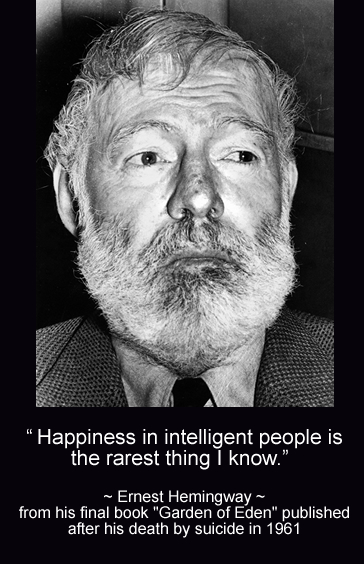
Hemingway-HappinessThe Pulitzer Prize winning American writer Ernest Hemingway (1899 – 1961) said “Happiness in intelligent people is the rarest thing I know”.  
At the end of his life Hemingway was being chased by the FBI and IRS because he lived in Cuba and was a friend of Fidel Castro, a communist, who opposed the Rothschild international bankers ambition control of the world.  Understandably, Hemingway, also a long time alcoholic, became depressed and suicidal.  His wife sent him to a mental hospital where they gave him dozens of electric shock treatments and heavy drugs to “cure” his depression.  Two days after being released from the hospital his shot himself in the head with his double-barreled shotgun! Hemingway was super-intelligent, but unhappy.
Hemingway is an example that Intelligence, alone, is not the “key to happiness”.  I remembered what Krishnamurti said:
Jiddu Krishnamurti“…you have the idea that only certain people hold the key to the Kingdom of Happiness. No one holds it. No one has the authority to hold that key. That key is your own self, and in the development and the purification and in the incorruptibility of that self alone is the Kingdom of Eternity….
You have been accustomed to being told how far you have advanced, what is your spiritual status. How childish! Who but yourself can tell you if you are incorruptible?  I am not concerned, nor with creating new cages, nor new decorations for those cages. My only concern is to set men absolutely, unconditionally free.”
 
It is interesting that Krishnamurti uses the words “development, purification and incorruptibility” to describe the “key” to happiness.  Perhaps this  describes the path we have can follow to discover the truth and happiness.  
Perhaps it is not as important to be “happy” as it is to see the truth and not become corrupted or depressed by it.  Maybe our “development” and “incorruptibility” demand and require that we become “depressed” sometimes as part of our “development”.  And, as part of our progress toward Freedom, which is an essential part of Happiness.

GREAT TRUTHS

Republished by Blog Post Promoter

1000535_597218293644603_150889131_n

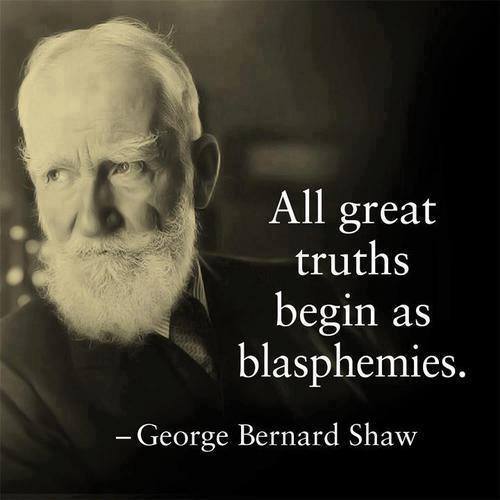
“All Great Truths begin as Blasphemies”. — George Bernard Shaw

_____________________________________________________

George Bernard Shaw (26 July 1856 – 2 November 1950) …”was an Irish playwright and a co-founder of the London School of Economics. Although his first profitable writing was music and literary criticism, in which capacity he wrote many highly articulate pieces of journalism, his main talent was for drama, and he wrote more than 60 plays. He was also an essayistnovelist and short story writer. Nearly all his writings address prevailing social problems, but have a vein of comedy which makes their stark themes more palatable. Issues which engaged Shaw’s attention included education, marriage, religion, government, health care, and class privilege.  He was most angered by what he perceived as the exploitation of the working class. An ardent socialist, Shaw wrote many brochures and speeches for the Fabian Society. He became an accomplished orator in the furtherance of its causes, which included gaining equal rights for men and women, alleviating abuses of the working class, rescinding private ownership of productive land, and promoting healthy lifestyles.”

—  SOURCE: Wikipedia.org

DOUBT EVERTHING

Republished by Blog Post Promoter

BACONSPEAREOn planet Earth, it’s really not a good idea to “believe” or to accept ANYTHING on the surface.  As safe bet is to DOUBT EVERYTHING.

This is especially true when it to do with “royalty” or “leaders” of governments.  I very excellent example of this illustrated by the discovery that Sir Francis Bacon was the “bastard” son of Queen Elizabeth I of England. (7 September 1533 – 24 March 1603)  This is compounded by the discovery that Sir Francis Bacon actually wrote the plays attributed to Bill Shakespeare!

Sir Francis Bacon was a scientist, philosopher, courtier, diplomat, essayist, historian and successful politician, who served as Solicitor General (1607), Attorney General (1613) and Lord Chancellor (1618). Those who subscribe to the theory that Sir Francis Bacon wrote the Shakespeare work generally refer to themselves as “Baconians”, while dubbing those who maintain the orthodox view that William Shakespeare of Stratford wrote them “Stratfordians”.

The idea was first proposed by Delia Bacon in lectures and conversations with intellectuals in America and Britain. William Henry Smith was the first to publish the theory in a letter to Lord Ellesmere published in the form of a sixteen-page pamphlet entitled Was Lord Bacon the Author of Shakespeare’s Plays?  Smith suggested that several letters to and from Francis Bacon hinted at his authorship. A year later, both Smith and Delia Bacon published books expounding the Baconian theory. In Delia Bacon’s work, “Shakespeare” was represented as a group of writers, including Francis Bacon, Sir Walter Raleigh and Edmund Spenser, whose agenda was to propagate an anti-monarchial system of philosophy by secreting it in the text.

Baconian theory developed a new twist in the writings of Orville Ward Owen and Elizabeth Wells Gallup. Owen’s book Sir Francis Bacon’s Cipher Story (1893–5) claimed to have discovered a secret history of the Elizabethan era hidden in cipher-form in Bacon/Shakespeare’s works. The most remarkable revelation was that Bacon was the son of Queen Elizabeth. According to Owen, Bacon revealed that Elizabeth was secretly married to Robert Dudley, Earl of Leicester, who fathered both Bacon himself and Robert Devereux, 2nd Earl of Essex, the latter ruthlessly executed by his own mother in 1601. Bacon was the true heir to the throne of England, but had been excluded from his rightful place. This tragic life-story was the secret hidden in the plays.

Baconian theory had received support from a number of high profile individuals. Mark Twain showed an inclination for it in his essay Is Shakespeare Dead?   Friedrich Nietzsche expressed interest in and gave credence to the Baconian theory in his writings. The German mathematician Georg Cantor believed that Shakespeare was Bacon. He eventually published two pamphlets supporting the theory in 1896 and 1897.  By 1900 leading Baconians were asserting that their cause would soon be won.

In 1916 a judge in Chicago ruled in a civil trial that Bacon was the true author of the Shakespeare canon!

_____________________________________

READ MORE ABOUT BACON vs. SHAKESPEARE HERE:   http://en.wikipedia.org/wiki/Baconian_theory