Republished by Blog Post Promoter


Republished by Blog Post Promoter
Republished by Blog Post Promoter
 Telepathy (from the ancient Greek τηλε, tele meaning “distant” and πάθη, pathe or patheia meaning “feeling, perception, passion, affliction, experience”) is the supposed transmission of information from one person to another without using any of our known sensory channels or physical interaction.
Telepathy is commonly used in fiction, with a number of superheroes and supervillains, as well as figures in many science fiction novels, etc., use telepathy. Notable fictional telepaths include the Jedi in Star Wars. The use of “The Force”, which enables the use of the spirit to influence the physical universe. The inspiration for Star Wars was based largely on the much earlier science fiction books of E.E. Smith, most especially in the six books of THE LENSMEN SERIES, first published in 1948.
The mechanics of telepathy in fiction vary widely. Some fictional telepaths are limited to receiving only thoughts that are deliberately sent by other telepaths, or even to receiving thoughts from a specific other person. For example, in Robert A. Heinlein’s 1956 novel Time for the Stars, certain pairs of twins are able to send telepathic messages to each other.
In A. E. van Vogt’s science fiction novel Slan, the mutant hero Jommy Cross can read the minds of ordinary humans. Some telepaths can read the thoughts only of those they touch, such as Vulcans in the Star Trek media franchise. Star Trek science consultant and writer André Bormanis, has revealed that telepathy within the Star Trek universe works via the “psionic field.” According to Bormanis, a psionic field is the “medium” through which unspoken thoughts and feelings are communicated through space. Some humanoids can tap into this field through a kind of sense organ located in the brain; in the same manner that human eyes can sense portions of the electromagnetic field, telepaths can sense portions of the psionic field. In the book “Eragon“, Eragon can communicate through his mind with almost anyone, including his dragon Saphira, but it is possible to block people from one’s mind with a barrier.
In the Harry Potter series by J. K. Rowling, telepathy is a magical skill known as Legilimency. In the John Wyndham novel The Chrysalids, the main character and narrator David Strorm is one of a group of nine telepaths. In Anthony Horowitz’s Power of Five series twins Jamie and Scott Tyler were born with telepathic powers that enable them to read people’s minds and, ultimately, control them.
Republished by Blog Post Promoter
Republished by Blog Post Promoter

Republished by Blog Post Promoter
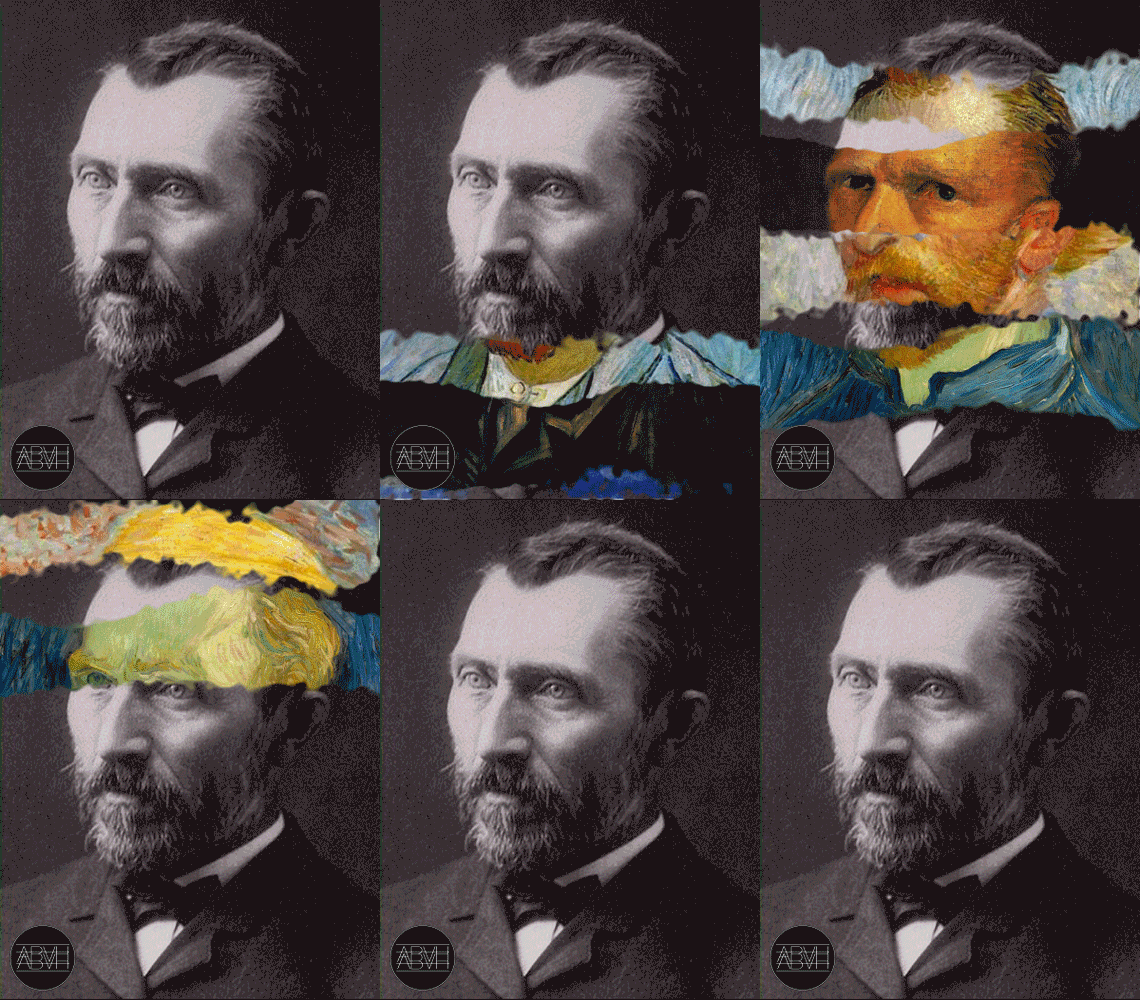
Here is an interesting animated GIF with an overlay of a photograph against “selfy” paintings of Vincent van Gogh. As far as I know, there is no known photograph of tthe artist. This could be the only one.
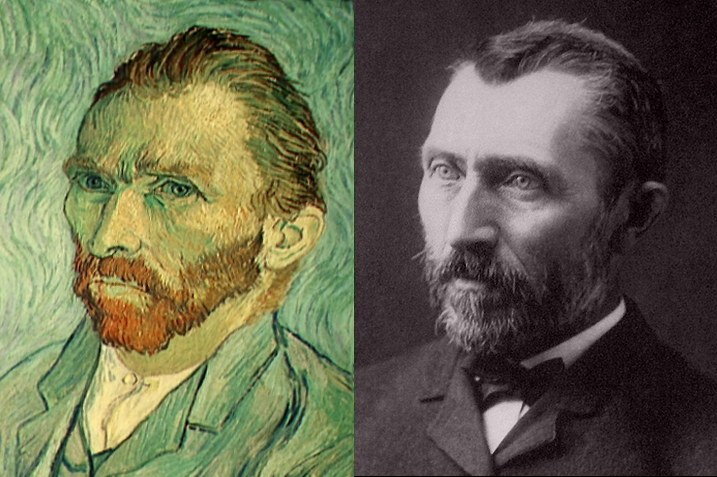
Vincent Willem van Gogh (30 March 1853 – 29 July 1890) was a Post-Impressionist painter of Dutch origin whose work—notable for its rough beauty, emotional honesty, and bold color—had a far-reaching influence on 20th-century art. After years of painful anxiety and frequent bouts of mental illness, he died aged 37 from a gunshot wound, generally accepted to be self-inflicted (although no gun was ever found).
He began to draw as a child, and he continued to draw throughout the years that led up to his decision to become an artist. He did not begin painting until his late twenties, completing many of his best-known works during the last two years of his life. In just over a decade, he produced more than 2,100 artworks, consisting of 860 oil paintings and more than 1,300 watercolors, drawings, sketches, and prints. His work included self portraits, landscapes, still lifes, portraits as well as paintings of cypresses, wheat fields and sunflowers.
He spent his early adulthood working for a firm of art dealers, traveling between The Hague, London, and Paris, after which he taught for a time in England at Isleworth and Ramsgate. One of his early aspirations was to become a pastor, and from 1879 he worked as a missionary in a mining region in Belgium, where he began to sketch people from the local community. In 1885, he painted his first major work, entitled The Potato Eaters. His palette at the time consisted mainly of somber earth tones and showed no sign of the vivid coloration that distinguished his later work. In March 1886, he moved to Paris and discovered the French Impressionists. Later, he moved to the south of France and was influenced by the strong sunlight he found there. His work grew brighter in color, and he developed the unique and highly recognizable style that became fully realized during his stay in Arles in 1888. The extent to which his mental health affected his painting has been a subject of speculation since his death. Despite a widespread tendency to romanticize his ill health, modern critics see an artist deeply frustrated by the inactivity and incoherence brought about by his bouts of illness. According to art critic Robert Hughes, Van Gogh’s late works show an artist at the height of his ability, completely in control and “longing for concision and grace”. (Wikipedia.org)