Category Archives: LIVES

TOURISTS AT A CRUCIFICXION

Republished by Blog Post Promoter
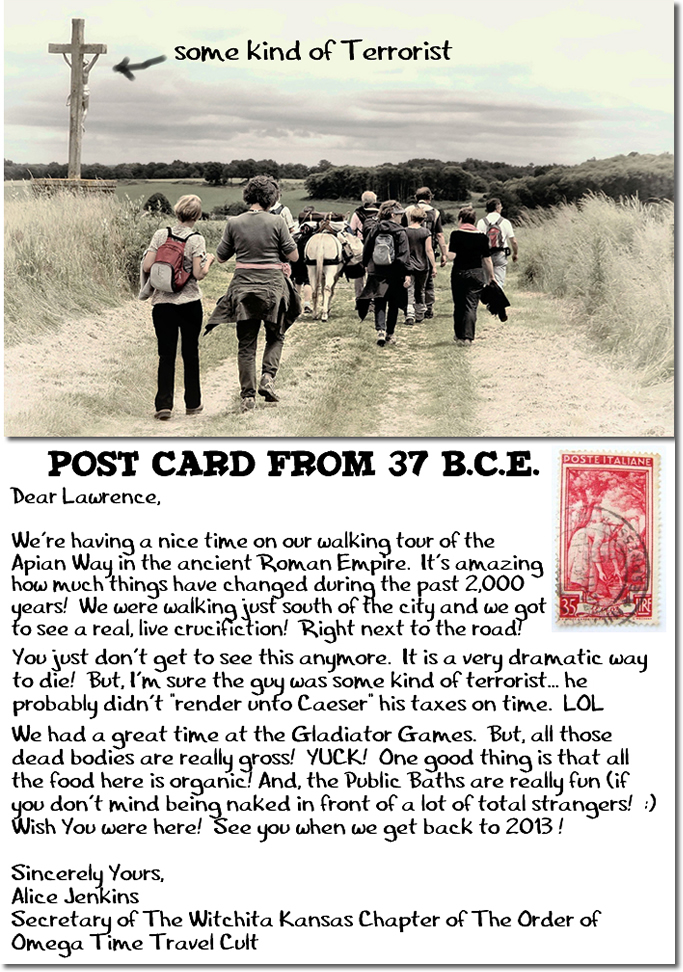
POSTCARD FROM 37 BCE

Crucifixion was often performed to terrorize and dissuade its witnesses from perpetrating particularly heinous crimes. Victims were left on display after death as warnings to others who might attempt dissent. Crucifixion was usually intended to provide a death that was particularly slow, painful (hence the term excruciating, literally “out of crucifying”), gruesome, humiliating, and public, using whatever means were most expedient for that goal. Crucifixion methods varied considerably with location and time period.

The Greek and Latin words corresponding to “crucifixion” applied to many different forms of painful execution, from impaling on a stake to affixing to a tree, to an upright pole (a crux simplex) or to a combination of an upright (in Latin, stipes) and a crossbeam (in Latin,patibulum).

In some cases, the condemned was forced to carry the crossbeam on his shoulders to the place of execution. A whole cross would weigh well over 300 pounds (135 kg), but the crossbeam would not be quite as burdensome, weighing around 100 pounds. The Roman historian Tacitus records that the city of Rome had a specific place for carrying out executions, situated outside the Esquiline Gate, and had a specific area reserved for the execution of slaves by crucifixion. Upright posts would presumably be fixed permanently in that place, and the crossbeam, with the condemned person perhaps already nailed to it, would then be attached to the post.

While a crucifixion was an execution, it was also a humiliation, by making the condemned as vulnerable as possible. Although artists have depicted the figure on a cross with a loin cloth or a covering of the genitals, writings by Seneca the Younger suggest that victims were crucified completely naked.  When the victim had to urinate or defecate, they had to do so in the open, in view of passers-by, resulting in discomfort and the attraction of insects. Despite its frequent use by the Romans, the horrors of crucifixion did not escape mention by some of their eminent orators. Cicero for example, described crucifixion as “a most cruel and disgusting punishment”, and suggested that “the very mention of the cross should be far removed not only from a Roman citizen’s body, but from his mind, his eyes, his ears.”

Frequently, the legs of the person executed were broken or shattered with an iron club, an act called crurifragium, which was also frequently applied without crucifixion to slaves. This act hastened the death of the person but was also meant to deter those who observed the crucifixion from committing offenses.  — REFERENCE SOURCE:  Wikipedia.org
SHORT PEOPLE

Republished by Blog Post Promoter

Children are basically just “short people”. In a few year they will become “tall” people, just like you — probably even taller. So, maybe we should start treating our “short” people like real people instead of some kind of cute toys or disenfranchised “lesser beings”. They are entitled to the same respect, dignity and responsibilities that adults are supposed to grant to each other. After all, they are going to become the people our mothers warned us about being careful not to hang out with.  If you don’t educate them into the reality that they can realize their dreams, while sharing the responsibility for taking care of themselves and being a part of the community, they will be the people our mothers warned us about.

INVOCATION OF THE GODS

Republished by Blog Post Promoter

Invocation of the gods

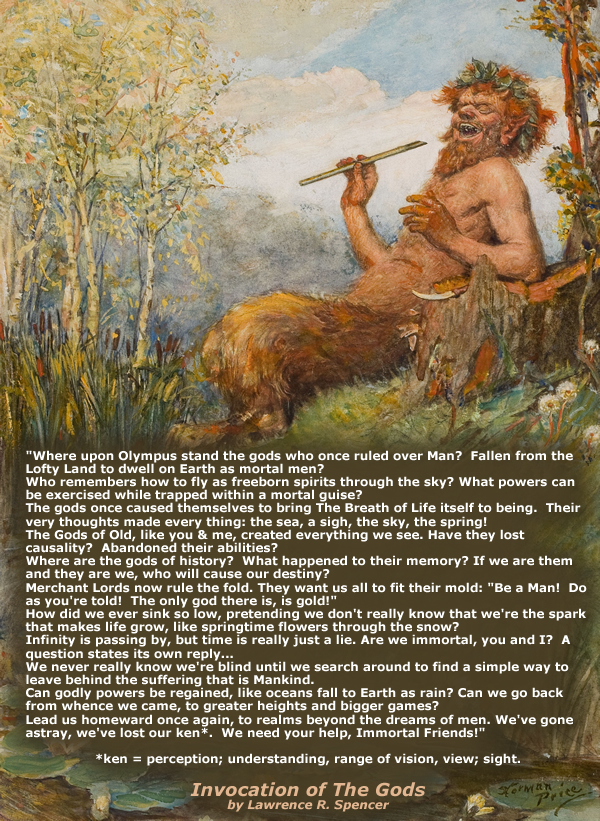
“Where upon Olympus stand the gods who once ruled over Man?  Fallen from the Lofty Land to dwell on Earth as mortal men?

Who remembers how to fly as freeborn spirits through the sky? What powers can be exercised while trapped within a mortal guise?

The gods once caused themselves to bring The Breath of Life itself to being.  Their very thoughts made every thing: the sea, a sigh, the sky, the spring!

The Gods of Old, like you & me, created everything we see. Have they lost causality?  Abandoned their abilities?

Where are the gods of history?  What happened to their memory? If we are them and they are we, who will cause our destiny?

Merchant Lords now rule the fold. They want us all to fit their mold: “Be a Man!  Do as you’re told!  The only god there is, is gold!”

How did we ever sink so low, pretending we don’t really know that we’re the spark that makes life grow, like springtime flowers through the snow?

Infinity is passing by, but time is really just a lie. Are we immortal, you and I?  A question states its own reply…

We never really know we’re blind until we search around to find a simple way to leave behind the suffering that is Mankind.

Can godly powers be regained, like oceans fall to Earth as rain? Can we go back from whence we came, to greater heights and bigger games?

Lead us homeward once again, to realms beyond the dreams of men. We’ve gone astray, we’ve lost our ken*.  We need your help, Immortal Friends!”

— Lawrence R. Spencer

*ken = perception; understanding, range of vision, view; sight.

SEARCHING FOR CALVIN & HOBBES

Republished by Blog Post Promoter

CALVIN & HOBBES SEARCH

If you are a fan of the greatest cartoon series every created, “CALVIN and HOBBES”, you will enjoy this great tool!  You can search the entire database of Calvin and Hobbes cartoon by Key Word.  Thanks to Bill Watterson for the amazing cartoons, and to Michael Yingling for the search engine!

http://michaelyingling.com/random/calvin_and_hobbes/

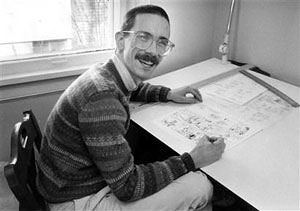
Bill Waterson thenCalvin and Hobbes is a daily comic strip that was written and illustrated by American cartoonist Bill Watterson, and syndicated from November 18, 1985, to December 31, 1995. It follows the humorous antics of Calvin, a precocious, mischievous, and adventurous six-year-old boy, and Hobbes, his sardonic stuffed tiger. The pair are named after John Calvin, a 16th-century French Reformation theologian, and Thomas Hobbes, a 17th-century English political philosopher.At the height of its popularity, Calvin and Hobbes was featured in over  2,400 newspapers worldwide. Nearly 45 million copies of the 18 Calvin and Hobbes books have been sold.  Calvin and Hobbes is set in the contemporary United States in an unspecified suburban area. The strip depicts Calvin’s flights of fantasy and his friendship with Hobbes, and also examines Calvin’s relationships with family and classmates. Hobbes’ dual nature is a defining motif for the strip: To Calvin, Hobbes is a live anthropomorphic tiger; all the other characters see him as an inanimate stuffed toy. Calvin and Hobbes