Category Archives: LIVES

LEARNING TO GRIEVE

Republished by Blog Post Promoter

grieving

“It is important, as we get older, to learn how to grieve. Although this may sound self-evident, experience has taught me that it is not. In a culture that emphasizes stoicism and forward movement, in which time is deemed “of the essence,” and there is little toleration for slowness, inwardness, and melancholy, grieving – a healthy, necessary aspect of life – is too often overlooked. As we get older, of course, and losses mount, the need for conscious grieving becomes more pronounced. Only by learning how to grieve can we hope to leave the past behind and come into the present moment.

The older we get, the more we lose; this is the law of impermanence. We lose loved ones, cherished dreams, physical strength, work, and relationships. Often, it seems like loss upon loss. All these losses bring up enormous grief that we must be prepared to embrace completely, if we are to live with open hearts.

My dear friend Stephen Levine has recommended that we build temples specifically for the purpose of grieving, ritual sites where we can feel safe to pour out the sadness and loss that we feel. In the Jewish tradition of sitting shiva, and in the traditional Irish wake, we find such outlets for extended grieving, but these rituals are becoming rare in our culture and are not frequently practiced.

Over the years, in working with people who are grieving, I’ve encouraged them first of all to surrender to the experience of their pain. To counteract our natural tendency to turn away from pain, we open to it as fully as possible and allow our hearts to break. We must take enough time to remember our losses – be they friends or loved ones passed away, the death of long-held hopes or dreams, the loss of homes, careers, or countries, or health we may never get back again. Rather than close ourselves to grief, it helps to realize that we only grieve for what we love.

In allowing ourselves to grieve, we learn that the process is not cut and dried. It’s more like a spiral that brings us to a place of release, abates for a time, then continues on a deeper level. Often, when grieving, we think that it’s over, only to find ourselves swept away by another wave of intense feeling. For this reason, it’s important to be patient with the process, and not be in a hurry to put our grief behind us.

While the crisis stage of grief does pass in its own time – and each person’s grief has its own timetable – deep feelings don’t disappear completely. But ultimately you come to the truth of the adage that “love is stronger than death.” I once met with a girl whose boyfriend was killed in Central America. She was grieving and it was paralyzing her life. I characterized it for her this way. “Let’s say you’re in ‘wise-woman training.’” If she’s in wise-woman training, everything in her life must be grist for the mill. Her relationship with this man would become part of the wisdom in her. But first she had to see that her relationship with him is between Souls. They no longer have two incarnated bodies to share, so she had to find the Soul connection. Two Souls can access each other without an incarnation.”

— – Ram Dass, 2014
IMPOSTERS

Republished by Blog Post Promoter

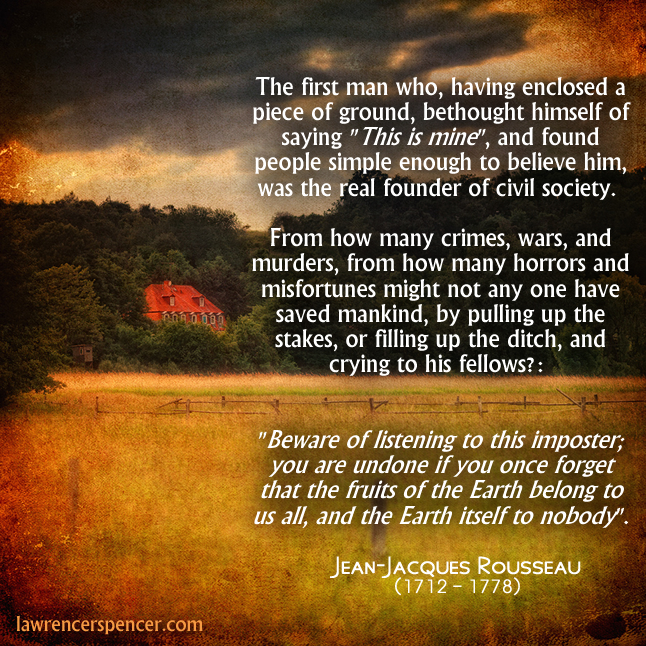
“The first man who, having enclosed a piece of ground, bethought himself of saying “This is mine”, and found people simple enough to believe him, was the real founder of civil society.
From how many crimes, wars, and murders, from how many horrors and misfortunes might not any one have saved mankind, by pulling up the stakes, or filling up the ditch, and crying to his fellows?: 
“Beware of listening to this imposter; you are undone if you once forget that the fruits of the Earth belong to us all, and the Earth itself to nobody”.

Jean-Jacques Rousseau (June 28, 1712 – July 2, 1778)  was a Franco-Swiss philosopher of Enlightenment whose political ideas influenced the French Revolution.

MORE QUOTES from Rousseau:

“A country cannot subsist well without liberty, nor liberty without virtue. ”

“Virtue is a state of war, and to live in it means one always has some battle to wage against oneself.”

“Men, be kind to your fellow-men; this is your first duty, kind to every age and station, kind to all that is not foreign to humanity. What wisdom can you find that is greater than kindness?”

Read more about Rousseau —  http://en.wikiquote.org/wiki/Jean-Jacques_Rousseau

THE CYNIC

Republished by Blog Post Promoter

“The cynic is one who never sees a good quality in a man, and never fails to see a bad one. He is the human owl, vigilant in darkness and blind to light, mousing for vermin, and never seeing noble game. The cynic puts all human actions into two classes–openly bad and secretly bad. All virtue and generosity and disinterestedness are merely the appearance of good; but selfish at the bottom. He holds that no man does a good thing except for profit. The effect of his conversation upon your feelings is to chill and sear them; to send you away sour and morose. His criticisms and hints fall indiscriminately upon every lovely thing, like frost upon flowers.” – Henry Ward Beecher

“Cynicism may not be a lovely, warm and fuzzy view of reality, but neither is birth, disease, war, greed, cruelty, madness, murder, insanity, starvation, murder, chaos and death.” – Lawrence R. Spencer

George Carlin was one of the greatest, and most famous, cynics of all time.  I’d say “god rest his soul”, but he didn’t believe in “god(s), so I’ll just say “see ya!”.

OBSERVE YOUR SELF

Republished by Blog Post Promoter

HUMAN INTELLIGENCE

An Overview of Krishnamurti’s Life and Work

“Jiddu Krishnamurti was born on 11 May 1895 in Madanapalle, a small town in south India. He and his brother were adopted in their youth by Dr Annie Besant, then president of the Theosophical Society. Dr Besant and others proclaimed that Krishnamurti was to be a world teacher whose coming the Theosophists had predicted. To prepare the world for this coming, a world-wide organization called the Order of the Star in the East was formed and the young Krishnamurti was made its head.

In 1929, however, Krishnamurti renounced the role that he was expected to play, dissolved the Order with its huge following, and returned all the money and property that had been donated for this work.  From then, for nearly sixty years until his death on 17 February 1986, he travelled throughout the world talking to large audiences and to individuals about the need for a radical change in mankind.

Krishnamurti is regarded globally as one of the greatest thinkers and religious teachers of all time. He did not expound any philosophy or religion, but rather talked of the things that concern all of us in our everyday lives, of the problems of living in modern society with its violence and corruption, of the individual’s search for security and happiness, and the need for mankind to free itself from inner burdens of fear, anger, hurt, and sorrow. He explained with great precision the subtle workings of the human mind, and pointed to the need for bringing to our daily life a deeply meditative and spiritual quality.

Krishnamurti belonged to no religious organization, sect or country, nor did he subscribe to any school of political or ideological thought. On the contrary, he maintained that these are the very factors that divide human beings and bring about conflict and war. He reminded his listeners again and again that we are all human beings first and not Hindus, Muslims or Christians, that we are like the rest of humanity and are not different from one another. He asked that we tread lightly on this earth without destroying ourselves or the environment. He communicated to his listeners a deep sense of respect for nature. His teachings transcend man-made belief systems, nationalistic sentiment and sectarianism. At the same time, they give new meaning and direction to mankind’s search for truth. His teaching, besides being relevant to the modern age, is timeless and universal.

Krishnamurti spoke not as a guru but as a friend, and his talks and discussions are based not on tradition-based knowledge but on his own insights into the human mind and his vision of the sacred, so he always communicates a sense of freshness and directness although the essence of his message remained unchanged over the years.”    Visit the Krishnamurti Official Website at http://www.jkrishnamurti.org/