Inside the book, Vermeer: Portraits of A Lifetime. Analysis of all the paintings of Johannes Vermeer. The book reveals for the first time that the women featured in the paintings of Johannes Vermeer were members of his own family, his daughters, his wife and mother-in-law, Maria Thins.
Vermeer: Portraits of A Lifetimeis a revolutionary reexamination of the mystique and mythology surrounding the 17th Century Dutch Master painter, Johannes Vermeer. For the first time in over 300 years names of people who posed for his paintings are identified. An unknown portrait of Vermeer, painted by his friend, Gerard ter Borch, is exposed. This book is an empathetic retrospective, built on observations that reveal answers to dozens of speculations about his paintings, his wife, his daughters, and contemporaries who were the subjects of his art, and with whom he shared his brief life in Delft.
Many videotapes of Johnny Carson’s 1960s episodes were lost in the fire of NBC’s archives, but at least part of Ayn Rand’s first appearance on The Tonight Show (she was on three times over the years, clearly Carson was a fan) has survived and has been posted on YouTube. Apparently, Carson snubbed his other guests that evening and kept Rand on for the entire 90 minute show. Topics include Objectivism, rationality, raising children, religion, the military draft and the Vietnam War. (via Dangerous Minds)
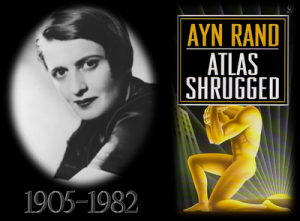
Ayn Rand, born Alisa Zinov’yevna Rosenbaum, February 2 1905 – March 6, 1982) was a Russian-American novelist, philosopher,playwright, and screenwriter. She is known for her two best-selling novels The Fountainhead and Atlas Shrugged and for developing a philosophical system she called Objectivism.
Born and educated in Russia, Rand moved to the United States in 1926. She worked as a screenwriter in Hollywood and had a play produced on Broadway in 1935–1936. After two early novels that were initially less successful, she achieved fame with her 1943 novel The Fountainhead. In 1957, she published her best-known work, the philosophical novel Atlas Shrugged. Afterward she turned to nonfiction to promote her philosophy, publishing her own magazines and releasing several collections of essays until her death in 1982.
Rand’s fiction was poorly received by many literary critics, and academia generally ignored or rejected her philosophy. The Objectivist movement attempts to spread her ideas, both to the public and in academic settings.She is a major influence among libertarians and American conservatives. (Wikipedia.org)
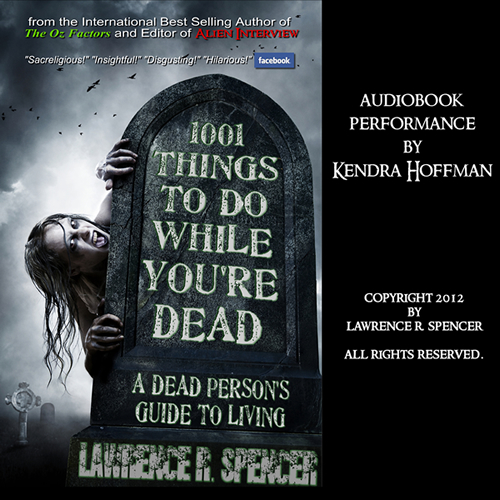
Excerpts from the book “1001 THINGS TO DO WHILE YOU’RE DEAD: A Dead Person’s Guide to Living“, by Lawrence R. Spencer
GO TOWARD THE LIGHT!
A lot of people (including a long list of living and dead celebrities) who were pronounced “medically dead” said that they had a “near death experience”. (See Footnote) [i]
Obviously, the medical or scientific definition of “death” could use some review, since it does not include, consider or acknowledge anything having to do with the “spirit” or the “you” that is experiencing having a “life”. This is a rather large and fundamental oversight.
Nonetheless, a very common report from those spirits who “left” their body or “floated above” their body, is that they remained completely aware of their surroundings, other people, conversations, sounds, smells, and other sensory perceptions one would normally experience during life.
Another common report is that they were immediately “drawn” toward a bright light. For a variety of reasons they decided, or where “told” by another disembodied spirit, to go back to the body. After they returned, the body “came back to life”, and they lived happily ever after – at least until they died again and did NOT come back again. At that time, one assumes they decided to go toward the light and that they did NOT come back, as far as we know.
STAY AWAY FROM THE LIGHT!
This is an alternative option to # 1 above. Many persons who have had a “near death experience” after an accident or during surgery or a nearly fatal illness, reported afterward that they felt drawn toward a brilliant white, gold or blue light and experienced warm, loving emotions. Likewise, they felt compelled or commanded to return to take care of someone or some unfinished business. Just as many people experienced shock, pain, fear, anxiety, terror, grief, etc., as one might expect.
Those people decided to stay away from the light and go back to their body. They lived long enough to tell someone about the experience. So, if you want to continue living with a body, this would be the most likely option for you. Otherwise, option #1 is still available, although not necessarily recommended. In this case, you might want to consider the next option:
REMAIN ALERT!
Light, or no light, it may be a good idea to remain alert while you’re dead. If you are paying close attention to what is going on in your vicinity, you may be able to take advantage of the situation or learn something that will be useful to know while you’re dead. You won’t know until you get there, of course, but you can prepare yourself in advance by deciding to remain calm and continue to be aware of what’s happening to you and around you at the moment of death and in the “thereafter”.
ATTEND YOUR OWN FUNERAL.
When your relatives or public officials get around to disposing of your used body you may choose to attend the funeral. This can be complicated, tedious and disturbing to yourself and other funeral guests. Or it can be a great comfort to you and your loved ones. It’s up to you.
If you are concerned that the used body is disposed of properly you should definitely attend to make sure your final wishes have been followed. You may also want to check to see who is really grieving over your absence, and who is only pretending so they can get a share of your estate, and who came for the free food and drinks.
Reverence for the dead is very important. Especially if you’re the one that is dead. One thing is certain – you will never think of funerals the same way again. If you care about what your relatives or the undertaker is going to do with your used body you will want to stay to the end. This includes the burial, cremation, sprinkling of the ashes, donation to the “used parts” laboratory, or whatever is supposed to be done with your used body.
If you plan ahead you can have your body buried in a vegetable garden, a forest, a flower bed, or fed to the fishes in the ocean. It’s a shame to let a perfectly good source of nutrition for plants or other living creatures go to waste!
AVOID YOUR FUNERAL.
If you are squeamish about autopsies, embalming, funeral piers, cremation incinerators, worms, bugs or bacteria you may want to stay away until all that messy, bad smelling business is over and done.
However, funeral directors have become quite masterful, over the past 5,000 years, at making a dead body look as good, or better, than it looked when it was alive. A little formaldehyde, a few strategic injections, a little stuffing, nice clothes, cosmetics, a wig and a comfy, silk-lined coffin, your used body can look better than ever!
This is a good reason to stay away as you may be enticed to start thinking about going back. Obviously, it’s too late. Factually, you never were a body and you definitely are not a body now. So stay focused. The future is where the rest of your life will be lived!”
__________________________________
FOOTNOTE:
[i] Near death experience. Examples of celebrities who reported they had “near death experiences”:
Jane Seymour is an actress most noted for the cult classic movie, “Somewhere in Time,” with actor Christopher Reeves, and the television series “Dr. Quinn, Medicine Woman.” When Jane Seymour was 36 years of age, she had a severe case of the flu and was given an injection of penicillin. She suffered an allergic reaction which led to a near-death experience.
“I literally left my body. I had this feeling that I could see myself on the bed, with people grouped around me. I remember them all trying to resuscitate me. I was above them, in the corner of the room looking down. I saw people putting needles in me, trying to hold me down, doing things. I remember my whole life flashing before my eyes, but I wasn’t thinking about winning Emmys or anything like that. The only thing I cared about was that I wanted to live because I did not want anyone else looking after my children. I was floating up there thinking, “No, I don’t want to die. I’m not ready to leave my kids.” And that was when I said to God, “If you’re there, God, if you really exist and I survive, I will never take your name in vain again.” Although I believe that I “died” for about thirty seconds, I can remember pleading with the doctor to bring me back. I was determined I wasn’t going to die.” She then suddenly found herself back in her body.
Peter Sellers was the comic genius of a generation of actors. He brought brilliant characterizations to numerous films, including “The Mouse That Roared” (1959), “Dr. Strangelove” (1964), “The Pink Panther” (1964), and “Being There” (1979). He was known for his enthusiastic way of totally absorbing himself in his characters, even carrying roles offstage. He also suffered from sad moods between films. While he knew his characters thoroughly, he said that he really did not know who he was. Then Peter Sellers, the brilliant, confused actor, had a near-death experience.
Seated in a Hollywood mockup of a limousine’s back seat while shooting his last great film, “Being There”, he told Shirley MacLaine about his near-death experience, astonished that she did not consider him “bonkers.” Shirley documents their conversation in her book, Out on a Limb. In 1964, during the first of a rapid series of eight heart attacks, when his heart stopped and he was clinically dead, he had an out-of-body experience and saw the bright, loving light:
“Well, I felt myself leave my body. I just floated out of my physical form and I saw them cart my body away to the hospital. I went with it … I wasn’t frightened or anything like that because I was fine; and it was my body that was in trouble.”
The doctor saw that he was dead and massaged his heart vigorously, Meanwhile: “I looked around myself and I saw an incredibly beautiful bright loving white light above me. I wanted to go to that white light more than anything. I’ve never wanted anything more. I know there was love, real love, on the other side of the light which was attracting me so much. It was kind and loving and I remember thinking “That’s God.””
Peter’s out-of-body soul tried to elevate itself toward the light, but he fell short: “Then I saw a hand reach through the light. I tried to touch it, to grab onto it, to clasp it so it could sweep me up and pull me through it.” But just then his heart began beating again, and at that instant the hand’s voice said: “It’s not time. Go back and finish. It’s not time.” As the hand receded he felt himself floating back down to his body, waking up bitterly disappointed.
What effect did his near-death experience have on Sellers? His biographer says that “The act of “dying” became for Peter Sellers the most important experience of his life.” Sellers said of death: “I’ll never fear it again.” Family and friends found him more spiritual and reflective than before.
Actress Elizabeth Taylor spoke about her experience of having “died” on the operating table while undergoing surgery, and of passing through a tunnel towards a brilliant white light. Interviewed by Larry King on CNN’s “Larry King Live,” the legendary Hollywood star related how she had “died” for five minutes on the operating table.
“I was pronounced dead once and actually saw the light. I find it very hard to talk about, actually, because it sounds so corny. It happened in the late ’50s, and I saw Mike (Todd, Taylor’s third husband, who was killed in a plane crash in 1958). When I came to, there were about 11 people in the room. I’d been gone for about five minutes – they had given me up for dead and put my death notice on the wall. I shared this with the people that were in the room next to me. Then after that I told another group of friends, and I thought, “Wow, this sounds really screwy. I think I’d better keep quiet about this.” Robert Pastorelli is most noted for his starring role in the television series, “Murphy Brown.” At the age of 19, he had a car accident which caused a near-death experience that literally changed how he was living, in a very dramatic way.
“It smashed right into the driver’s door. It hit me so hard it actually knocked the shoes off my feet. My car rolled over about four times on this big highway and the next thing I knew I was in intensive care with a collapsed lung. Every one of my ribs was shattered. I had lacerations to my head and face, and my kidneys, spleen and gall bladder were all ruptured. I was a mess.
“I was in excruciating pain. Then, in the next second, there was no pain. Suddenly I realized I was out of my body. I was floating above myself, looking down at my unconscious body lying in the hospital emergency room with my eyes closed. I could see tubes down my nose and throat. I knew I was dying and I thought, “Well, this must be death.” I even saw a priest giving me the last rites. But it was the most peaceful feeling in the world. Then I saw my father starting to faint out of grief. Two nurses grabbed him and sat him down in a chair across the room.
“When I looked down and saw my father’s pain it had an effect on me. I firmly believe that at that moment I made a decision to live, not die. The next thing I knew I was waking up back in my body. Later, in the recovery room, when I was fully conscious, I told my father what had happened, his fainting and all. He was astounded.”
“Basic Instinct” star, Sharon Stone, has told how she had a “white light experience” during her brain scare. Stone says she almost died after internal bleeding caused by a tear in an artery at the base of her skull. Sharon was interviewed by Katie Couric about her journey into the afterlife.
When it hit me I felt like I’d been shot in the head. That’s the only way I can really describe it. It hit me so hard it knocked me over on the sofa. And Phil was out of town and I called him and said, “I think I had a stroke.” But in all fairness, I’m a person who’s always saying, ” I think I’ve had a stroke, I think I’ve had a heart attack, I think I’ve had a brain hemorrhage …
I had a real journey with this that took me to places both here and beyond that affected me so profoundly that my life will never be the same …
I get to be not afraid of dying and I get to tell other people that it’s a fabulous thing and that death is a gift. And not that you should kill yourself, but that when death comes to you, as it will, that it’s a glorious and beautiful thing. This kind of giant vortex of white light was upon me and I kind of – poof – sort of took off into this glorious, bright, bright, bright white light and I started to see and be met by some of my friends. But it was very fast – whoosh! Suddenly, I was back. I was in my body and I was in the room.î
Gary Busey, once Hollywood’s “bad boy,” was nominated for an Oscar for the movie, “The Buddy Holly Story.” Busey, who fought addiction with drugs and alcohol for several years, was nicknamed “Gary Abusey” by his wife. Busey has had supernatural encounters in which he nearly died three or more times in his life …a drug overdose, cancer, and an accident west of Albuquerque, New Mexico.
But the most tragic experience, and one that changed his life, was a motorcycle accident in 1988. Gary was going about 40-50 miles per hour riding on 750 pounds of cold steel. He was not wearing a helmet when he crashed. He was flung over the top of his cycle, head first into the curb and he cracked his skull. Busey had an NDE while he was dying on the operating table after having brain surgery. During his NDE, he was surrounded by angels. Busey stated that they didn’t appear in the form that people see on Christmas cards. The angels he saw were big balls of light that floated and carried nothing but love and warmth – and this love is unconditional.
Larry Hagman, of “Dallas” and “I Dream of Jeanie” fame, underwent a liver transplant in 1995. Years of heavy drinking resulted in cirrhosis and cancer of the liver. He was only weeks away from certain death at the time of his liver transplant and near-death experience.
Larry describes what he experienced: “I was able to look over the edge. I got a little glimpse of what was the next step. I didn’t see a light some people see, but I had a wonderful feeling of bliss and warmth. The bottom line is “love,” that sounds corny, but it was just lovely, uplifting.”
Rebecca DeMornay starred in the movie thriller, “The Hand That Rocks The Cradle.” When she was 7 years old, she was in Mexico City, Mexico, when she got ill from a peptic ulcer and had what she believes was a near-death experience.
“One night the doctors told my mother that there was only a fifty-fifty chance that I’d make it. I remember that I was tied to three IVs but I recall getting out of bed and looking out of the window: it was snowing. There was an old-fashioned lamppost and barefoot children were dancing around it, singing. I went back to bed and the next morning the crisis was over. In 1983 I started thinking about it: “Does it ever snow in Mexico City? Do they have these strange kind of lampposts there?” I went back to Mexico and I didn’t see those lampposts anywhere. Nor does it ever snow there.”
Donald Sutherland, who played the character, Hawkeye Piece, in the movie version of “Mash”, had a near-death experience when ill with meningitis in 1979.
“Suddenly the pain, fever and acute distress seemed to evaporate. I was floating above my body, surrounded by soft blue light. I began to glide down a long tunnel, away from the bed … but suddenly I found myself back in my body. The doctors told me later that I had actually died for a time.”
Eric Estrada became famous for his starring role in the television series, “Chips.” While filming an episode of “Chips,” he had a terrible motorcycle accident that led to a near-death experience.
“Suddenly I was in a long corridor with bright lights, beautiful music, and a feeling of great peace. But something seemed to be blocking my progress. A voice told me, “You’ve got to go back. You’ve a lot still to do. You’ve achieved success and stardom but you haven’t achieved personal happiness and peace of mind.” After hearing the voice, he returned to his body.
“The Domain Expeditionary Force first entered into the Milky Way galaxy very recently — only about 10,000 years ago. Their first action was to conquer the home planets of the “Old Empire” (this is not the official name, but a nick-name given to the conquered civilization by The Domain Forces) that served as the seat of central government for this galaxy, and other adjoining regions of space. These planets are located in the star systems in the tail of the Big Dipper constellation. She did not mention which stars, exactly.” — excerpt from the book “Alien Interview”.
The Original Meaning
The word “swastika” comes from the Sanskrit svastika: “su” meaning “good,” “asti” meaning “to be,” and “ka” as a suffix.
The swastika is an ancient symbol that has been used for over 3,000 years. (That even predates the ancient Egyptian symbol, the Ankh!) Artifacts such as pottery and coins from ancient Troy show that the swastika was a commonly used symbol as far back as 1000 BCE.
During the following thousand years, the image of the swastika was used by many cultures around the world, including in China, Japan, India, and southern Europe. By the Middle Ages, the swastika was a well known, if not commonly used, symbol, but was called by many different names:
China – wan
England – fylfot
Germany – Hakenkreuz
Greece – tetraskelion and gammadion
India – swastika
Though it is not known for exactly how long, Native Americans also have long used the symbol of the swastika.


 So what do we do when we’re dead anyway?