Republished by Blog Post Promoter
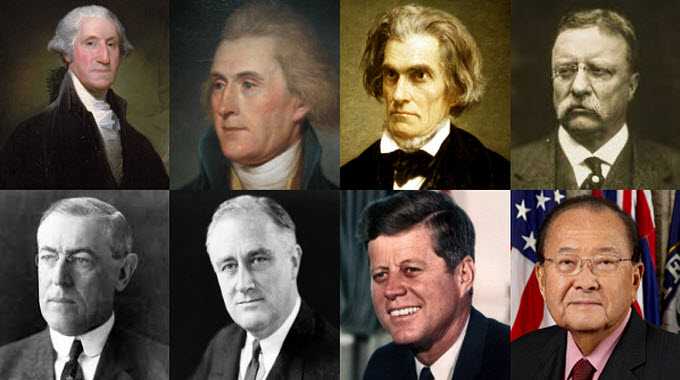
The warnings listed below, which appear in chronological order, began with our first president – George Washington. The last president to speak out was JFK, who was assassinated. Read what they and other political leaders have said about the invisible government.
 “It was not my intention to doubt that, the Doctrines of the Illuminati, and principles of Jacobinism had not spread in the United States. On the contrary, no one is more truly satisfied of this fact than I am. The idea that I meant to convey, was, that I did not believe that the Lodges of Free Masons in this Country had, as Societies, endeavoured to propagate the diabolical tenets of the first, or pernicious principles of the latter (if they are susceptible of seperation). That Individuals of them may… actually had a seperation [sic] of the People from their Government in view, is too evident to be questioned.” – George Washington, 1st President of the United States (1789–1797), from a letter that Washington wrote on October 24, 1798, which can be found in the Library of Congress. For an analysis of Washington’s warning, see the article “Library of Congress: George Washington Warns of Illuminati”

“I sincerely believe, with you, that banking establishments are more dangerous than standing armies.” —Thomas Jefferson, 3rd President of the United States (1801–1809) and principal author of the United States Declaration of Independence (1776), in a letter written to John Taylor on May 28, 1816

“A power has risen up in the government greater than the people themselves, consisting of many and various powerful interests, combined in one mass, and held together by the cohesive power of the vast surplus in banks.” – John C. Calhoun, Vice President (1825-1832) and U.S. Senator, from a speech given on May 27, 1836
Note that it appears that Washington’s and Jefferson’s concerns regarding bankers and separation of the people from the government was realized by 1836. This fact was confirmed in a letter written by FDR in 1933 (see below) in which he wrote that “a financial element in the large centers has owned the government ever since the days of Andrew Jackson.” Jackson was the seventh president of the United States (1829-1937). Calhoun served as Jackson’s vice-president from 1829-1932.

“Behind the ostensible government sits enthroned an invisible government owing no allegiance and acknowledging no responsibility to the people. To destroy this invisible government, to befoul the unholy alliance between corrupt business and corrupt politics is the first task of the statesmanship of the day.”— Theodore Roosevelt, 26th President of the United States, Theodore Roosevelt, An Autobiography, 1913 (Appendix B)

“A great industrial nation is controlled by its system of credit. Our system of credit is privately concentrated. The growth of the nation, therefore, and all our activities are in the hands of a few men… [W]e have come to be one of the worst ruled, one of the most completely controlled and dominated, governments in the civilized world—no longer a government by free opinion, no longer a government by conviction and the vote of the majority, but a government by the opinion and the duress of small groups of dominant men.” – Woodrow Wilson, 28th President of the United States, The New Freedom, 1913
“Since I entered politics, I have chiefly had men’s views confided to me privately. Some of the biggest men in the United States, in the field of commerce and manufacture, are afraid of something. They know that there is a power somewhere so organized, so subtle, so watchful, so interlocked, so complete, so pervasive, that they had better not speak above their breath when they speak in condemnation of it.” – Woodrow Wilson, 28th President of the United States, The New Freedom, 1913

“The real menace of our Republic is the invisible government, which like a giant octopus sprawls its slimy legs over our cities, states and nation… The little coterie of powerful international bankers virtually run the United States government for their own selfish purposes. They practically control both parties, … and control the majority of the newspapers and magazines in this country. They use the columns of these papers to club into submission or drive out of office public officials who refuse to do the bidding of the powerful corrupt cliques which compose the invisible government. It operates under cover of a self-created screen [and] seizes our executive officers, legislative bodies, schools, courts, newspapers and every agency created for the public protection.” – New York City Mayor John F. Hylan, New York Times, March 26, 1922

“The conscious and intelligent manipulation of the organized habits and opinions of the masses is an important element in democratic society. Those who manipulate this unseen mechanism of society constitute an invisible government which is the true ruling power of our country… We are governed, our minds are molded, our tastes formed, our ideas suggested, largely by men we have never heard of.” – Edward Bernays (“the father of public relations”), Propaganda, 1928 (note that Bernays’ book, Propaganda, begins with the above quote).

“Mr. Chairman, we have in this country one of the most corrupt institutions the world has ever known. I refer to the Federal Reserve Board and the Federal Reserve Banks. The Federal Reserve Board, a Government board, has cheated the Government of the United States and the people of the United States out of enough money to pay the national debt…Mr. Chairman, when the Federal Reserve act was passed, the people of the United States did not perceive that a world system was being set up here… and that this country was to supply financial power to an international superstate — a superstate controlled by international bankers and international industrialists acting together to enslave the world for their own pleasure.” – Congressman Louis T. McFadden, from a speech delivered to the House of Representatives on June 10, 1932

“The real truth of the matter is, as you and I know, that a financial element in the large centers has owned the government ever since the days of Andrew Jackson.” — Franklin Delano Roosevelt, 32nd President of the United States (1933–1945), in a letter to Colonel Edward M House dated November 21, 1933, as quoted in F.D.R.: His Personal Letters, 1928-1945.

“Today the path to total dictatorship in the U.S. can be laid by strictly legal means… We have a well-organized political-action group in this country, determined to destroy our Constitution and establish a one-party state… It operates secretly, silently, continuously to transform our Government… This ruthless power-seeking elite is a disease of our century… This group…is answerable neither to the President, the Congress, nor the courts. It is practically irremovable.” – Senator William Jenner, 1954 speech

“The individual is handicapped by coming face-to-face with a conspiracy so monstrous he cannot believe it exists. The American mind simply has not come to a realization of the evil which has been introduced into our midst. It rejects even the assumption that human creatures could espouse a philosophy which must ultimately destroy all that is good and decent.” —J. Edgar Hoover, The Elks Magazine, 1956

“The very word “secrecy” is repugnant in a free and open society; and we are as a people inherently and historically opposed to secret societies, to secret oaths and to secret proceedings… Our way of life is under attack. Those who make themselves our enemy are advancing around the globe… no war ever posed a greater threat to our security. If you are awaiting a finding of “clear and present danger,” then I can only say that the danger has never been more clear and its presence has never been more imminent… For we are opposed around the world by a monolithic and ruthless conspiracy that relies primarily on covert means for expanding its sphere of influence–on infiltration instead of invasion, on subversion instead of elections, on intimidation instead of free choice, on guerrillas by night instead of armies by day. It is a system which has conscripted vast human and material resources into the building of a tightly knit, highly efficient machine that combines military, diplomatic, intelligence, economic, scientific and political operations. Its preparations are concealed, not published. Its mistakes are buried, not headlined. Its dissenters are silenced, not praised. No expenditure is questioned, no rumor is printed, no secret is revealed.” — John F Kennedy, 35th President of the United States, from a speech delivered to the American Newspaper Publishers Association on April 27, 1961 and known as the “Secret Society” speech (click here for full transcript and audio).

“The Rockefellers and their allies have, for at least fifty years, been carefully following a plan to use their economic power to gain political control of first America, and then the rest of the world. Do I mean conspiracy? Yes, I do. I am convinced there is such a plot, international in scope, generations old in planning, and incredibly evil in intent.” Congressman Larry P. McDonald, November 1975, from the introduction to a book titled The Rockefeller File.

“There exists a shadowy government with its own Air Force, its own Navy, its own fundraising mechanism, and the ability to pursue its own ideas of national interest, free from all checks and balances, and free from the law itself.” – Daniel K. Inouye, US Senator from Hawaii, testimony at the Iran Contra Hearings, 1986
Author: Ross Pittman is Founder and Chief Editor of Conscious Life News (CLN).