Republished by Blog Post Promoter
An adage is a short, usually philosophical, but memorable saying which holds some important fact of experience that is considered true by many people.

Republished by Blog Post Promoter
An adage is a short, usually philosophical, but memorable saying which holds some important fact of experience that is considered true by many people.
Republished by Blog Post Promoter

This animated GIF shows the destruction caused by an atomic bomb in 2.3 seconds.
What kind of demented psychopathic fucks would spend YOUR TAX DOLLARS to build weapons like this?
THE SAME PEOPLE THAT YOU ELECTED TO RUN YOUR GOVERNMENT!
WTF ARE YOU THINKING?!
Republished by Blog Post Promoter
The 1997 film “Wag The Dog”, (see my Blog post — https://lawrencerspencer.com/2011/05/02/wagging-the-rabid-dog/) reveals (satirically) how the “news” on television is created to control and manipulate YOUR MIND. When we turn on our TV set or go to the movies, we are witnessing an artificially created reality controlled by the CIA. Why do they go to all the trouble and expense to control “The Media”? They want to OWN YOU! The fastest and simplest way to “own” you, is to control everything you think is “reality”. If you want to “free your mind”, stop watching TV. Then stop reading newspapers, magazines and listening to the opinions of other people, like me…. Eventually, you will discover that you have time to THINK YOUR OWN THOUGHTS. The truth is within you. Reality is what YOU create for yourself. Learn more about the role of the CIA in the quotations below:
“We’ll know our disinformation program is complete when everything the US public believes is false.”
-William J. Casey, 1981.
“The CIA owns everyone of any significance in the major media.”
– William Colby, former CIA director
“We’ll know our disinformation program is complete when everything the American public believes is false.”
– William Casey, CIA Director (from first staff meeting, 1981)
“Deception is a state of mind and the mind of the State.”
– James Angleton, head of CIA counter intelligence from 1954-1974
“I never would have agreed to the formulation of the Central Intelligence Agency back in forty-seven, if I had known it would become the American Gestapo.”
– Harry S. Truman
“The individual is handicapped by coming face-to-face with a conspiracy so monstrous he cannot believe it exists.”
– J. Edgar Hoover, ex-FBI director on the New World Order conspiracy
“If the American people knew what we have done, they would string us up from the lamp posts.”
– George H. W. Bush
” I will splinter the CIA into a thousand pieces and scatter it into the winds.”
– John F. Kennedy
“Fifty men have run America, and that’s a high figure.”
– Joseph Kennedy, father of JFK, in the July 26th, l936 issue of The New York Times
“There is no such thing, at this date of the world’s history, in America, as an independent press. You know it and I know it. There is not one of you who dares to write your honest opinions, and if you did, you know beforehand that it would never appear in print. I am paid weekly for keeping my honest opinion out of the paper I am connected with. Others of you are paid similar weekly salaries for similar things, and any of you who would be so foolish as to write honest opinions would be out on the streets looking for another job. If I allowed my honest opinions to appear in one issue of my paper, before twenty-four hours my occupation would be gone. The business of the journalists is to destroy the truth; to lie outright; to pervert; to vilify; to fawn at the feet of mammon, and to sell his country and his race for his daily bread. You know it and I know it, and what folly is this toasting an independent press? We are the tools and vassals of rich men behind the scenes. We are the jumping jacks, they pull the strings and we dance. Our talents, our possibilities, and our lives are all the property of other men. We are intellectual prostitutes.”
– John Swinton, former New York Times Chief of Staff
– CIA Controlled Media: CIA Admits Using News To Manipulate the USA (The Intel Hub, Feb. 27, 2012):
Republished by Blog Post Promoter
Republished by Blog Post Promoter
 Consequences of breeding
For almost 4,000 years people have been breeding dogs for certain traits—whether it be a physique ideal for hunting pests like badgers or a temperament suitable for companionship. But the vast number of modern breeds—and the roots of their genetically caused problems—came about over the past two centuries, as dog shows became popular and people began selectively inbreeding the animals to have specific physical features. Over time the American Kennel Club (AKC) and other such organizations have set standards defining what each variety should look like. To foster the desired appearance, breeders often turn to line breeding—a type of inbreeding that mates direct relatives, such as grandmother and grandson. When a male dog wins numerous championships, for instance, he is often bred widely—a practice known as popular sire syndrome (pdf)—and his genes, healthy or not, then are spread like wildfire throughout the breed. As a result, purebred dogs not only have increased incidences of inherited diseases but also heightened health issues due to their bodily frames and shapes, such as hip dysplasia in large breeds like the German shepherd and the Saint Bernard, and patellar luxation, or persistent dislocation of the kneecap, in toy and miniature breeds.
How did we get to this situation? “Historically, a breeder’s primary concern was to produce dogs that look like the breed standard,” explains James Serpell, professor of ethics and animal welfare and director of the Center for the Interaction of Animals and Society at the University of Pennsylvania School of Veterinary Medicine. “Even if they did recognize health problems, breeders were too driven to produce what was perceived to be the most perfect breed.”
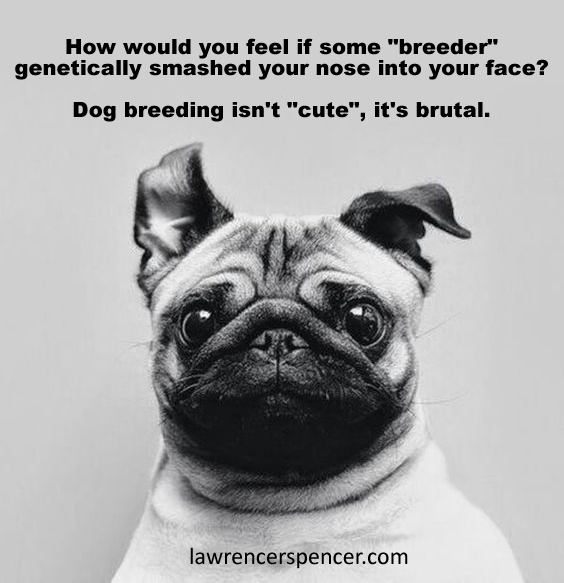
In the 1850s, for example, the bulldog looked more like today’s pit bull terrier—sturdy, energetic and athletic with a more elongated muzzle. But by the early 20th century, when dog shows became popular, the bulldog had acquired squat, bandy legs and a large head with a flattened muzzle. This altered figure makes it nearly impossible for them to reproduce without assistance, and the facial changes cause severe breathing problems in a third of all bulldogs. Breeders frequently turn to artificial insemination because the female bulldog’s bone structure cannot support the male’s weight during mating. Most cannot give birth naturally either, because the puppies’ heads are too big for the birth canal.
Large head size and short legs are part of the written standard, so Serpell believes these standards would have forced the bulldog into extinction if breeders did not rely on artificial insemination. “By essentially requiring judges to select animals that are the written standard, the club, in a way, signed the bulldog’s death warrant,” Serpell says.
Despite the negative effects of controlled breeding, animal science experts point to the value of selecting for consistency. “A breed standard is the template providing information about the appearance and temperament and reflects the original function and purpose of the breed,” says Milan Hess, a Colorado-based veterinarian who works with the AKC. When choosing a dog as a pet, consumers look to the breed standard for certainty. “They know what it will look like and how it will act,” says Thomas Famula, an animal-breeding specialist at the University of California, Davis.
Healthy choices
With the search for consistency yielding unforeseen flaws, however, who is to blame? Although the AKC sets the breed standards, it is principally a registry organization and has little control over the actual breeding process. Famula believes dog breeders hold the highest responsibility because they make the decisions about which dogs to mate. “In the end, breeders are the ones creating the next generation of dogs,” Famula explains. But researchers like Famula and Jerold Bell, a geneticist at the Tufts University Cummings School of Veterinary Medicine, note that breeding practices are greatly influenced by the puppy buyers who Bell believes are largely ignorant about genetic issues. “The public is completely unaware. They see a cute dog and are sold,” Bell says. When purchasing a puppy, buyers can ask for medical tests and family history of diseases; but this rarely happens. “Although it’s ultimately the breeders’ responsibility, if there’s no pressure from the buyer, the system won’t change,” he adds, emphasizing that most of the top 10 diseases plaguing all dogs are controlled by single genes which, when identified, are easy to eliminate in the next generation.
Meanwhile many organizations breeding dogs for police work or to aid the disabled routinely do use data registries to maintain health information and make smart pairing decisions that reduce the prevalence of inherited ailments. The Seeing Eye, a guide dog school in Morristown, N.J., for example, uses genetic testing and keeps a database that tracks all dogs’ potential problems. “We have a geneticist on staff who evaluates each dog as a potential breeder, and we occasionally bring in dogs from other guide schools to ensure our gene pool doesn’t get too restricted,” says Michelle Barlak, senior public relations associate at The Seeing Eye.
Moving forward
It is possible to improve a breed and maintain its characteristics, of course. Consider the dalmatian. The challenge: the genes responsible for the breed’s sought-after characteristic spotting pattern also result in high levels of uric acid in the breed’s urine, predisposing them to the formation of urate crystals that frequently cause urinary blockages. Selecting against uric acid, however, would result in a spotless dalmatian. Now there’s new hope from work that began in 1973, when Robert Schaible, a geneticist at the Indiana University School of Medicine, started the Dalmatian–English Pointer Backcross Project. He paired an AKC champion dalmatian with an English pointer, a breed with normal uric acid levels and a disposition similar to that of the dalmatian, and then crossed a dog from that litter to another dalmatian and so on. In 2011, after 15 generations, the AKC allowed dalmatians from this healthier pedigree, spots intact, to register.
Looking ahead at the future of purebreds, Serpell emphasizes that the goal is not to get rid of them but rather to put the health of the animals first. “I don’t think anyone wants the breeds to disappear,” Serpell says. “I don’t want the bulldog to disappear, I just want the bulldog to be transformed back into an animal that can function properly and is reasonably healthy.”
This article is provided by Scienceline, a project of New York University’s Science, Health and Environmental Reporting Program.
https://www.scientificamerican.com/article/although-purebred-dogs-can-be-best-in-show-are-they-worst-in-health/