Republished by Blog Post Promoter
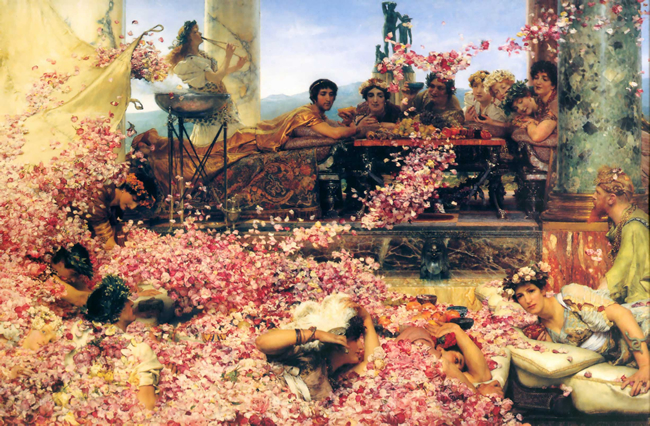
Nothing is as aesthetically harmless as a shower of rose petals. So it is with the decadent opulence and aesthetic excesses of a declining empire. In the western world the “peasants” are smothered with glitz and glamorous televised special effects, entertainments, athletic spectacles and indulged in gluttonous festivals on a daily basis. Conversely, during the Black Death plague that wiped out 2/3 of European civilization, people wore flowers around their necks to disguise the smell of their rotting flesh, just before they died. This is the origin of the children’s song “Ring Around The Rosey, Pocket Full of Poseys, All Fall Down“.
We are the very same beings who lived in Rome. We died. We were reincarnated. This process repeated, again, and again, and again, explains the rise and fall of human civilizations on Planet Earth. So far, EVERY civilization on Earth has failed and disappeared. Without exceptions. Why is that? Simple: we are the people our mothers warned us about. It does not matter whether you “believe” it, or not. What is, is. What will be, will be. Unless each one of us decides to change our personal behavior. Unless we create a sustainable civilization for everyone, every day, our civilization declines and disappears. When we allow criminals and maniacs to rule our lives (Secret Societies, Private Bankers and Politicians) we are doomed to repeat the same decay and death we’ve already endured a thousand times. Personally, I’m tired of it. It’s too fucking boring and absurd!
Last year I read The History of the Decline and Fall of the Roman Empire by Edward Gibbon (27 April 1737– 16 January 1794) which was published in six volumes between 1776 and 1788. I am also a painter and a student of art history. The decadent murder attempt rendered beautifully in the painting titled, “The Roses of Heliogabalus” was painted in 1888 by the Anglo-Dutch academician Sir Lawrence Alma-Tadema.
“According to Gibbon, the Roman Empire succumbed to barbarian invasions in large part due to the gradual loss of civic virtue among its citizens. They had become weak, outsourcing their duties to defend their Empire to barbarian mercenaries, who then became so numerous and ingrained that they were able to take over the Empire. Romans, he believed, had become effeminate, unwilling to live a tougher, “manly” military lifestyle. In addition, Gibbon argued that Christianity created a belief that a better life existed after death, which fostered an indifference to the present among Roman citizens, thus sapping their desire to sacrifice for the Empire. He also believed its comparative pacifism tended to hamper the traditional Roman martial spirit. Finally, like other Enlightenment thinkers, Gibbon held in contempt the Middle Ages as a priest-ridden, superstitious, dark age.” (Wikipedia.org)
Any student of history, especially of the Roman Empire, cannot be otherwise than overwhelmed by the nearly identical parallels in the decay and decline of the American Empire. This principle difference is that the American deterioration has taken only 200 years, whereas the collapse of Rome took about 1500. I cannot resist commenting on the decadent, aesthetic irony embodied by this painting: It is based on an episode in the life of the Roman emperor Heliogabalus, (204–222), taken from the Augustan History. He is portrayed attempting to smother his unsuspecting guests in rose-petals released from false ceiling panels. “In a banqueting room with a reversible ceiling he once overwhelmed his parasites with violets and other flowers, so that some were actually smothered to death, being unable to crawl out to the top.”
The emperor was cut to pieces by swords at the age of 18, by the Praetorian Guard, — at the instigation of his own grandmother — who was outraged and incensed by the perverse sexual and political behavior of this boy-emperor. Heliogabalus was bi-sexual, rampantly promiscuous, and unabashedly disrespectful of Roman Law and moral codes.
“Members of the Praetorian Guard attacked Heliogabalus and his mother: So he made an attempt to flee, and would have got away somewhere by being placed in a chest, had he not been discovered and slain, at the age of 18. His mother, who embraced him and clung tightly to him, perished with him; their heads were cut off and their bodies, after being stripped naked, were first dragged all over the city, and then the mother’s body was cast aside somewhere or other, while his was thrown into the river.”
What do you think the Praetorian Guard might do with Emperors, Wall Street Banksters and Congressmen today?
How much longer do you think American civilization will endure before it is smothered in its own decadence?