Category Archives: ART

Paintings, photography, aesthetic objects, beautiful communication, and anything I consider to be art, artful, artistic, artsy or whatever.
Art is subjective. It is a quality of communication can be contributed to by the viewer through empathy or agreement with its creator.

TRAVEL TWO BILLION LIGHT YEARS IN TWO MINUTES

Republished by Blog Post Promoter

OUR UNIVERSE….. actually only 0.000001% of it…. each yellow dot is a single galaxy!  

( CLICK ON THE PHOTO TO ENLARGE )

PHYSICAL UNIVERSE

WATCH A VIDEO ON THE MILLENNIUM SIMULATION WEBSITE:  http://www.mpa-garching.mpg.de/galform/virgo/millennium/

The Millennium Simulation used more than 10 billion particles to trace the evolution of the matter distribution in a cubic region of the Universe over 2 billion light-years on a side. It kept busy the principal supercomputer at the Max Planck Society’s Supercomputing Centre in Garching, Germany for more than a month. By applying sophisticated modelling techniques to the 25 Tbytes of stored output, Virgo scientists have been able to recreate evolutionary histories both for the 20 million galaxies which populate this enormous volume and for the supermassive black holes which occasionally power quasars at their hearts.

 The movie shows a 3-dimensional visualization of the journey through the simulated universe. On the way, we visit a rich cluster of galaxies and fly around it. During the two minutes of the movie, we travel a distance for which light would need more than 2.4 billion years.

THE CORE

Republished by Blog Post Promoter

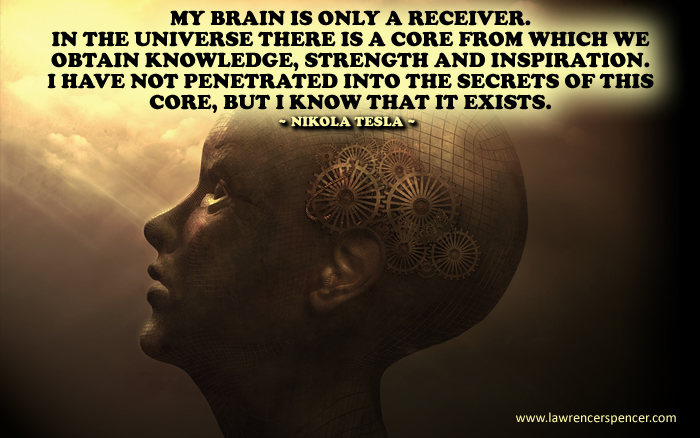
TESLA BRAIN

Nikola Tesla (July 10, 1856 – January 7, 1943) was a physicist, inventor, mechanical and electrical engineer of unusual intellectual brilliance and practical achievement. He was an important contributor to the birth of commercial electricity, and is best known for his many revolutionary developments in the field of electromagnetism in the late 19th and early 20th centuries. Tesla’s patents and theoretical work formed the basis of modern alternating current (AC) electric power systems, including the polyphase system of electrical distribution and the AC motor. This work helped usher in the Second Industrial Revolution.

Tesla is most famous for conceiving the rotating magnetic field principle (1882) and then using it to invent the induction motor together with the accompanying alternating current long-distance electrical transmission system (1888). His patents and theoretical work still form the basis for modern alternating current electric power systems. He also developed numerous other electrical and mechanical devices including the fundamental principles and machinery of wireless technology, including the high frequency alternator, the Tesla coil, the blameless turbine, the spark plug, and numerous other inventions.

In addition to his work on electromagnetism and electromechanical engineering, Tesla contributed in varying degrees to the establishment of robotics, remote control, radar, and computer science, and to the expansion of ballistics, nuclear physics, and theoretical physics.

He pioneered modern electrical engineering and many of his discoveries were of groundbreaking importance. In the United States during this time, Tesla’s fame rivaled that of any other inventor or scientist in history or popular culture. Tesla demonstrated wireless energy transfer to power electronic devices as early as 1893, and aspired to intercontinental wireless transmission of industrial power in his unfinished Wardenclyffe Tower project (1901-1917) also known as the Tesla Tower, located in Long Island, New York.

Tesla was fluent in eight languages – Serbian, Czech, English, French, German, Hungarian, Italian, and Latin.

UNIVERSE HAIKU

Republished by Blog Post Promoter

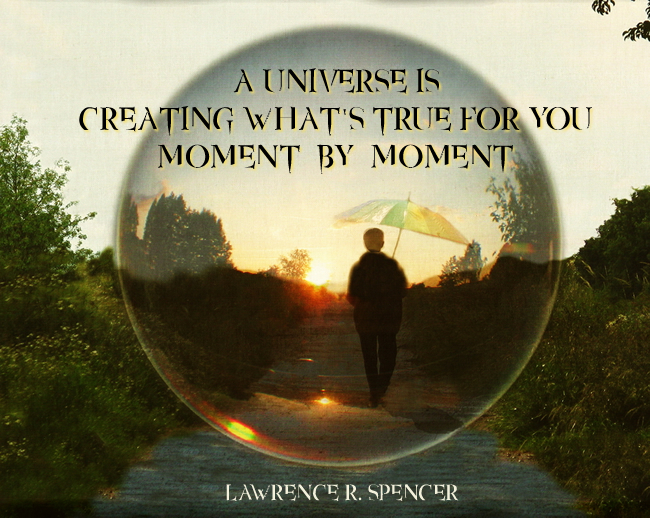
A UNIVERSE IS

CREATING WHAT’S TRUE FOR YOU

MOMENT BY MOMENT

______________________________________________

Definition of “HAIKU” — noun:   an epigrammatic Japanese verse form of three short lines.  In contrast to English verse typically characterized by meter, Japanese verse counts sound units known as “on” or morae. Traditional haiku consist of 17 on, in three phrases of five, seven and five on respectively.