Republished by Blog Post Promoter
All posts by LRS
ESSENCE OF YOU
Republished by Blog Post Promoter
es·sence ( s
s
 ns)
ns)
n.
1. The intrinsic or indispensable properties that serve to characterize or identify something.
2. The most important ingredient; the crucial element.
3. The inherent, unchanging nature of a thing or class of things.
4.
a. An extract that has the fundamental properties of a substance in concentrated form.
b. Such an extract in a solution of alcohol.
c. A perfume or scent.
5. One that has or shows an abundance of a quality as if highly concentrated: a neighbor who is the essence of hospitality.
6. Something that exists, especially a spiritual or incorporeal entity.
[Middle English essencia and French essence, both from Latin essentia, from esse, to be, from the presumed present participle *ess ns, *essent- (on the model of differentia, difference, from differns, different-, present participle of differre, to differ), created to translate Greek ousi
 (from ousa, feminine present participle of einai, to be); see es- in Indo-European roots.]
ns, *essent- (on the model of differentia, difference, from differns, different-, present participle of differre, to differ), created to translate Greek ousi (from ousa, feminine present participle of einai, to be); see es- in Indo-European roots.]ELECTROMAGNETIC WAVE SPECTRUM
Republished by Blog Post Promoter
Here is another marvelous episode of the now defunct “Rocketboom” internet show. Here MemeMolly tells us about how the “electromagnetic spectrum” works. It is VERY interesting to note that HUMAN BODIES are able to perceive only a VERY TINY percentage of the entire spectrum (which is nearly infinite). But, more interesting is that the chemical components of the atmosphere surrounding the infamous planet “Earth” are specifically and uniquely suited to ensure that human being are literally BLIND with regard to our inability to perceive more than an infinitely SMALL part of the entire spectrum of available energy conveyed by the the waves of energy particles that saturate our environment! What happens when you die, or depart from your body? Are you able to “see” more clearly without a body? To learn more, read the book ALIEN INTERVIEW.
DOWNLOAD THE E-BOOK 
VISIT THE WEBSITE and BLOG for the book at www.alieninterview.org and www.alieninterview.org/blog
A SINGLE THOUGHT
Republished by Blog Post Promoter
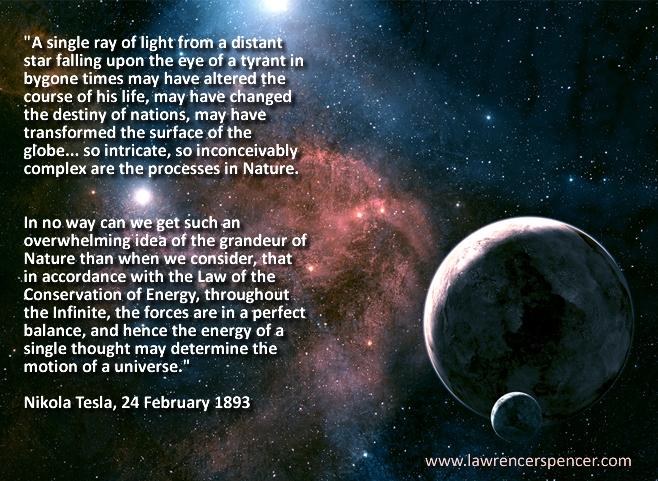
“A single ray of light from a distant star falling upon the eye of a tyrant in bygone times may have altered the course of his life, may have changed the destiny of nations, may have transformed the surface of the globe, so intricate, so inconceivably complex are the processes in Nature. In no way can we get such an overwhelming idea of the grandeur of Nature than when we consider, that in accordance with the law of the conservation of energy, throughout the Infinite, the forces are in a perfect balance, and hence the energy of a single thought may determine the motion of a universe.”
NIKOLA TESLA —
“On Light And Other High Frequency Phenomena” A lecture delivered before the Franklin Institute, Philadelphia (24 February 1893)
MY BEST FRIENDS
Republished by Blog Post Promoter