Republished by Blog Post Promoter
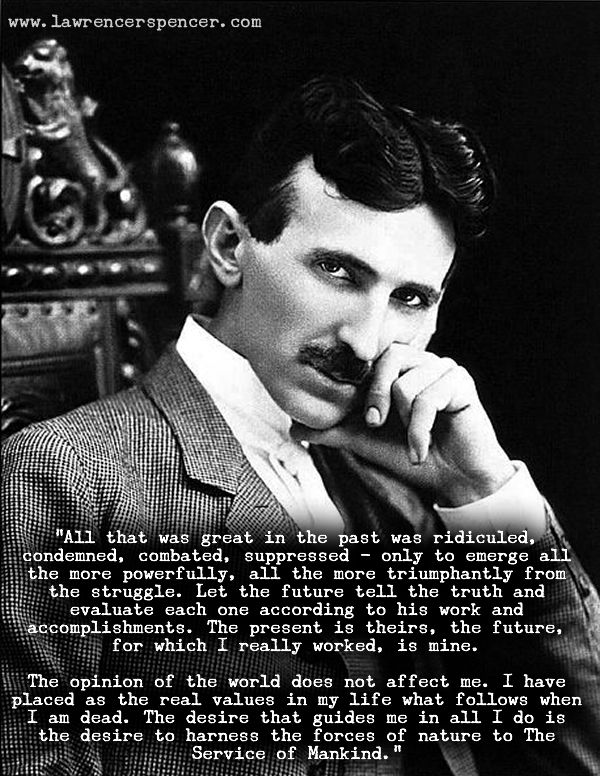
“Of all the frictional resistances, the one that most retards human movement is ignorance, what Buddha called ‘the greatest evil in the world.’ The friction which results from ignorance can be reduced only by the spread of knowledge and the unification of the heterogeneous elements of humanity. No effort could be better spent.”
Nikola Tesla (10 July 1856 – 7 January 1943)
In recent years it has become widely recognized that Nikola Tesla conceived the fundamental inventions that caused Mankind to leap from darkness into the light. Alternating current electricity, radio, remote control, wireless communication, television, and hundreds of electric and electronic conveniences that make global travel and communication possible. I recently read the most comprehensive book about the details of his life, inventions and struggles to be of service to Humanity.
During his life he was fought, opposed and ridiculed. His original ideas and inventions were uniformly stolen by others who made personal fortunes from his work. His “partner”, J.P. Morgan — the financial king of the age — personally prevented Teslas greatest invention from be constructed and put into use: the GLOBAL transmission of FREE ELECTRIC ENERGY and COMMUNICATION. At the time of his death the FBI confiscated all of his personal property and “secret” inventions. Tesla died alone and impoverished after having created the pivotal inventions that have proven to be a greater practical value to Humankind that ANY other inventor in history.
A Few Facts about Nikola Tesla:
Tesla read many works, memorizing complete books, and supposedly possessed a photographic memory.
He was a polyglot, speaking eight languages: Serbo-Croatian, Czech, English, French, German, Hungarian, Italian, and Latin.
Tesla related in his autobiography that he experienced detailed moments of inspiration. During his early life, Tesla was stricken with illness time and time again. He suffered a peculiar affliction in which blinding flashes of light would appear before his eyes, often accompanied by visions. Often, the visions were linked to a word or idea he might have come across; at other times they would provide the solution to a particular problem he had encountered. Just by hearing the name of an item, he would be able to envision it in realistic detail. Tesla would visualize an invention in his mind with extreme precision, including all dimensions, before moving to the construction stage. He typically did not make drawings by hand but worked from memory. Beginning in his childhood, Tesla had frequent flashbacks to events that had happened previously in his life.
Tesla claimed to never sleep more than two hours.
For exercise, Tesla walked 8 to 10 miles per day. He squished his toes one hundred times for each foot every night, claiming that it stimulated his brain cells.
Although Tesla opposed war and believed that war could not be avoided until its cause was removed, he concluded that some wars might be justifiable.
Later in life, Tesla made claims concerning a “teleforce” weapon.The press called it a “peace ray” or death ray.Tesla described the weapon as being able to be used against ground-based infantry or for antiaircraft purposes. Tesla gives the following description concerning the particle gun’s operation: “[The nozzle would] send concentrated beams of particles through the free air, of such tremendous energy that they will bring down a fleet of 10,000 enemy airplanes at a distance of 200 miles from a defending nation’s border and will cause armies to drop dead in their tracks.”
Tesla worked every day from 9 A.M. until 6 P.M. or later, with dinner from exactly 8 to 10 pm. Tesla would then resume his work, often until 3 am.
Tesla became a vegetarian in his later years, living on only milk, bread, honey, and vegetable juices.
Tesla never married, claiming that his chastity was very helpful to his scientific abilities.
Opinion on the Theory of Relativity: “I hold that space cannot be curved, for the simple reason that it can have no properties. It might as well be said that God has properties. He has not, but only attributes and these are of our own making. Of properties we can only speak when dealing with matter filling the space. To say that in the presence of large bodies space becomes curved is equivalent to stating that something can act upon nothing.”
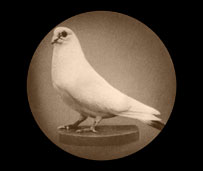 Tesla had many pigeons he fed and cared for, but one, he was particularly fond of. “I have been feeding pigeons, thousands of them for years. But there was one, a beautiful bird, pure white with light grey tips on its wings; that one was different. It was a female. I had only to wish and call her and she would come flying to me. I loved that pigeon as a man loves a woman, and she loved me. As long as I had her, there was a purpose to my life.”
He described it as being a beautiful female bird, pure white with light gray tips on its wings. One night the bird flew into Tesla’s room at Hotel St. Regis, and he perceived that she was attempting to tell him she was dying. Tesla said a light came from her eyes more intense than he had ever produced by the most powerful lamps in his laboratory. The bird then died and Tesla said that at that same moment, something went out of his life and he knew his life’s work was finished.
Learn more about Tesla:
www.teslauniverse.com
Wizard: The Life and Times of Nikola Tesla : Biography of a Genius by Marc Seifer (Feb 1, 2001)

The authors continue, “In addition, some 40 billion pounds a year of slaughterhouse wastes like blood, bone, and viscera, as well as the remains of millions of dead cats and dogs passed along by veterinarians and animal shelters, are rendered annually into livestock feed–in the process turning cattle and hogs, which are natural herbivores, into unwitting carnivores.”