Category Archives: THE OZ FACTORS

“The Oz Factors” is a book which reveals the 12 common denominators of civilization that prevent mankind for discovering workable solutions to the problems of life. The Oz Factors was written by Lawrence R. Spencer and published in 1999.

LOGIC IN THE LAND OF OZ

Republished by Blog Post Promoter
“WHICH IS THE WAY BACK TO KANSAS?”

“I’d give anything to get out of Oz altogether, but which is the way back to Kansas? I can’t go the way I came.”–Dorothy

“The only person who might know would be the great and wonderful Wizard of Oz himself. He lives in the Emerald City and that’s a long journey from here. Did you bring your broomstick with you?“–Glinda, the Good Witch of the North

“No, I’m afraid I didn’t.“–Dorothy

“Well then, you’ll have to walk. It’s always best to start at the beginning and all you do is follow the Yellow Brick Road.”–Glinda in ‘The Wizard of Oz’

One of the primordial questions Dorothy was trying to answer in ‘The Wizard of Oz’ was, “which is the way back to Kansas?”

Trying to figure out the answers to the mysteries of life here on planet Earth is even harder than Dorothy trying to get back to Kansas–none of us have a broomstick to ride, we don’t have a good witch to ask for directions and there is no Yellow Brick Road to follow.  So, we’re stuck here having to figure it out for ourselves, logically, using the information we have in our environment.

To begin at the beginning, the Land of Oz is a type of Universe. According to Webster’s Dictionary, a universe is defined as: “an area, province or sphere, as of thought or activity, regarded as a distinct, comprehensive system or world.”

The physical reality we all share on Earth and everything throughout the surrounding space is called the Physical Universe (PU).

On the other side of reality is your own imagination, your personal perceptions, viewpoints, dreams, hopes, desires, and creations, which comprise Your Own Universe (YOU).

The Land of Oz can be considered to be a Universe dreamed up by Dorothy, as conceived in the mind of L Frank Baum, the author of the book. (It has been speculated that the author created the “Land of Oz” after glancing at his file cabinet. The two file drawers were labeled “A-N” and “O-Z”. Dorothy could just as easily have been transported by the author’s pen into the imaginary “Land of AN”.)

In the movie version of the story, Dorothy creates the Land of  Oz in a dream, induced by a knock on the head, using remnants of Kansas in the physical universe mixed together with creations from her own universe–which, for Dorothy, existed over the rainbow in the Land of Oz.

Every Universe seems to be made up of its own, peculiar set of Laws. The PHYSICAL UNIVERSE, for example, is built on a set of agreed upon Laws.  A few examples of these Laws are:

The Law of Motion: “For every action, there is an equal and opposite reaction.”

The Food Chain Law: “In order for one life organism to live, another life organism must die.”

The Law of Gravity: “Whatever goes up, must come down.”

The Law of Time: “Time marches on.”

Most of us take the Laws of the Physical Universe for granted because everyone seems to agree with them. However, such laws leave a lot to be desired when compared to the Laws of a Universe we might create for ourselves!

In YOUR OWN UNIVERSE you can create any set of Laws, or have no Laws at all. You can make them, change them or break them. The Laws of YOUR OWN UNIVERSE can be anything or nothing, limited only by your imagination.

In YOUR OWN UNIVERSE, everything you wish comes true, because you are the “wizard” of YOUR OWN UNIVERSE!

In Dorothy’s universe, Scarecrows and trees can talk; witches can be beautiful and fly in magic bubbles; Munchkin girls join the “Lullaby League” and Munchkin boys have a “Lollipop Guild”; horses can change their color; and, Dorothy can dye her eyes to match her gown.

Dorothy’s first awareness of the particular universe she calls the Land of Oz is the realization that she is definitely NOT in Kansas. When she opens the door to her farmhouse, which has just crash-landed in Oz, Dorothy compares her past experience in Kansas with her present experience in Munchkinland. The Technicolor flowers, a good witch in a flying bubble, all the little brightly dressed people, a yellow brick road, etc, are definitely NOT similar to anything she has ever seen in Kansas.

The Land of Oz is an example of what Earth scientists would call an anomaly. For Dorothy, the anomaly is a departure from the usual arrangement of things as compared to her past experiences. In the universe of Oz, everything is so completely different from the universe Dorothy is familiar with in Kansas that she thinks she is lost.

How do you find the way back home when you are lost?

One way is to ask someone for directions. Of course, if you’ve ever been sent on a wild goose chase by a stranger, the experience taught you that it is a good idea to be somewhat selective as to whom you ask for directions. So, how do you know who is a reliable source of directions or information?

Perhaps it would be a good idea to find out something about the person from whom you are asking directions before you act upon what they tell you. Right? (Or, is it left?)
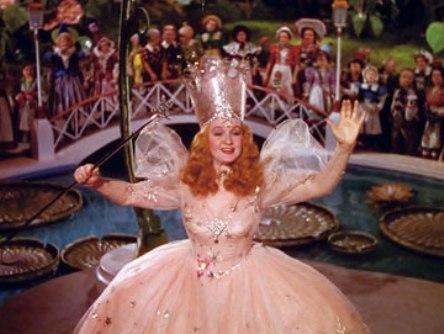
In our example, should Dorothy be asking for directions back to Kansas from the local natives, the Munchkins?

The main reason one would ask a local resident for directions is that one makes the assumption, otherwise known as an hypothesis (which is the first step in creating any scientific theory), that someone who lives in the area will be a reliable source of information and will give correct directions.

Well, in Dorothy’s case, the Munchkins have lots of familiarity with the Land of Oz, but they have no familiarity with Kansas. Fortunately for Dorothy, they are honest enough to tell her that they don’t have a clue where Kansas is, and they pass the buck to the Wizard of Oz, who they believe knows everything. And, based on their familiarity with the Yellow Brick Road and Munchkinland, they are certain that it leads to where the Great Oz lives.

Most would agree that a certainty is better than an assumption. When one has no familiarity based on personal experience or observation, it is best not to assume that one knows the correct directions. So, one asks for information from someone one believe knows–like a scientist, for example–who is supposed to be familiar with the area or subject in question.

Do the local Munchkins or local scientists of Oz give Dorothy the correct directions to help her get back to Kansas?

When Dorothy crash-landed her house in Munchkin City, the Munchkins cowered under the bushes and flowers in terror of retribution for the death of the Wicked Witch of the East from her mean, nasty, ugly sister, the Wicked Witch of the West.

Their benevolent, all-powerful protector, Glinda, the Good Witch of the North, who the Munchkins trust implicitly, is not much help in solving Dorothy’s problem, either. To begin with, Glinda does not have all the information regarding the situation, because she was not even there when Dorothy crashed her house into Munchkin City and inadvertently killed a wicked witch.

Undaunted by her lack of factual information, the first thing Glinda does after coaxing the Munchkins out from their hiding places, is to sing them a song about her assumption, or hypothesis, regarding Dorothy’s crash-landing. She sings: “Come out, come out, wherever you are, and meet the young lady who fell from a star. She fell from the sky, she fell very far, and ‘Kansas’ she says, is the name of the star.”

So, where did Glinda get the idea that Dorothy came from a star? Dorothy never said that she came from a star! But, somehow this all seems very logical to the Munchkins. Even Dorothy doesn’t object to Glinda’s false statement!

In our analogy, Glinda’s assumption that Dorothy fell from a star could be called a scientific theory. The theory proposed by the Good Witch of the North is that Kansas is a star! This theory is based on an assumption derived from an apparent anomaly as measured against her own personal experience and by information received from the Munchkins who are supposed to be a reliable source, but, who did not actually see the house crash because they were all in hiding. In truth, none of them have any familiarity with Kansas or cyclones or farm houses or dogs or little girls, either!

To complicate matters further, Glinda has to put on the appearance that she knows what she’s talking about in front of all her Munchkins followers, even though she is really just making a wild guess. After all, she has a very good job being the protector of the Munchkins, who appear to be utterly defenseless against their enemies, the Wicked Witch sisters. Anyway, Glinda is a good witch, which means she is probably really trying to help, so, they all believe her scientific theory that Dorothy has fallen from a star.

In their cute little minds, the Munchkins have accepted, without question, the logic, which underlies the assumption that is the basis of Glinda’s scientific theory:

SKY equals VERY FAR equals STAR equals KANSAS.

This kind of reasoning process could be called “Everything Logic”; i.e., Everything Equals Everything. This sort of logic might also be the definition of stupidity.

Example: If KANSAS equaled SKY equaled STAR, one could theoretically gaze up into the heavenly firmament to watch Kansas cattle grazing on the twinkling prairies in the stars above.

Unfortunately, much of what we call “science” on planet Earth is based on “Everything Logic”.

___________________________________________

— Excerpted from the book THE OZ FACTORS by Lawrence R. Spencer
 

THE WAY

Republished by Blog Post Promoter

“The river of human history is clogged and fouled with the putrid refuse of unworkable solutions to the mysteries and problems of life: war, ruined civilizations, insanity, mental anguish, drugs, despair, murder, disease, criminality and starvation. We are the victims of our individual and collective inability to find workable solutions to these unwanted conditions. Our sciences, religion, government and education systems, which should be held responsible, have failed to resolve these basic questions of our existence. As proof, our humanity has long since been exceeded by our ability to destroy life with nuclear and other weapons.

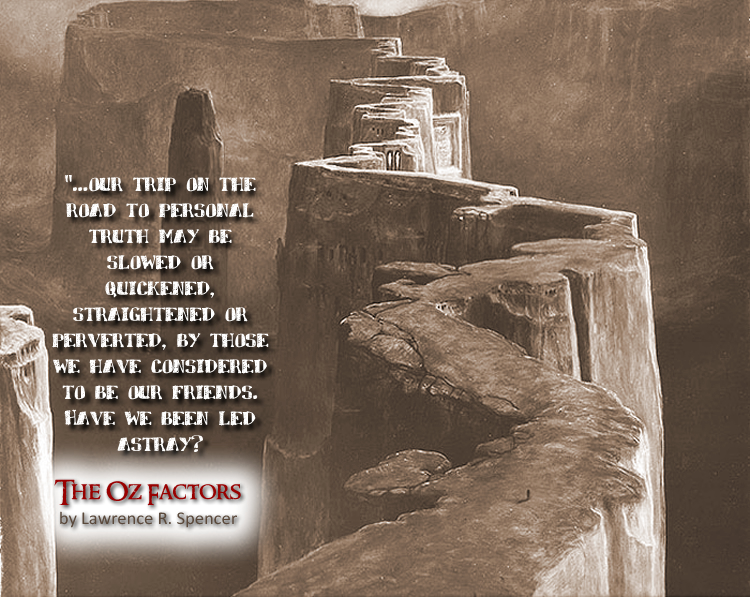
               Meanwhile, each of us, knowingly or unknowingly, search for a spiritual way home; a way home to the resolution of the primordial mysteries of our existence: Who are we? Where did we come from? What is our purpose? Each step along the road in our search is heavily influenced by the directions we have been given by those who have traveled before us. Our ancestors, friends, teachers, leaders, scientists, philosophers, writers and artists of the past and present serve as guides in our journey. They help to shape our ability to make our own decisions as to which is the wisest route to travel, or whether to travel at all. Yet, our trip on the road to personal truth may be slowed or quickened, straightened or perverted, by those we have considered to be our friends. Have we been led astray?

               Our thoughts and conjectures about life and universes are often based on assumptions, unproved theories, hearsay, rumors and misinformation. The actions we take in life may be based on ancient attitudes and archaic practices which are impractical or no longer applicable. Our view of the physical universe and of our own spiritual universes are spawned and nourished by a panoply of educational and environments influences. Lies replace the truth when a vested interest is being served.

               Our decision making processes, the road we choose to follow, is a sort of “logic”. The solutions we use to resolve the problems and mysteries of our lives will be workable or unworkable, depending on the workability of our “logic”.

               Yet, in the end, the decisions we make, individually and collectively, will influence the road taken by future Man. Our own lives, the duration or extinction of the human race and all life forms on Earth depend on the decisions we make today.

               In the midst of this constant decision making process, modern Western civilization is confronted with an unprecedented, uncontrolled explosion of technological innovation, unseen in recorded history. “Reality” is regulated by vested interests who seek personal gain to the detriment of the greater good. Science has become the soulless and impersonal religion of the 21st Century. Our planetary environment is at risk of irreversible damage, bordering on the annihilation of every living creature. Psychiatric drugs and an unseen one-world government are invading our lives like the flying monkeys in the Land of Oz. Encounters of a Third Kind have replaced the gods of mythology with a more tangible awareness that we may not be alone in this universe. New Age archaeology is rediscovering our past and redefining the paradigms of our history with shock waves of revelations that the Theory of Evolution is archaic and unworkable.

               “The Oz Factors” analyzes the subject of Western Logic: How was it created? What are its parts? How does it work or fail to work? How does it effect our lives?

               Each of twelve Oz Factors are defined as “A COMMON DENOMINATOR OF WESTERN LOGIC WHICH PREVENTS OBSERVATION, UNDERSTANDING, AND THE ATTAINMENT OF A WORKABLE SOLUTION” to problems of human origin and existence. How these factors influence our history, science, philosophy, our lives and our future is clearly demonstrated, offering a wide variety of new theories as possible alternative routes to the traditional directions we have followed in the past.

               The story of “The Wizard of Oz” is used as an analogy through which the reader can more easily understand unfamiliar subjects, in much the same way that Chemistry, for example, can be more easily understood when compared to the familiar subject of cooking; i.e. mixing chemicals in a laboratory is similar to mixing ingredients in a kitchen. The material covered in this book provides examples of incidents which shape our viewpoint of the physical universe and which impinge upon our own personal universes.

               “The Oz Factors” offers a simple, yet comprehensive method through which anyone can discover for themselves workable solutions to problems which are considered to be “mysteries” in Western science and philosophy. Discover what is true for you, without religious or academic dogma. Join me in our mutual search for solutions to the primordial questions of existence. May you find a simple and useful road map in “The Oz Factors”. 

Lawrence R. Spencer, The Forward to THE OZ FACTORS

Support independent publishing: Buy this book on Lulu.

YOU ARE THE POWER

Republished by Blog Post Promoter

“I am Oz, the great and powerful! Who are you?”–The Wizard in ‘The Wizard of Oz’

                “If you please, I am Dorothy, the small and meek.”–Dorothy

                 “SILENCE!”–The Wizard

You are_the power

Ultimately, you are the only person who can decide what is true in any universe —

is it black & white like Kansas, multicolored like the Land of Oz, or is it all really just a dream?

The Oz Factors can help you decide what is true for you…

Support independent publishing: Buy this book on Lulu.

SOLVING MYSTERIES

Republished by Blog Post Promoter

“IT REALLY WAS NO MIRACLE”

“She brings you good news. Or haven’t you heard? When she fell out of Kansas, a miracle occurred.”–Glinda

“It really was no miracle. What happened was just this …”–Dorothy in ‘The Wizard of Oz’

Whether an event is a miracle or not is relative–it depends on the person you talk to. What is their understanding of the events or evidence presented to them? What is their level of technology? How diverse and sophisticated is their own experience?

The Munchkins seem to agree with Glinda, that compared to their own experience, a house falling from the sky, which happens to kill a wicked witch, is a miracle. They know that the Wicked Witch of the East is dead and Dorothy was in the house that killed her. So, to them, Dorothy is a heroine. She is given a heroine’s welcome parade, a bouquet of flowers, a huge lollipop, and she inherits the Ruby Slippers. It’s not exactly a road map back to Kansas, but at least the natives of Munchkinland are appreciative of her inadvertent help.

As outside observers, our point of view on this rather pathetically illogical misinterpretation and misrepresentation of events is quite different. We have seen the beginning of the movie. We’re not afraid of witches because we don’t live in Munchkinland. We also know it’s just a movie, and that we can get up and go home after the show.

As a result, we are more reliable sources of information than the Munchkins, or the Good Witch of the North, for the following reasons:

1/         We have an external viewpoint to the Oz Universe.

2/         We have no vested interest in the Land of Oz.

3/         We are familiar with both Kansas and Munchkinland.

4/         As the audience, we also have the experience of viewing the black and white beginning of the film, so we know that Dorothy is using real-life characters to play fictional parts in the creation of her own Technicolor universe.

Yet, without an external observer to step into the movie to give her advice, Dorothy is still stuck in the Land of Oz.

So, the inexperienced Munchkins and their guardian witch in a flying bubble, tell Dorothy that she has to take a hike on the Yellow Brick Road to look for some wizard who they all seem certain will know how to get back to Kansas.

On Earth, the average scientist, who is trying to figure out the answers to the primordial questions of life, the history of planet Earth, the origins of life forms, global ecological and environmental problems, etc., has even more disadvantages than Dorothy:

1/ An Earth scientist hasn’t been on Earth since the beginning of “the movie”.

2/ An Earth scientist is one of the “Munchkins” himself. This means that he or she is subject to the fears, superstitions, economic pressures, personal viewpoints and lies told by the wicked witches of Earth.

3/ An Earth scientist doesn’t have a Yellow Brick Road to follow or Ruby Slippers to protect him from wicked witches who care only about their own vested interests (such as big corporations and governments with lots of money to spend on advertising and flying legal monkeys).

4/ There is no Wizard in the Emerald City of Earth to solve problems for them.

A logical method of evaluating whether or not we are on the right road to finding our way back home, or to answering the primordial questions of life, could be summed up as follows:        A SCIENTIFIC THEORY OR A PERSONAL VIEWPOINT IS ONLY AS USEFUL AS IT CAN BE DEMONSTRATED TO SOLVE THE MYSTERY OR THE PROBLEMS IT ADDRESSES. WHEN THE THEORY OR VIEWPOINT CAN BE DEMONSTRATED TO SOLVE THE PROBLEMS OF THE SUBJECT IT ADDRESSES, IT IS NO LONGER A THEORY OR VIEWPOINT. IT IS A “WORKABLE SOLUTION”.

Lawrence R. Spencer, excerpted from the book THE OZ FACTORS

Support independent publishing: Buy this book on Lulu.Printed book

THE OZ FACTORS Audiobook

Download the

Audiobook

from Audible.com

COSMIC CLOCK

Republished by Blog Post Promoter

TIME-VIEWPOINT

“Time is a subject that is far from absolute. The measurement of time is the activity of monitoring the movement of matter or energy particles through space. In order to establish the passage of time, one must establish an agreed-upon reference point for beginning the period of time to be measured. Then, the increments of measurement must be uniformly consistent throughout the period of time being quantified. This set of qualifying factors, however, applies only to the Physical Universe.

Does time (as the Munchkins would say) morally, ethically, spiritually, physically, positively, absolutely, undeniably and reliably actually, really exist?

Imagine that you are completely isolated, unable to observe any physical motion whatsoever–no sun, moon and stars, night or day. If you were isolated from your own body such that you could not detect any breathing rhythm or heartbeat or cellular motion of any kind to use as a reference point, would time exist?

People who have been locked in solitary confinement, whether in a prison or in an isolation chamber, have experienced the phenomenon of “no time”.

Since many people seem to have an innate, built-in time sense, or a “biological clock”, there may be a subjective awareness of time. But, even so, time is determined by measuring some motion in the physical universe. Oz Factors_LULU

How can the dates of something for which you have no starting point be measured? How can the age of our planet, our galaxy, or the entire physical universe be determined? How can the age of something which does not exist in the physical universe, such as a spirit, be calculated?

Logically, an arbitrary unit of measurement must be chosen. Then a particle or object which can move through space must exist. This particle would have to travel at a uniformly predictable rate of speed. The unit of measurement would depend on the magnitude or size of the motion of the particle relative to a fixed point in space, or a fixed point of view.

Here is a simple example: let’s imagine a theoretical COSMIC TIME CLOCK in which ONE SECOND equals ONE EARTH YEAR.Support independent publishing: Buy this book on Lulu.

If you counted the ticks of the second hand of this cosmic clock in “normal” time increments of 24 hour days, every day, how long would it take you to measure the recent history of planet Earth?

2 years and 22 days ago would equal the end of the Dinosaur Age (75 million BC)

1 hour, 14 minutes,6 seconds ago equals 2,450 BC– Egyptian Pharaoh Khufu

53 minutes, 36 seconds ago equals 1220 BC–Moses’ Exodus from Egypt

42 minutes 39 seconds ago equals 563 BC–Buddha is born

33 minutes 16 seconds ago equals “year zero” the calendar in use throughout most of the world, sponsored by Pope Gregory XIII in 1582

8 minutes 24 seconds ago equals 1492 AD, Columbus “discovers” America

3 minutes 40 seconds ago equals 1776 AD, the United States of America is founded

One human average lifetime (70 years) equals 1 minute, 10 seconds on the Cosmic Time Clock.

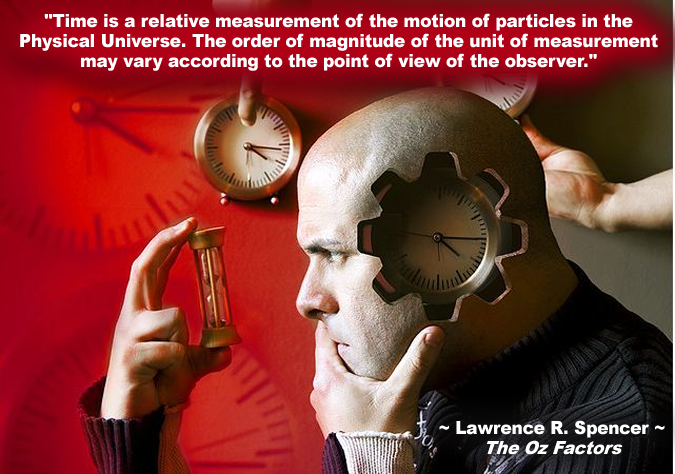
Time is a relative measurement of the motion of particles in the Physical Universe. The order of magnitude of the unit of measurement may vary according to the point of view of the observer.

To venture a guess as to the age of the physical universe, based on a supposed decay of matter is another example of “scientific theory” based on assumption and personal viewpoint.

According to some authorities, mainly from the non-physical sciences, such as philosophy, there is reason to believe that the physical universe may have existed for many trillions of years or perhaps for a nearly infinite period of time. However, since time is a relative factor, it’s importance as a tool for evaluating other information is also relative.”

— Excerpt from THE OZ FACTORS, by Lawrence R. Spencer