Category Archives: ART

Paintings, photography, aesthetic objects, beautiful communication, and anything I consider to be art, artful, artistic, artsy or whatever.
Art is subjective. It is a quality of communication can be contributed to by the viewer through empathy or agreement with its creator.

STAY HUNGRY. STAY FOOLISH. STAY TRUE TO YOU.

Republished by Blog Post Promoter
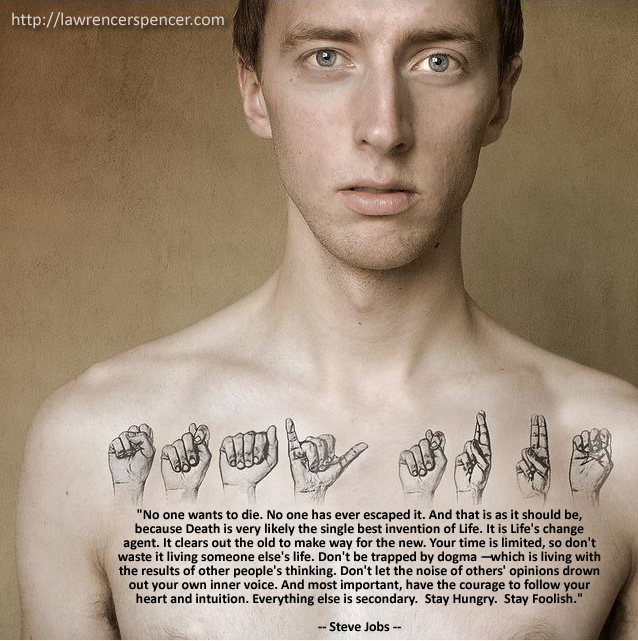
"No one wants to die. No one has ever escaped it. And that is as it should be, because Death is very likely the single best invention of Life. It is Life's change agent. It clears out the old to make way for the new. Your time is limited, so don't waste it living someone else's life. Don't be trapped by dogma — which is living with the results of other people's thinking. Don't let the noise of others' opinions drown out your own inner voice. And most important, have the courage to follow your heart and intuition. Everything else is secondary.  Stay Hungry.  Stay Foolish."

-- Steve Jobs --

ELVISH LANGUAGE

Republished by Blog Post Promoter

Repost of the article from “DIGIPHILE” —  http://digiphile.wordpress.com/2009/01/23/online-jrrtolkein-translators-and-font-converters/

“If you know me well, you know I’ve been a devout fan of the work of J. R. R. Tolkien since I was eight, when my uncle Jim gave me the Lord of the Rings for Christmas. I devoured the book, along with the Hobbit and then the Silmarillion, reading each many times. I still enjoy revisiting Middle Earth, most recently in Children of Hurin, the revised dark epic released by Christopher Tolkien last year.

Jim’s son, Chris, however, is a genuine Tolkien scholar, particularly with regards to linguistics. When I recently shared a J.R.R.T. resource I’d found online with him and other family members, he replied with a number of other wonderful resources. Since he was kind enough to share his knowledge with me, I thought I’d pass it along to the rest of the world.

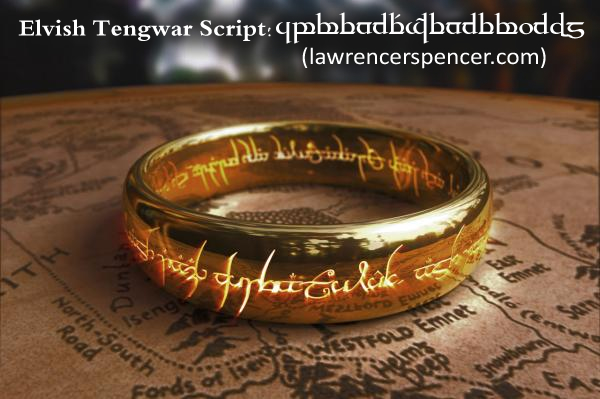
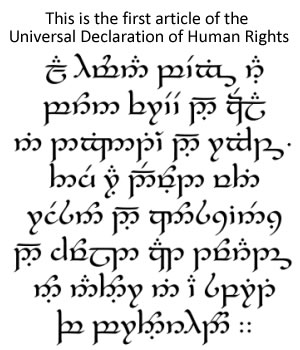
The Tengwar Scribe allows you to write text in Roman letters, select a Tengwar mode, and have the text transcribed to Tengwar. Tengwar, if you recall, is “a script that was invented by J.R.R. Tolkien. In his works, the tengwar script, invented by Fëanor, was used to write a number of the languages of Middle-earth, including Quenya and Sindarin. However, it can also be used to write other languages, such as English (most of Tolkien’s tengwar samples are actually in English). The word tengwar is Quenya for ‘letters’.” (Wikipedia)

The Tengwar Scribe is Windows-only, however, so you may want to look into Online Tengwar Transcriber, which works on any platform.


Hiswelókë’s Sindarin dictionary includes a Sindarin lexicon in XML (TEI) format and two freeware applications. Dragon Flame for Microsoft Windows and Linux, embeds the Sindarin dictionary along with additional tools. Hesperides does the same for OS X. Sindarin, as you may recall, was “the Elvish language most commonly spoken in Middle-earth in the Third Age. It was the language of theSindar, those Teleri which had been left behind on the Great Journey of the Elves.”(Wikipedia)

Finally, Ardalambion, according to Chris, is “a good resource for learning about the Elvish languages themselves; you can even find an extremely thorough, well-researched “Quenya Course” consisting of 20 lessons, plus appendices and exercises with keys.”

Thanks for resources, cuz! There are many other wonderful Tolkien resources online too, notably the Encyclopedia of Arda, an Elvish to English dictionary and an English to Elvish dictionary.”

DOORS OF PERCEPTION

Republished by Blog Post Promoter

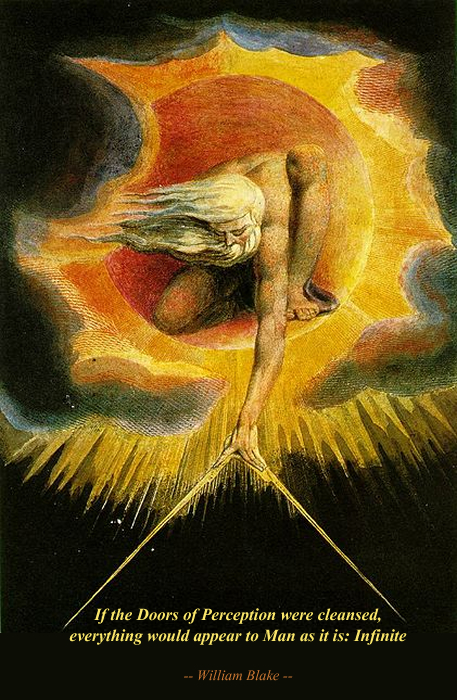
doors of perception

If the Doors of Perception were cleansed, everything would appear to Man as it is: Infinite

— Word and painting by William Blake —

_______________________________________

William Blake (28 November 1757 – 12 August 1827) was an English poet, painter and printmaker. Largely unrecognised during his lifetime, Blake is now considered a seminal figure in the history of the poetry and visual arts of the Romantic Age. His prophetic poetry has been said to form “what is in proportion to its merits the least read body of poetry in the English language”. His visual artistry led one contemporary art critic to proclaim him “far and away the greatest artist Britain has ever produced”.  Considered mad by contemporaries for his idiosyncratic views, Blake is held in high regard by later critics for his expressiveness and creativity, and for the philosophical and mystical undercurrents within his work.

Blake shared Dante’s distrust of materialism and the corruptive nature of power, and clearly relished the opportunity to represent the atmosphere and imagery of Dante’s work pictorially. Even as he seemed to near death, Blake’s central preoccupation was his feverish work on the illustrations to Dante’s Inferno; he is said to have spent one of the very last shillings he possessed on a pencil to continue sketching.

On the day of his death, Blake worked relentlessly on his Dante series. Eventually, it is reported, he ceased working and turned to his wife, who was in tears by his bedside. Beholding her, Blake is said to have cried, “Stay Kate! Keep just as you are – I will draw your portrait – for you have ever been an angel to me.” Having completed this portrait (now lost), Blake laid down his tools and began to sing hymns and verses.  At six that evening, after promising his wife that he would be with her always, Blake died. Gilchrist reports that a female lodger in the house, present at his expiration, said, “I have been at the death, not of a man, but of a blessed angel.”

SOURCE: Wikipedia.org