Republished by Blog Post Promoter
Each year, the nation’s funeral industry buries:
- 827,060 gallons of embalming fluid
- 30+ million board feet of tropical rainforest hardwoods for caskets
- 14,000 tons of steel for vaults
- 90, 272 tons of steel for caskets
- 2,700 tons of copper and bronze for caskets, and
- 1.6 million tons of reinforced concrete for vaults
The Environmental Protection Agency puts casket manufacturers on their list of Top 50 Hazardous Waste Generators. Casket manufacturers spray chemicals such as methyl and xylene on caskets. Cemeteries put tons of fertilizers and pesticides and billions of gallons of water on their lands every year. Every year they deposit billions of tons of CO2 and other green house gases into the atmosphere to keep cemeteries manicured and looking “good”.
Cremation adds to the problem. The amount of non-renewable fossil fuel needed to cremate bodies in North America is equivalent to a car making 84 trips to the Moon and back….every year! Every time a cremation occurs, the process releases 400 lbs of CO2 into the atmosphere. Cremations emit nitrogen oxides, carbon monoxide, sulfur dioxide, particulate matter, mercury, hydrogen fluoride, hydrogen chloride, NMVOCs, and other heavy metals. The United Nations indicates that crematoria contribute 0.2% of the world’s emissions of dioxins and furans.
Surprised?
Learn more about The Green Burial Alternative
http://www.awillforthewoods.com/learn_more_greenburial.html
A “green” burial is an alternative to the modern burial model. The modern model often includes a “protective” or sealed casket, an outside concrete grave box or sealed vault to place the casket in and embalming of the deceased. The modern model also includes perpetual care of the manicured cemetery. The “green” approach eliminates all of these standard elements for a more environmentally responsible end-of-life choice.
The deceased is usually not embalmed in the green funeral although non-toxic embalming fluids have recently become available. Either way, this eliminates the use of toxic chemicals, primarily formaldehyde. Refrigeration of the deceased is easily accomplished and the law allows up to 72 hours for a non-embalmed burial to take place.
The green casket must be made of biodegradable materials. Renewable softwoods, woven wicker, seagrass and bamboo have become popular materials for casket construction along with linings of cotton and linen. Recall the plain pine box and linen shroud of yesteryear. The use of this type of casket saves our natural resources used to construct the traditional casket made of steel, semi-precious metals such as copper and bronze and highly finished hardwoods, some of which are becoming increasingly rare (mahogany and black walnut for instance). In addition, no concrete box or sealed vault is used. This saves resources used in the construction of vaults.
Another element in the green burial is the placement of the casket directly into the ground. This returns the deceased to nature in a relatively short time, promoting the cycle of life – allowing you to literally push up daisies.
Green burial encompasses a final resting place within a natural environment. Instead of tombstones and manicured lawns, a green cemetery resembles a nature preserve – prairie grasses, wildflowers, memorial forests, and other settings indigenous to the natural landscape. Graves are marked by a tree, bush or natural stone among other biodegradable options. Global Positioning System (GPS) technology ensures permanent location of the deceased.
*Statistics compiled from Casket and Funeral Association of America, Cremation Association of North America, Doric Inc., The Rainforest Action Network and Mary Woodsen, Pre-Posthumous Society.
Related Web Links:
America:
www.greenburialcouncil.org
www.gravematters.us
www.memorialecosystems.com
Australia:
Natural Earth Burial Society of Australia
Funeral Rights, by Robert Larkins
U.K.:
www.naturaldeath.org.uk
World-wide:
wikipedia on natural burial

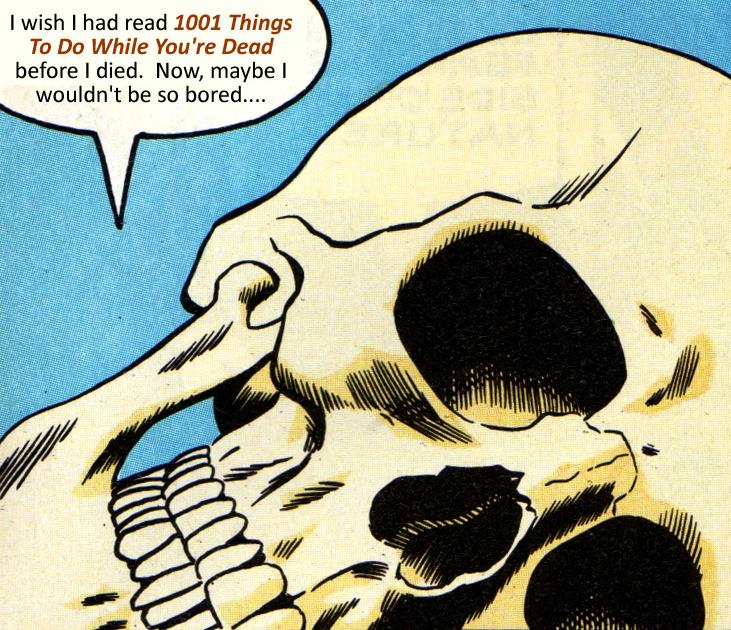
 This book is dedicated to all living beings who expect to die sometime and to all of the dead people who ever lived who may still be living somewhere, sometime, somehow. This book is also dedicated to all of the people who are living that may need some ideas about what to do with themselves after they die. Finally, this book is dedicated to all the people who will soon be living by virtue of one or more of the following circumstances: birth, rebirth, resurrection, reincarnation, transconfiguration, cryogenic resuscitation, invasion of alien beings, angels falling out of grace, an act of one or more gods, transformation or transmigration, arrival from a different time / space / universe / plane of existence, unimaginable others, Whoever you were, are, or will be, I trust that you will enjoy the “Rest of Eternity”. — Lawrence R. Spencer
![1001 Things to Do While You're Dead | [Lawrence Spencer]](https://ecx.images-amazon.com/images/I/51ROhipKNuL._SL175_.jpg "1001 Things to Do While You're Dead | [Lawrence Spencer]")