Republished by Blog Post Promoter

Republished by Blog Post Promoter
Republished by Blog Post Promoter
Republished by Blog Post Promoter
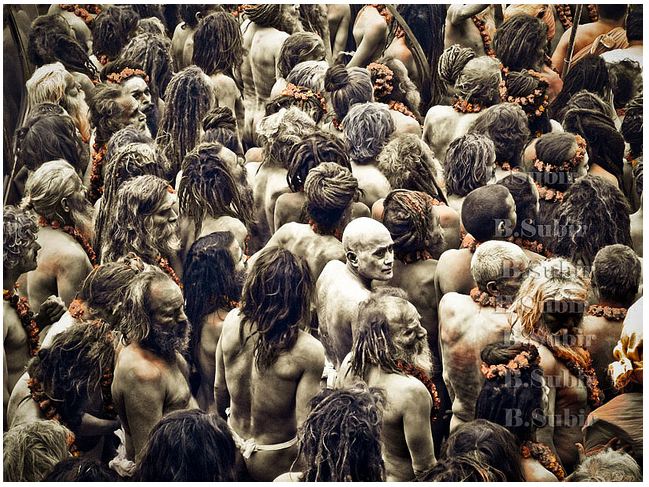
In Hindu mythology, its origin is found in one of the popular creation myths and the Hindu theories on evolution, the Samudra manthan episode (Churning of the ocean of milk), which finds mention in the Bhagavata Purana, Vishnu Purana, the Mahabharata, and the Ramayana.
The Gods had lost their strength, and to regain it, they thought of churning the Ksheera Sagara (primordial ocean of milk) for amrit (the nectar of immortality), this required them to make a temporary agreement with their arch enemies, the demons or Asuras, to work together with a promise of sharing the nectar equally thereafter. However, when the Kumbha (urn) containing the amrita appeared, a fight ensued. For twelve days and twelve nights (equivalent to twelve human years) the gods and demons fought in the sky for the pot of amrita. It is believed that during the battle, Lord Vishnu flew away with the Kumbha of elixir, and that is when drops of amrita fell at four places on earth: Prayag, Haridwar, Ujjain and Nashik, and that is where the Kumbh Mela is observed every twelve years.
First written evidence of the Kumbha Mela can be found in the accounts of Chinese traveller, Huan Tsang or Xuanzang (602 – 664 A.D.) who visited India in 629 -645 CE, during the reign of King Harshavardhana. (Source: Wikipedia.org)
____________________________________________________
This photograph was shot it at Kumbha Mela 2010.
For more photos,click the artists website: subirbasak.orgfree.com
Copyright © – Subir Basak. http://subirbasak.orgfree.com/
Republished by Blog Post Promoter
 MEME [noun]
1. a cultural item that is transmitted by repetition and replication in a manner analogous to the biological transmission of genes.
2. a cultural item in the form of an image, video, phrase, etc., that is spread via the Internet and often altered in a creative or humorous way.
Etymology: 1976, introduced by evolutionary biologist Richard Dawkins in “The Selfish Gene,” coined by him from Greek sources, e.g. mimeisthai, “to imitate” (see mime), and intended to echo gene.